
You're probably already running a sales cycle, even if you've never called it that.
A customer rings while you're on a job. You promise to send a quote later. The details sit in your notes app, the customer reply lands in email, the appointment goes into a calendar, and the invoice gets created somewhere else entirely. Nothing looks badly broken on its own. The problem is that the handover between each step is where work gets missed, approval slows down, and payment drifts.
For a UK service business, the cycle of sales is the path from first enquiry to money in the bank. It isn't corporate jargon. It's the working process behind how you win jobs, schedule them properly, bill accurately, and keep clients coming back. If that process is messy, your business feels messy to run.
That matters because the average B2B sales cycle in the UK typically ranges between 60 to 120 days. For service businesses, that means planning for a closing window of at least two months, which is why quote turnaround and scheduling discipline matter so much for cash flow. If your admin is scattered, that time stretches in all the wrong places.
If you want more practical advice on running a more organised service business, the AetherCloud blog for UK service businesses covers the day-to-day side of quoting, invoicing, payments, and client management.
Table of Contents
- Introduction What Is the Cycle of Sales
- The 9 Stages of a Service Business Sales Cycle
- Key KPIs to Track at Each Stage
- Common Bottlenecks That Stall Your Sales Cycle
- Optimise Your Sales Cycle with AetherCloud
- A Practical Playbook From Quote to Cash
- Stop Juggling Tools and Start Winning Jobs
Introduction What Is the Cycle of Sales
The cycle of sales is the repeatable route a customer follows with your business from first contact to final payment. In a service business, that route usually includes the enquiry, the first reply, the quote, the approval, the booking, the work itself, the invoice, and the payment. If any of those handovers are slow or unclear, the customer feels friction.
A lot of tradespeople, consultants, and freelancers don't struggle because they're bad at selling. They struggle because their process lives in too many places. Leads arrive through calls, WhatsApp, email, web forms, and referrals. Then the admin gets rebuilt by hand every time.
Why this matters in service work
In product businesses, a buyer can often click and pay. In service businesses, the customer usually needs reassurance first. They want a reply, a clear scope, a sensible price, and confidence that you'll show up when you say you will.
That's why the cycle of sales is operational, not just commercial. Your sales performance depends on how quickly you can turn interest into a proper quote, then turn approval into a booked job and a paid invoice.
Practical rule: If a customer has to wait for you to retype details from one tool into another, your sales cycle is already slower than it needs to be.
What a good cycle looks like
A healthy cycle of sales feels boring in the best way. Enquiries are captured properly. Quotes go out quickly. Customers can approve without back-and-forth admin. Appointments are clear. Invoices match the agreed work. Payments are easy to make.
That kind of consistency does two things. It saves you time, and it makes your business look more professional at every stage.
The 9 Stages of a Service Business Sales Cycle
Most service businesses don't need a complicated enterprise framework. They need a sales cycle they can use effectively on a Tuesday morning when the phone won't stop ringing.
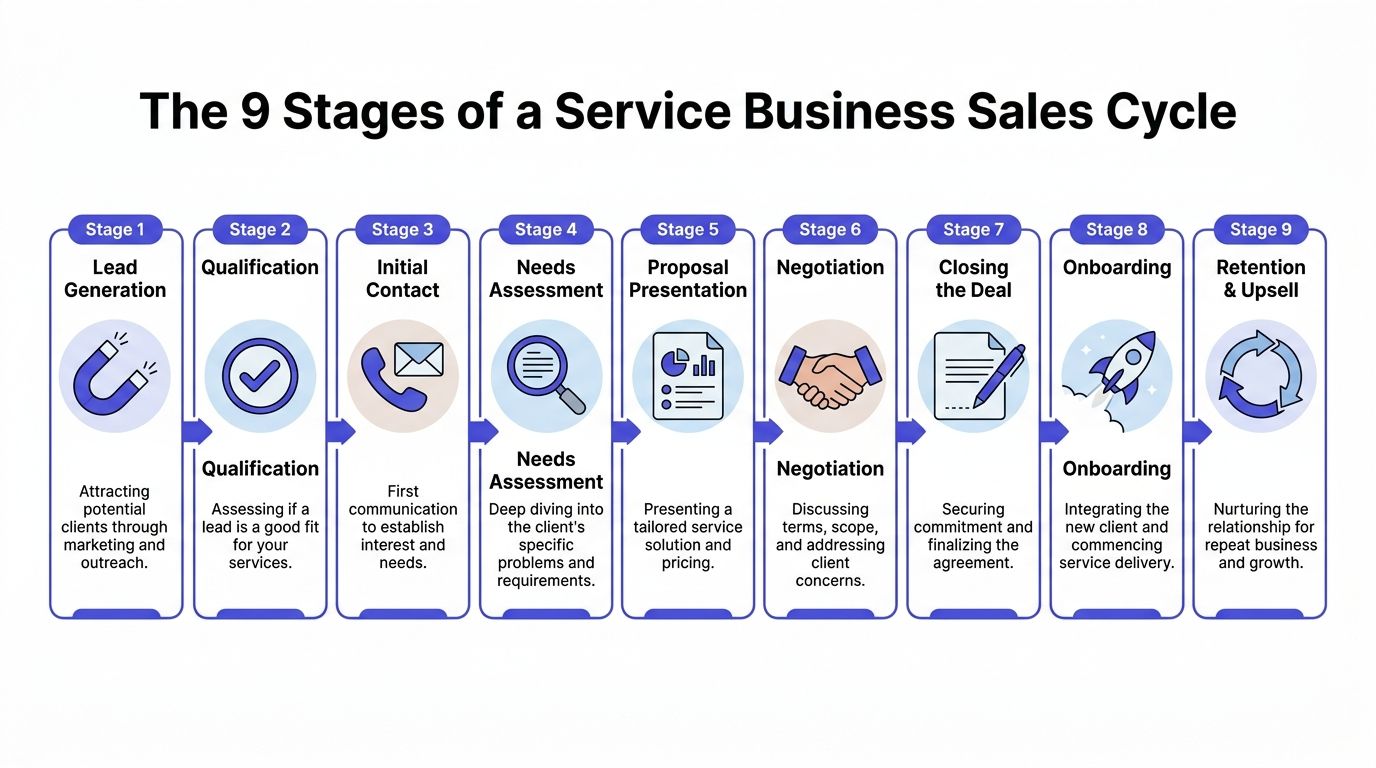
Lead
A lead is any person or company that shows interest in your service. That might come from a referral, a website form, a digital business card, social media, or a phone call. Your job at this stage is simple. Capture the details properly and don't leave them buried in messages.
Contact
Once the lead comes in, you make first contact. Speed and clarity are key. You're confirming what they need, checking whether it fits the kind of work you want, and setting expectations on next steps.
Some enquiries shouldn't move forward. That's fine. A short, clear reply that qualifies the job is better than wasting time pricing work that was never right for you.
Quote
The quote stage is where many small businesses lose momentum. A quote isn't just a price. It's your chance to show that you understand the job, have scoped it properly, and can present the work in a way that feels professional.
A strong quote usually answers the questions a client would otherwise send back to you:
- What is included in the price
- What is excluded so there's less confusion later
- When the work can happen
- How long approval is valid for
- What happens next if they want to go ahead
Approval
Approval is the point where the client says yes. In practice, this stage often drags because customers need to review details, ask for a small adjustment, or share the quote with someone else. If approval relies on awkward email chains or unclear documents, jobs stall here.
Scheduling
A won quote still isn't a booked job until it's in the diary properly. Scheduling means assigning the date, time, people, and any preparation needed. For a solo freelancer that may be straightforward. For a trades team juggling multiple bookings, it's where confusion starts if systems aren't joined up.
Delivery
Delivery is the actual service. The plumber attends the repair. The consultant runs the workshop. The agency completes the agreed milestone. Sales doesn't stop here. A smooth delivery stage protects the relationship and makes invoicing easier because the work done matches the work sold.
If the job delivered doesn't line up with the quote approved, the invoice becomes an argument instead of an admin step.
Invoicing
Invoicing should be a continuation of the quote, not a separate admin task built from scratch. The key is accuracy and speed. If you wait days to invoice after finishing the work, the customer's attention has already moved on.
Payment
Payment is where revenue becomes real. This stage sounds obvious, but many businesses still create friction here by sending invoices without clear payment options or by manually chasing what should've been tracked from the start.
Retention
A completed and paid job isn't the end of the cycle. It's the start of the next one. Retention means staying organised enough to follow up, win repeat work, and turn a one-off client into a regular source of business.
For service firms, this final stage often includes:
- Recording the job outcome so future work starts with context.
- Keeping contact details tidy so follow-ups aren't improvised.
- Making it easy to refer you because happy customers often open the door to the next enquiry.
Key KPIs to Track at Each Stage
If you don't measure your cycle of sales, you'll rely on gut feeling. That usually leads to the wrong fix. Many business owners assume they need more leads when the underlying issue is that quotes sit unanswered or invoices get paid too slowly.
A better approach is to track a small set of stage-based KPIs. That shows where the process is leaking. It also gives you a practical reason to tighten systems instead of working longer hours.
UK businesses using centralised platforms that combine quoting, invoicing, and online payment collection can achieve up to 40% faster pipeline movement, which directly affects revenue and cash flow by reducing approval and collection delays. If your numbers improve after centralising, you'll usually see it first in movement between stages, not in vanity metrics.
For businesses that want those figures in one place, the AetherCloud analytics dashboard is built around operational visibility rather than spreadsheet chasing.
The numbers that actually help
You don't need a long dashboard packed with labels you'll never use. You need measures that answer plain questions.
- Are enough enquiries turning into real conversations
- Are quotes getting approved
- Are approved jobs being booked without delay
- Are invoices being paid on time
- Are customers coming back
Sales Cycle Stages and Key Performance Indicators KPIs
| Stage | KPI | What It Measures |
|---|---|---|
| Lead | Enquiry volume | How many new potential jobs come in |
| Contact | Response time | How quickly you reply to new enquiries |
| Quote | Quote-to-approval rate | How often your quotes win the job |
| Approval | Approval turnaround time | How long clients take to accept or request changes |
| Scheduling | Time from approval to booking | How quickly work gets into the diary |
| Delivery | Job completion rate | Whether booked work is completed as planned |
| Invoicing | Time from job completion to invoice sent | How quickly you bill after delivery |
| Payment | Average days to pay | How long it takes to collect money |
| Retention | Repeat client rate | How often customers return for more work |
Working advice: Track one KPI per stage first. A simple scorecard used every week beats a complicated report you never open.
The point isn't to create more admin. The point is to spot where the cycle slows down so you can fix the right problem.
Common Bottlenecks That Stall Your Sales Cycle
The reason many service businesses feel busy but not in control is that the delays rarely come from one dramatic failure. They come from small admin gaps repeated every day.
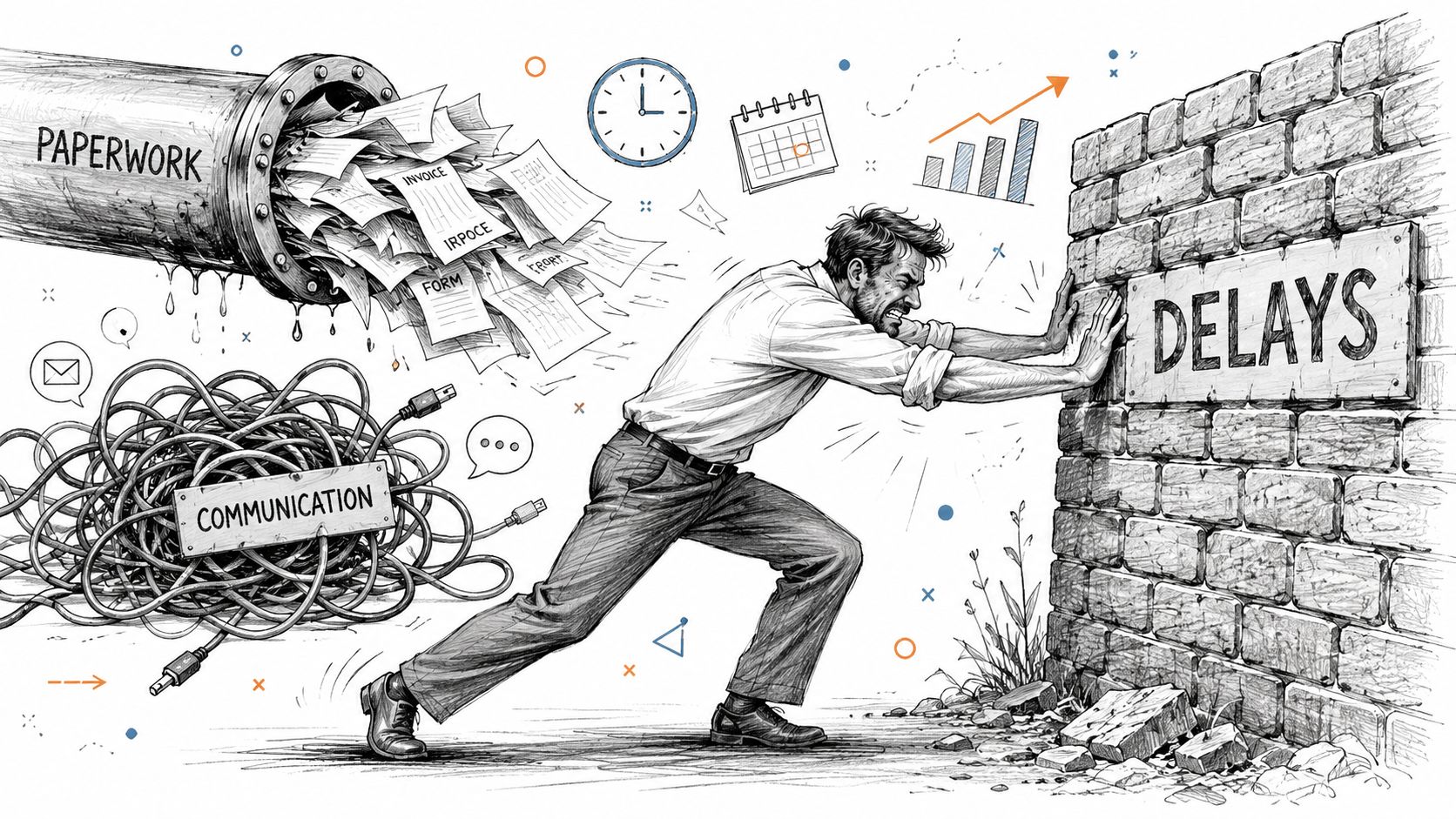
In the UK B2B sector, the conversion rate from a qualified opportunity to a closed deal is only 6%. For service businesses, that sharp drop-off is a useful warning. Slow approvals, fragmented communication, and awkward payment steps can easily push a willing customer into silence.
If you're trying to keep incoming work organised before it becomes a quote, a proper enquiry management workflow for service businesses makes the early part of the cycle much easier to control.
Where jobs get stuck
The most common bottlenecks are practical, not theoretical.
- Quotes created too slowly because details are sitting in messages, handwritten notes, or different files.
- Follow-ups missed because nobody has a reliable record of who's waiting on what.
- Booking confusion because the quote is approved but the diary isn't updated cleanly.
- Invoice delays because the team finishes the work and then leaves billing until later.
- Payment chasing because customers don't get a straightforward way to pay.
Each of those bottlenecks adds drag. Together, they make the business feel heavier than it should.
What bad bottlenecks look like in practice
One common pattern is this. A client asks for a quote. You reply quickly, but the quote itself goes out late because you need to rebuild the job details manually. By the time it arrives, the customer has already spoken to someone else.
Another is the hidden approval bottleneck. The customer wants to go ahead, but they cannot give immediate approval. They ask a question by email, you answer while travelling, they come back two days later, and the job never quite becomes firm.
Then there's the handover problem between doing the work and getting paid. A lot of firms are decent at winning jobs but poor at closing the loop financially. They complete the job, then leave the invoice for the evening or the end of the week. That gap is where memory slips, paperwork gets messy, and payment moves further away.
A sales cycle doesn't usually fail because people stop wanting the service. It fails because the next action isn't easy enough for the customer or the business owner.
Optimise Your Sales Cycle with AetherCloud
The fastest way to improve a sales cycle isn't to bolt on more apps. It's to remove handoffs.
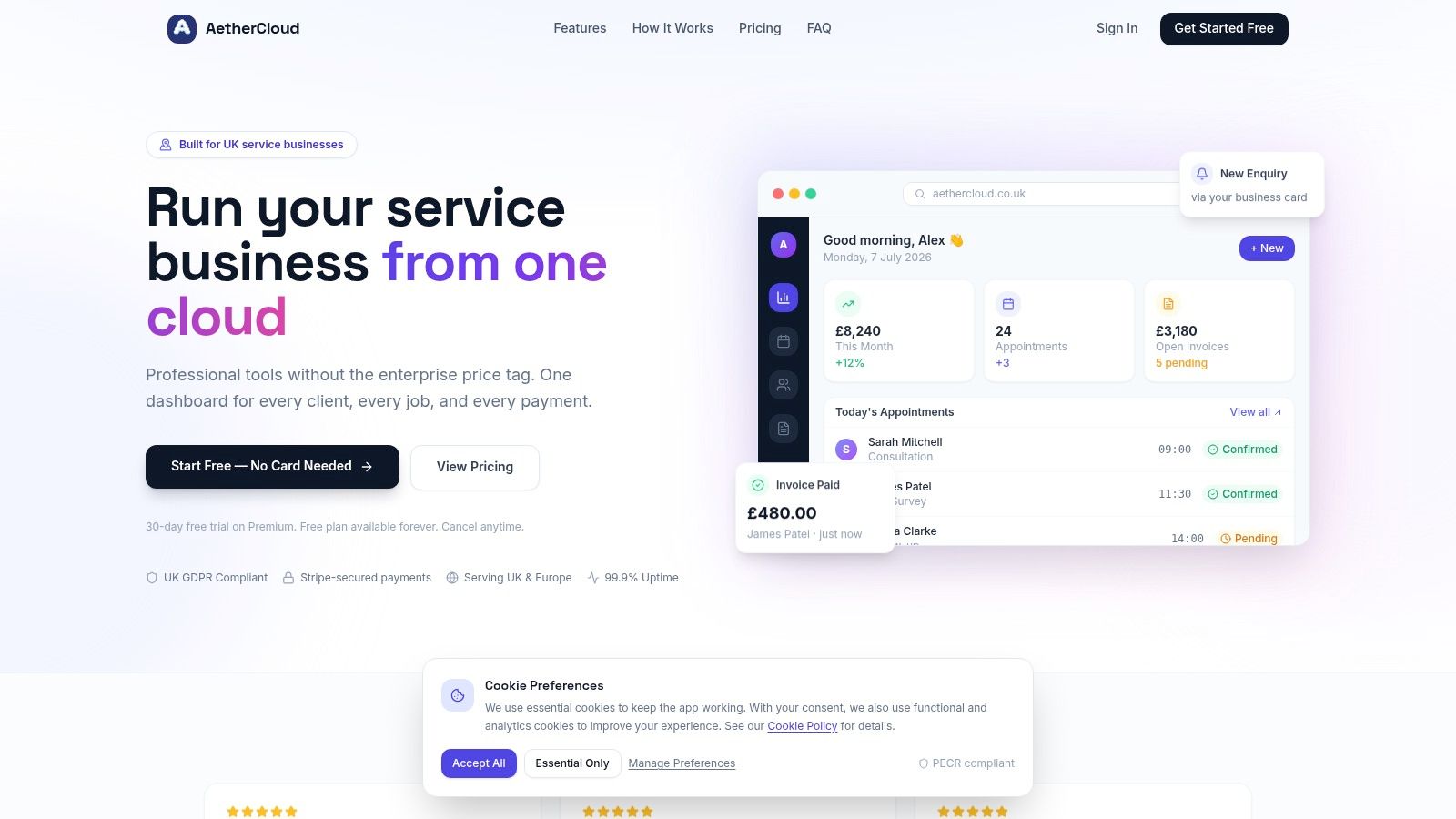
When your enquiries, contacts, quotes, appointments, invoices, and payments live in separate places, you spend time copying information instead of moving work forward. That's why a unified system matters. The AetherCloud platform for UK service businesses is built around that exact problem, replacing fragmented admin with one connected workflow.
A UK government study found a direct correlation between business data investment and improved labour productivity, as shown in the Business data use and productivity study. In plain terms, when your business data is better organised and easier to use, your team works more efficiently.
Why one system beats five disconnected ones
A disconnected stack usually creates the same set of problems:
- Duplicate entry because customer details must be typed into multiple tools.
- Version confusion because the latest quote or invoice isn't always obvious.
- Missed status changes because approval, booking, and payment updates happen in different places.
- Poor visibility because you can't easily see what's waiting, what's approved, and what's overdue.
A unified platform fixes those issues by keeping the customer record and the job record connected. That matters more than most owners realise. Once the quote is approved, the next actions shouldn't depend on fresh admin from scratch.
What a unified workflow changes
The improvement usually shows up in ordinary tasks.
A new enquiry becomes a contact record without being copied into another system. A quote is created from the same record rather than rebuilt. The client can review and respond through a public quote page instead of starting a long email thread. Once approved, the job can move straight into scheduling. After delivery, the invoice follows from the existing job details. Payment status is then visible without separate reconciliation work.
That kind of flow saves time, but it also changes the customer experience. Your business looks more organised because it is more organised.
Here's a quick look at how that joined-up workflow works in practice:
There's also a compliance advantage in using one UK-focused platform for core admin. When billing is in GBP, invoicing is VAT-ready, and customer handling is built around UK GDPR and the Data Protection Act 2018, you remove a lot of avoidable friction from day-to-day operations.
A Practical Playbook From Quote to Cash
A good sales cycle should feel smooth enough that you barely notice the handovers. Here's what that looks like in everyday service work.
A straightforward example
A prospective client receives your digital business card and sends an enquiry. Their details are already captured in one place, so you don't need to copy them into a CRM later. You review the request, ask one or two clarifying questions, and prepare the quote.
You then create the estimate and send it through the AetherCloud quotes workflow for service businesses. The client opens a public response page, reviews the scope, and approves it without needing a separate login or a messy chain of attachments.
From there, the approved quote becomes the basis for the booked job. The appointment is scheduled, the work is delivered, and the invoice is created from the same information rather than typed out again. The client receives a payment link, pays online, and the status updates in the same system.
Why this flow matters
That joined-up path cuts out the dead time between stages. It also removes the little bits of hesitation that slow customers down. They're not hunting for the latest document, asking how to approve, or wondering how to pay.
For UK trades and professional services, reducing sales cycle length by 20% through tools like digital public response pages for quotes increases revenue predictability and customer acquisition rates. That's the practical value of moving from scattered admin to a single quote-to-cash process.
Keep the customer moving with one clear next step at a time. Approve the quote. Confirm the booking. Pay the invoice. Simple journeys close faster.
Stop Juggling Tools and Start Winning Jobs
Most service businesses don't have a sales problem in the classic sense. They have an operations problem sitting inside the cycle of sales.
When the process is fragmented, every stage takes longer than it should. Enquiries go missing. Quotes sit unsent. Approvals drift. Bookings become messy. Invoices are late. Payments need chasing. None of that feels dramatic in the moment, but it adds up to slower cash flow and a business that's harder to run than necessary.
A better cycle of sales is built on clean handovers. Capture the enquiry properly. Reply quickly. Send a professional quote. Make approval easy. Book the work without confusion. Invoice without delay. Give the customer a simple way to pay. Then stay organised enough to win the next job too.
That's why simpler systems usually beat larger stacks for small UK service firms. You don't need more software. You need fewer gaps between the work you're already doing.
If you're tired of managing quotes, bookings, invoices, payments, and client records across separate tools, AetherCloud gives you one simple system built for UK service businesses. It brings scheduling, CRM, quoting, invoicing, online payments, digital business cards, and analytics together so you can stay organised, look professional, and get paid faster. Try AetherCloud to streamline your workflow and see how much smoother your cycle of sales can be.