

You're good at the actual work. The boiler gets fixed, the site gets cleaned, the logo gets delivered, the client meeting goes well. Then the business day starts. A message comes in on WhatsApp, another by email, someone asks for a quote on Facebook, an invoice is still unpaid, and tomorrow's booking lives in a calendar that doesn't talk to anything else.
That's where plenty of UK sole traders get stuck. Not because they lack skill, but because the route from enquiry to paid job is patchy. Work arrives inconsistently, quotes go out late, approvals drag, and cash lands later than it should. The business feels busy without feeling organised.
A go to market plan sounds like something built for boardrooms and software firms. For a local service business, it's much simpler than that. It's the map for how people find you, why they pick you, how they book or request a quote, and what happens next until the money is in the bank.
Think about a self-employed electrician who gets most jobs through referrals. Referrals are great, until they slow down. Without a clear way to show services, respond quickly, send a proper quote, and collect payment online, every new lead depends on manual follow-up. That creates friction at exactly the point where a customer wants certainty.
A practical go to market plan fixes that. It gives your business a shape clients can understand and act on.
If you run a trade, consultancy, agency, or solo service business, you don't need a corporate strategy document. You need a working plan that helps you get found, quote faster, win better-fit jobs, and get paid with less chasing. That's the difference between doing great work and building a great business. If you want to see the thinking behind a platform built for that kind of business, the AetherCloud story gives useful context.
Table of Contents
- Introduction From Great Work to a Great Business
- A Simple GTM Framework for Your Service Business
- Accelerate Your Plan with an All-in-One Platform
- Measure Success and Avoid Common Pitfalls
- Frequently Asked Questions about GTM Plans
Introduction From Great Work to a Great Business
A lot of small service businesses run on memory, goodwill, and speed. You remember who asked for a price. You mean to send the quote tonight. You trust that the customer will come back when they're ready.
Sometimes that works. Often it doesn't.
The common pattern is familiar. A decorator gets an enquiry while on a job, replies later, then forgets to follow up when the customer goes quiet. A freelance consultant has a good discovery call, sends a proposal from an old template, then has to rewrite the same details again for the invoice. A cleaner gets paid late because the client has to ask for bank details twice.
None of these are dramatic failures. They're small leaks. Enough of them and the business feels harder than it should.
The four parts that matter
A go to market plan for a service business comes down to four decisions.
- Who you want to serve
- What exactly you sell
- How people move from hearing about you to hiring you
- How you deliver and get paid without friction
That's it. If those four parts are clear, your business becomes easier to run and easier to buy from.
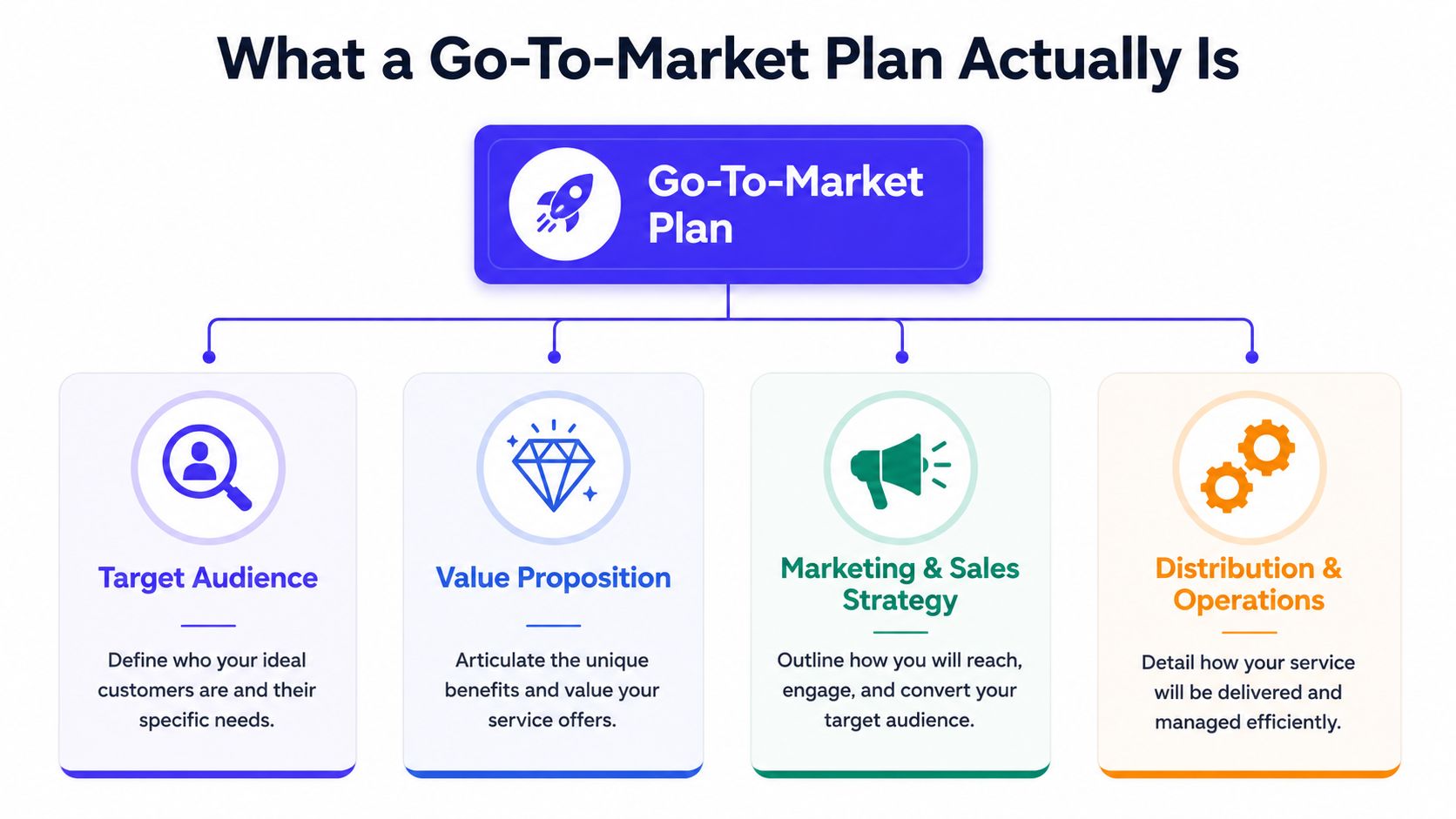
This is often overcomplicated because the phrase itself sounds heavy. In reality, your GTM plan is the joined-up answer to practical questions. Which clients do you want? What will they see first? How quickly can they get a clear price or next step? What makes saying yes feel easy?
A useful business setup starting point is any system that helps you think through these choices in one place.
Why this now matters more than it used to
The way buyers behave has changed. In UK B2B markets, 60% of buyers now do independent research before speaking to sales, and 80% of business interactions have moved to digital channels, according to this UK GTM analysis. Even if you don't think of yourself as “B2B”, the lesson still applies to service firms. People want to look you up, assess you, and understand how to proceed before they talk to you.
Practical rule: If a customer can't quickly understand what you do, how to ask for it, and what happens next, they often move on.
For a one-person business, that means your digital presence can't stop at “send me a message”. It needs to act like a tidy front desk. Clear offer. Clear next step. Clear route to approval and payment.
A weak go to market plan usually shows up as confusion. The wrong leads come in. Pricing changes from one customer to the next. The owner spends evenings stitching together admin instead of improving service.
A strong plan doesn't need to look complex. It just needs to remove uncertainty for the customer and repetition for you.
A Simple GTM Framework for Your Service Business
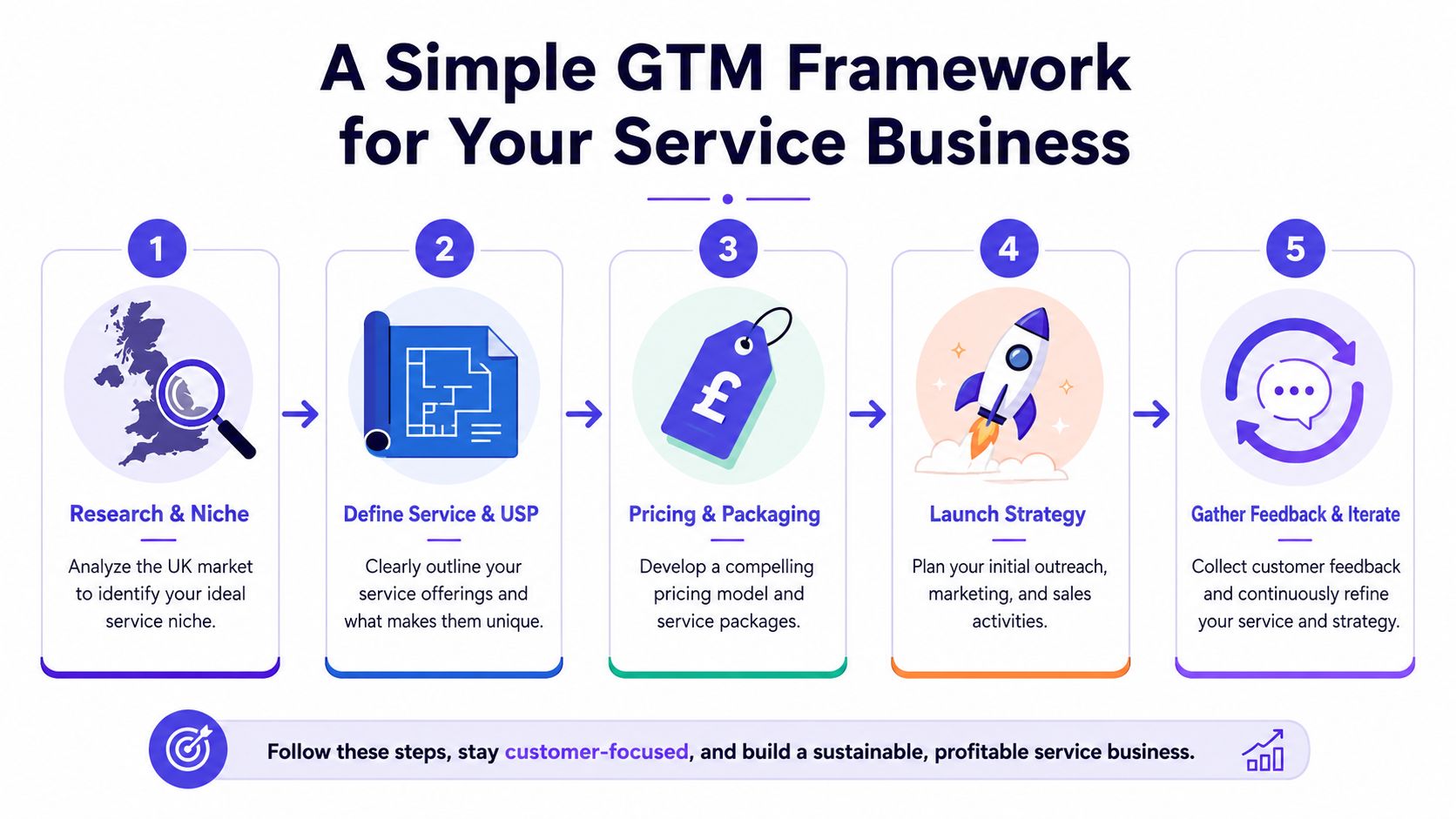
The easiest way to build a plan is to work from the job backwards. Start with the type of work you want, then build the path a customer takes to buy it.
Start with the work you want more of
Not every enquiry is worth chasing. The strongest small businesses get clear on their best-fit customer first.
For a plumber, that might be homeowners in a specific area who need planned work, not only emergency callouts. For a designer, it might be service firms that need ongoing monthly work rather than one-off logos. For a consultant, it could be owner-managed businesses that want implementation help, not just advice.
Use a short filter:
- Location: Where can you serve profitably without wasting time?
- Job type: Which services are straightforward to scope and deliver well?
- Client fit: Which customers respect process, value speed, and pay on time?
- Margin: Which jobs leave enough room after materials, travel, and admin?
When people skip this step, they market vaguely and attract vague leads.
Build a buying path that feels easy
Once you know who you want, tighten how they buy. Your customer journey should feel obvious from the outside.
A simple version looks like this:
| Stage | What the customer needs | What your business should provide |
|---|---|---|
| First contact | Confidence you're relevant | Clear service description and local credibility |
| Enquiry | An easy way to ask | Simple contact or booking route |
| Quote | Speed and clarity | Professional quote with clear scope |
| Approval | Minimal effort | A straightforward approve or respond step |
| Payment | Convenience | Fast invoice and online payment option |
For UK sole traders facing uncertain conditions, speeding up conversion matters. Public-facing quote and payment pages are an overlooked but practical part of a GTM plan because they remove steps between interest and action, as reflected in this UK business context update.
Customers rarely ask for “less friction”. They just disappear when there's too much of it.
A lot of lost work doesn't come from price. It comes from delay, vagueness, or effort. If the customer has to call you to confirm details, ask how to approve, and then request payment instructions, your process is doing the opposite of selling.
Your digital shop window matters. It might be a basic website, a Google Business Profile, a social profile, or a trade directory listing. The channel matters less than the handoff. Every place you appear should point towards one clean next action.
A useful example of that operational foundation is a company setup workflow designed for service businesses.
Here's a practical walkthrough on planning your process:
Launch small, then tighten the process
You don't need to perfect everything before you use it. Start with one offer, one audience, and one route to conversion.
A sensible first version might be:
- Define one core service people regularly ask for.
- Write one plain-English offer that explains what's included.
- Pick one main enquiry route so leads don't scatter.
- Use one quote format with a clear approval step.
- Send invoices through one process with payment built in.
That sounds basic because it is. Basic is useful. The point isn't complexity. It's consistency.
Once the process is live, notice where people stall. Do they ask the same questions before booking? Do they hesitate at the quote stage? Do invoices get paid slowly because the payment route is awkward? Those sticking points tell you where your GTM plan needs work.
Accelerate Your Plan with an All-in-One Platform
A plan on paper is one thing. Running it every day is another. Most sole traders don't struggle because they lack ideas. They struggle because execution is spread across too many disconnected tools.

What fragmented tools do to a small business
This is the usual setup. Bookings in one app. Customer details in notes or a spreadsheet. Quotes in Word. Invoices somewhere else. Payments by bank transfer. Follow-up reminders in your head.
Each tool may work on its own. Together, they create drag.
The problem isn't only time. It's inconsistency. You retype customer details. You lose track of which quote version was sent. You forget who hasn't replied. You spend more time checking status than moving jobs forward.
That matters because cash flow pressure is already tight for many UK service firms. The average payment delay reported in 2025 was 28 days, which makes faster invoice payment routes more important for day-to-day operations, according to this guide on operational efficiency for UK SMEs.
When the process is clunky, delay gets built in. Delay in sending the quote. Delay in getting approval. Delay in invoicing. Delay in payment.
What improves when the workflow lives in one system
An all-in-one setup changes the rhythm of the business.
A customer books or enquires. Their details are already in your contact records. You create a quote without switching systems. When they approve, you turn it into an invoice. The customer pays online through the same flow. You can then see what's outstanding without opening five tabs.
That's not about software for its own sake. It's about preserving momentum.
Here's where that makes a practical difference:
- Faster response: When customer details, enquiries, and scheduling live together, you can act while the lead is still warm.
- Cleaner handover: Approved quotes move straight into invoicing instead of being rebuilt manually.
- Less chasing: Online payment links remove the back-and-forth over payment details.
- Better visibility: Revenue and activity are easier to review when they sit in one dashboard.
A small business usually doesn't need more tools. It needs fewer gaps between them.
This matters even more when data is already messy. 95% of UK and US firms struggle with data issues, and 45% consider their data governance ineffective, according to this report on business data problems. A sole trader won't call it “data governance”, but they will recognise the symptoms. Duplicate records, missing notes, uncertain totals, and no clear picture of what's been sent, approved, or paid.
If you want the clearest operational benefit from a unified setup, focus on visibility first. A straightforward analytics dashboard for service activity and revenue usually tells you more than another app ever will.
Measure Success and Avoid Common Pitfalls
A go to market plan only helps if you can tell whether it's working. For a small service business, that doesn't mean building a complex reporting stack. It means tracking a few numbers that change behaviour.
The few numbers worth watching
Small businesses often avoid measurement because it feels too technical. That's a mistake. You don't need more reports. You need simple indicators tied to real actions.
For small UK businesses without dedicated analysts, that challenge is real. Simple measures such as online quote approval rate matter, especially when 191,000 UK companies were dissolved in Q1 2025, as noted in this UK business trends summary.
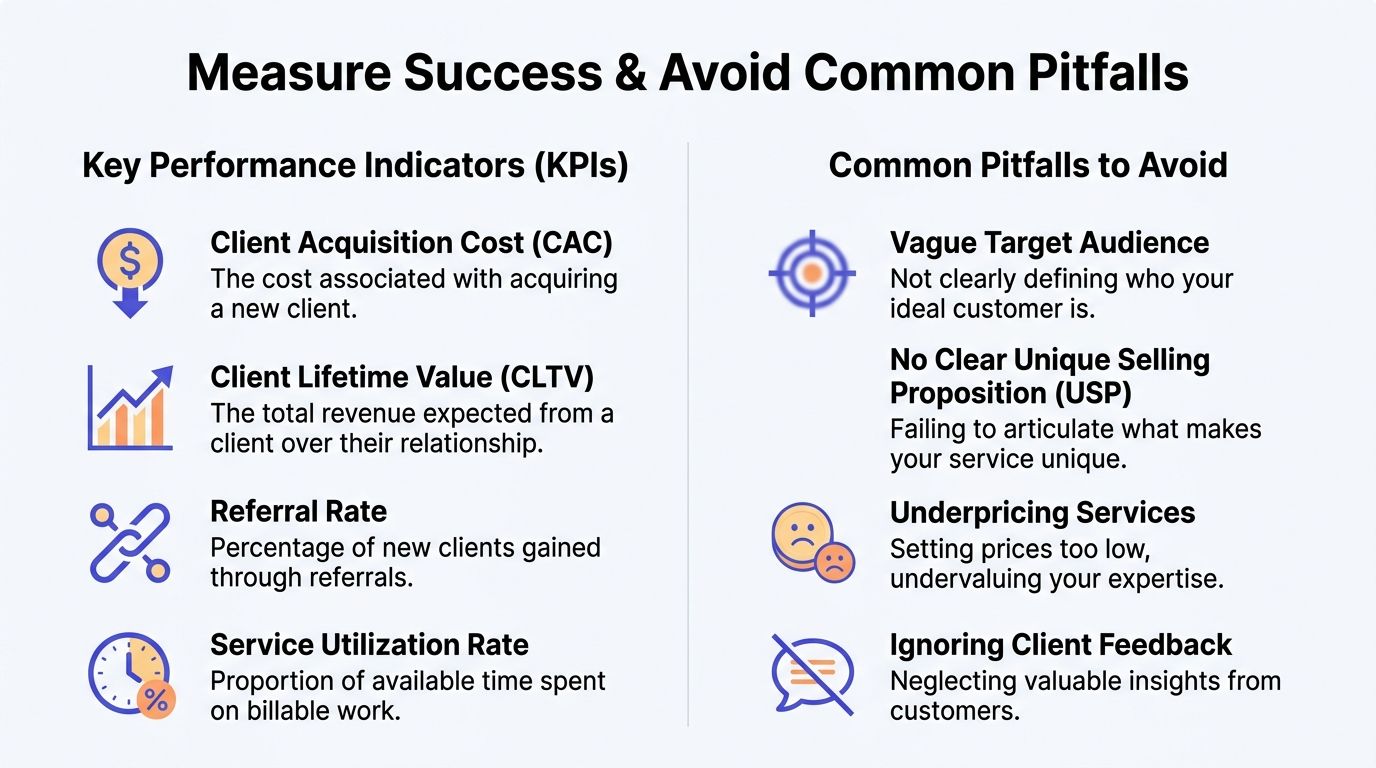
The most useful checks are usually these:
- Quote approval rate: Are the quotes you send turning into work?
- Response time to new enquiries: Are you replying quickly enough to serious leads?
- Time from invoice sent to invoice paid: How long does cash take to arrive?
- Repeat work or referrals: Are good customers coming back or sending others?
A simple enquiry management view can help you see whether leads are progressing or getting stuck.
Track the points where a customer can say yes, wait, or vanish. That's where your plan either works or leaks.
If your quote approval rate is weak, look at clarity before you look at price. If payments are slow, look at convenience before you blame the client. If enquiries are quiet, look at where your visibility and message are unclear.
Mistakes that quietly slow growth
Most GTM problems in a service business are ordinary. They don't look dramatic, so they keep repeating.
Here's a practical checklist of what to avoid:
- Trying to appear everywhere: A neglected Facebook page, stale website, and half-used trade listing don't add up to good marketing. One strong route beats several weak ones.
- Keeping the offer too broad: “I do a bit of everything” makes it hard for people to know when to contact you.
- Changing pricing case by case: Flexibility is useful. Randomness isn't. Customers feel uncertainty quickly.
- Replying too slowly: A slow response often loses the job before price is even discussed.
- Making approval awkward: If the client has to print, scan, or send a long email to accept, some won't bother.
- Leaving follow-up to memory: Memory works until the week gets busy.
There's also a survival point here. The business failure rate for the 12 months ending March 2025 was 53.1 per 10,000 companies in England and Wales, according to this analysis of UK business failure rates. For a sole trader, that doesn't mean panic. It means operational slack matters. Missed follow-up, messy records, and slow collection are not small admin issues when they happen every week.
A good GTM plan is often less about promotion than discipline.
Frequently Asked Questions about GTM Plans
Do I need a budget to have a go to market plan
No. You need decisions, not a big spend.
Most service businesses can improve their go to market by choosing a narrower audience, clarifying their offer, tightening their quote process, and making payment easier. Paid ads can help in some cases, but they don't fix a weak buying journey.
Is this different from marketing
Yes. Marketing is one part of it.
Your go to market plan includes how people find you, but also what you offer, how you price it, how you handle enquiries, how quotes get approved, and how money is collected. If marketing brings attention but the process after that is messy, the plan is incomplete.
Does a one-person business really need this
Yes, maybe more than a larger firm does.
A bigger business can hide weak process behind staff. A sole trader can't. If you are the marketer, scheduler, sales person, account manager, and finance team, your route from enquiry to payment needs to be simple enough to run on a busy Tuesday.
What should I sort out first
Start where customers feel friction.
If leads are coming in but not converting, tighten the quote and approval stage. If jobs are won but cash is slow, improve invoicing and payment. If nothing consistent is coming in, fix your offer and visibility first.
How do I know the plan is working
You should see cleaner movement through the core journey. Better quality enquiries. Faster quote turnaround. More approvals. Less chasing. Better visibility over what's been sent, booked, invoiced, and paid.
That's what a useful go to market plan does for a small service business. It turns scattered effort into a repeatable way of winning work.
AetherCloud brings scheduling, CRM, quoting, invoicing, payments, digital business cards, and business insights into one simple platform for UK service businesses. If you want a cleaner route from enquiry to quote to payment, try AetherCloud and see how it helps you run the whole workflow in one place.