

GDPR compliance is the ongoing process of handling personal customer data lawfully, transparently and securely under the UK GDPR and the Data Protection Act 2018, and the ICO can fine businesses that fall short. For a small service firm, that means every booking, quote, invoice, payment and support message needs a clear lawful basis, sensible controls and records you can show if asked.
Your diary fills up. A customer sends an enquiry, you add their details to your CRM, you book the job, you send a quote, then you invoice them and take payment online. None of that feels like “data protection work”, yet every step creates personal data that falls under the rules.
If you've ever wondered why GDPR feels so confusing, it's usually because most explanations stay at the level of privacy notices and cookie banners. The core issue for a UK service business is operational. Customer data lives inside booking pages, quote forms, invoices, payment links, spreadsheets, inboxes and support threads, so compliance has to live there too.
Table of Contents
- A Day in the Life of Customer Data at a UK Service Business
- The Legal Foundations Every UK Business Must Understand
- The Core Principles That Shape Everyday Decisions
- A Practical Compliance Checklist for Small UK Service Firms
- How Two Real UK Service Businesses Approach Compliance
- Breach Response and the 72-Hour Notification Clock
- Bringing It All Together and Building Good Habits
A Day in the Life of Customer Data at a UK Service Business
A small electrical contractor starts the day with a booking request from a homeowner. The customer leaves a name, mobile number, address and a short note about the fault. Later, the same team member sends a quote, converts it into an invoice, and follows up with a payment link. By the afternoon, there's a new enquiry in the inbox, another contact added to the CRM, and a reminder set for a future visit.
None of those actions is unusual. Together, they show how personal data moves through a normal working day. The customer's details are collected, checked, stored, shared, invoiced and sometimes retained long after the job ends.
Practical rule: if a person's details help you book, quote, bill or support a job, GDPR is already part of that workflow.
That's why a working definition of what is GDPR compliance needs to be practical, not abstract. It's not just “having a privacy policy”. It's the habit of handling customer information in a way that is lawful, transparent, limited to the job in hand and secure enough to stand up to scrutiny. For a service business, that means knowing where data enters the business, who can access it, how long it stays around and what happens if something goes wrong.
A simple example makes the point. If a customer asks for a quote and later changes their address before the visit, that correction has to be reflected in the records you use, not just in one place on one system. If an old enquiry sits in a spreadsheet, an inbox and a finance tool, then deleting it or exporting it for a subject access request becomes messy very quickly.
That's why UK GDPR and the Data Protection Act 2018 matter in daily operations, not just in policy documents. They set the framework for all of those ordinary data moments, from the first booking to the final payment and beyond, and they expect you to be able to show how you manage them. A good starting point is to think in terms of workflows, not legal theory, and map the customer journey as a data journey too. See how a customer journey becomes an operational workflow.
The Legal Foundations Every UK Business Must Understand
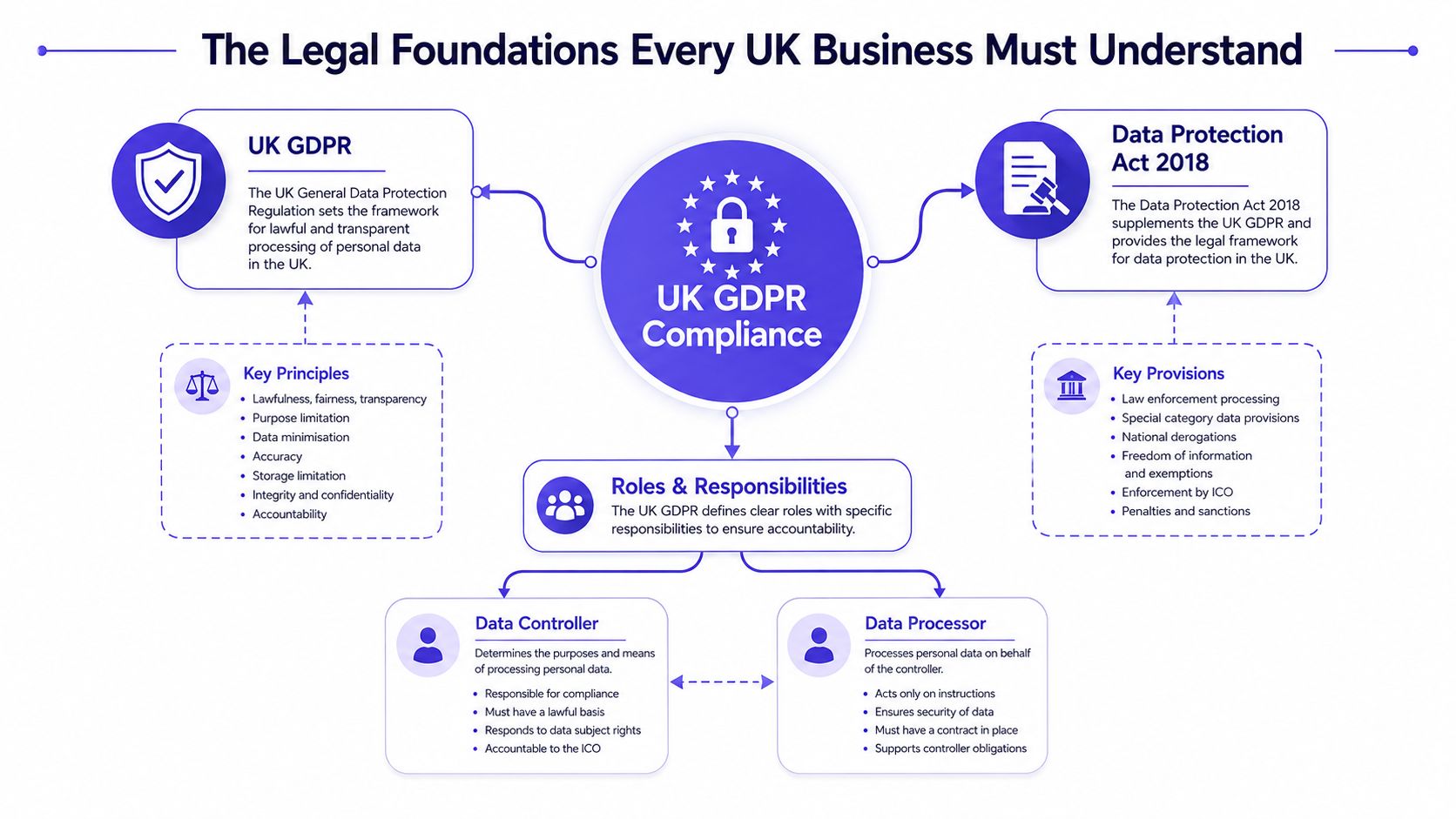
UK GDPR is the UK's retained version of the GDPR, working alongside the Data Protection Act 2018. It became enforceable on 25 May 2018, and the core model stayed aligned with the EU framework after Brexit as set out in the European Commission's overview. For a small business, the point isn't memorising the date, it's understanding that the law still expects a proper operating system for personal data.
The ICO is the UK regulator. In practice, the ICO and UK courts look for more than a privacy notice. They want to see a lawful basis for processing, transparent communication, and evidence that you can explain and defend how customer data is handled. That's the difference between “we meant well” and “we ran a compliant process”.
Controllers, processors and why the distinction matters
A controller decides why and how personal data is used. A processor handles that data on the controller's behalf. A typical plumber who uses a card payment provider is usually the controller for customer details collected to book and bill the job, while the payment provider acts as a processor for the payment handling part. A consultant using an external accountant may also share data with a processor, and the contract between them should reflect that relationship.
A few relationships can get more complicated. If two businesses decide together how and why data is used, they may be joint controllers. That matters because responsibility doesn't disappear just because a third party is involved. The legal question is always who decides the purpose, who carries out the processing, and who can prove it.
The framework also expects accountability. That means you don't just follow the rules, you keep records that show how you followed them. You should be able to explain your privacy notices, your processing activities and your processor contracts without rebuilding the story from scratch.
For that reason, many firms need practical help turning contracts into usable compliance records. A useful external reference on how to build a DPA in contract management can help clarify what those processor terms usually need to cover. On your own site, your privacy policy should reflect the actual workflows, not a generic copy-and-paste template.
The high-level takeaway is simple. UK GDPR and the Data Protection Act 2018 create a framework for lawful basis, transparency, accountability and clear role allocation. Those ideas sound legal, but they show up in ordinary business tasks like booking, quoting, invoicing and support.
The Core Principles That Shape Everyday Decisions
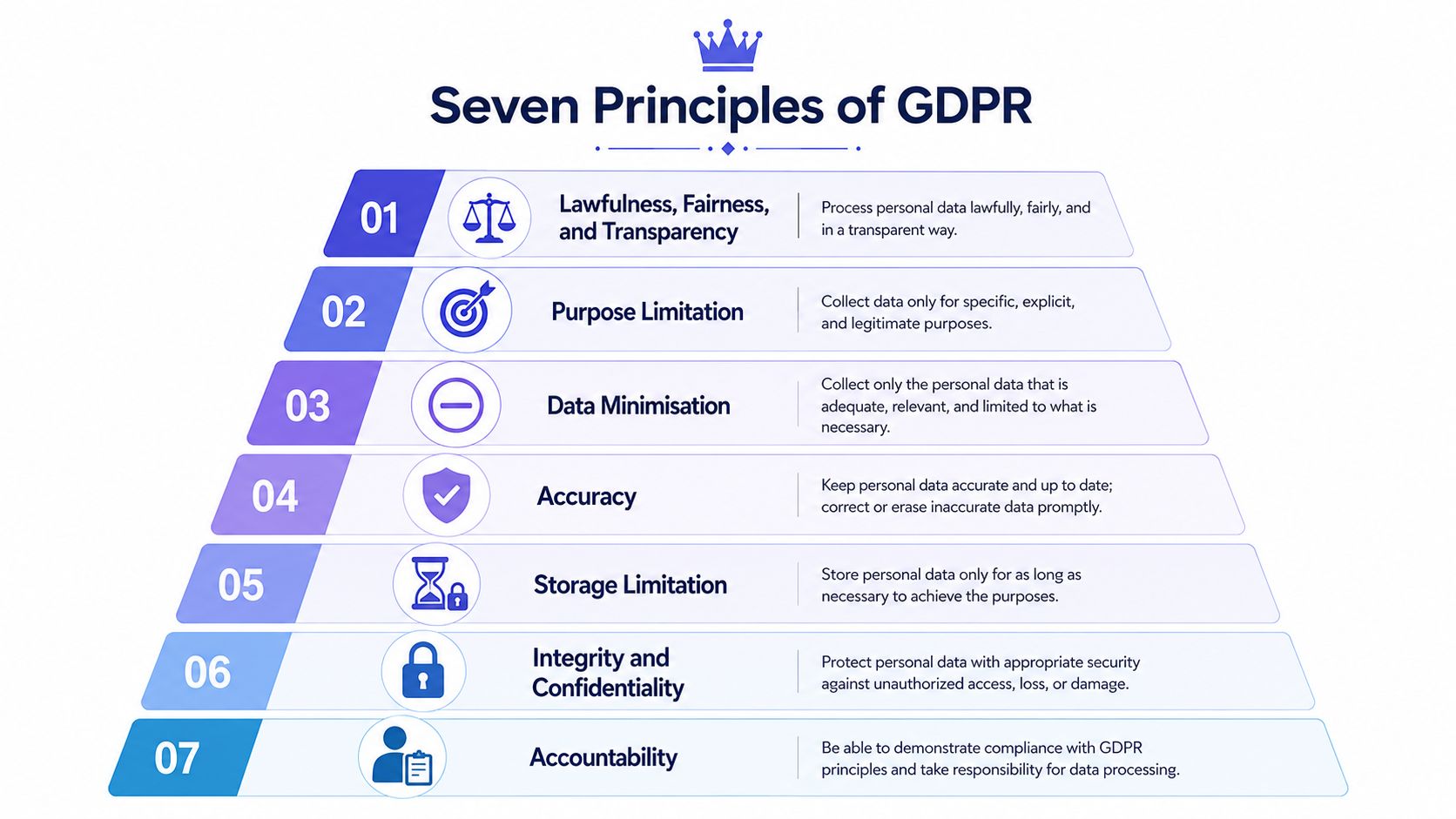
The seven GDPR principles become easier when you treat them as decision rules. Before you collect, store or share anything, ask what the job is, whether you need the data, how long you need it and who can see it. That mindset keeps compliance grounded in real work rather than policy language.
Turning principles into everyday questions
Lawfulness, fairness and transparency means you need a lawful basis and you need to tell people plainly what you're doing. If a customer fills in a booking form, they should know why you need the data and what happens next.
Purpose limitation means you collect data for a specific reason and stick to it. If you asked for an address because you're visiting their home, don't later reuse that information for unrelated marketing without a proper basis.
Data minimisation means you only ask for what you genuinely need. A beauty therapist taking advance appointments doesn't need a customer's date of birth if the service doesn't require it.
Accuracy means the records you rely on have to stay current. If a customer updates their contact number, the right number should be in the system you use for reminders and invoices.
Storage limitation is about not keeping data forever “just in case”. Old quotes, expired enquiries and completed job notes need a retention rule, not an eternal folder.
Integrity and confidentiality means the data is protected against unauthorised access, loss or damage. In practical terms, that means sensible permissions, secure logins and careful handling of devices and exports.
Accountability means you can show the thinking behind your decisions. If someone asks why you keep a certain record, you should have a documented answer, not a shrug.
A business analytics dashboard can be useful here, because it often shows how much operational data a team is already holding. Understanding business analytics in a service firm helps you spot where data is flowing, but the privacy question is always the same, do you need every field you're collecting?
Practical rule: if a form asks for something you can't justify in one sentence, it probably shouldn't be there.
The principles aren't separate tasks. They're the test you apply every time a new form, tool or workflow appears.
A Practical Compliance Checklist for Small UK Service Firms
A small business doesn't need a heavyweight privacy department to get this right. It does need a clear list of actions tied to the systems it uses, especially appointments, CRM notes, quotes, invoices and payments. The goal is to make compliance visible in day-to-day operations, not hidden in a folder nobody opens.
The work that actually needs doing
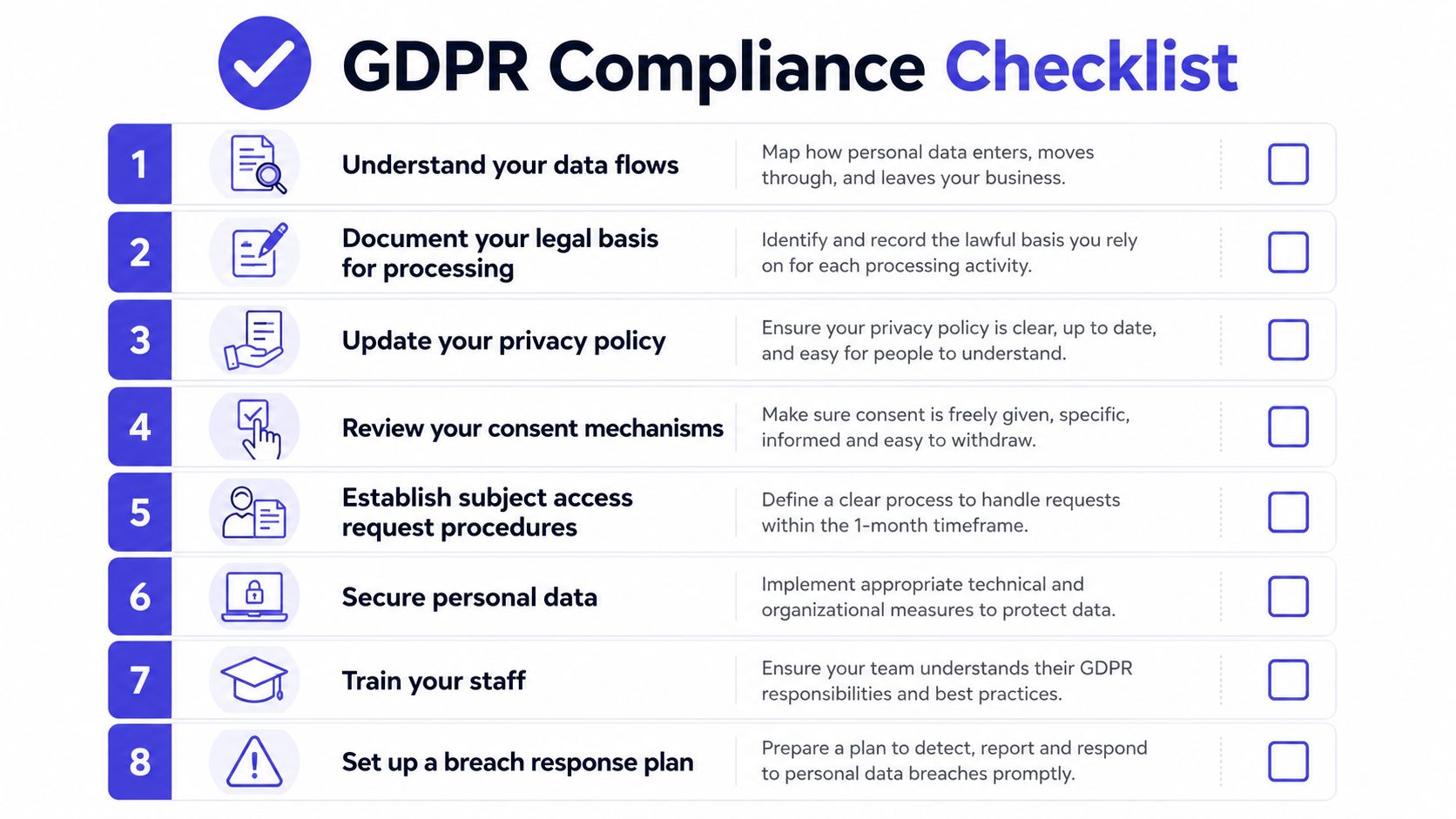
Start by mapping what personal data you hold and where it lives. That includes booking forms, shared inboxes, invoices, payment pages, spreadsheets and any messaging tools that carry customer details. If you can't trace a customer record from enquiry to payment, you'll struggle to answer access requests or deletion requests cleanly.
Next, write down the lawful basis for each workflow. A quote request may sit on the basis of contract or steps taken before entering a contract, while a marketing email list usually needs a different justification. The point is not to force every process into the same bucket, it's to document the right basis for each one.
Then update your privacy notice so it describes the actual journey of the data. If your customers book online, get a quote, receive an invoice and pay through your portal, the notice should say so in plain English. Generic wording creates confusion later, especially when someone asks what you did with their details.
Retention is often where small firms drift into risk. Old enquiries, completed jobs, expired quotes and settled invoices should each have a sensible retention period based on business need and legal obligations, not habit. If you keep everything forever, you also keep your clean-up problem forever.
The vendor side matters too. If you use a payment provider, email platform or booking tool, you need processor terms that reflect the relationship. A practical compliance stack often includes a written contract or data processing agreement, plus security settings such as role-based access and two-factor authentication on the main accounts. For a broader operational view, a checklist for GDPR data protection is useful as a reference point when reviewing your own setup.
If you handle online payments, the payment page itself matters because it's part of the customer journey and part of the data trail. How to accept online payments becomes a compliance topic as much as a cash-flow one when that page stores names, invoice references and payment status.
Practical rule: if a third party touches customer data, you need to know what they do with it and why.
A basic small-business checklist should also include access controls, staff training and a breach response plan. If your team can't log who accessed what, or if everyone shares one login, you're making simple compliance harder than it needs to be. The ICO would expect to see records, contracts, notices and incident procedures that match the way your business really operates.
How Two Real UK Service Businesses Approach Compliance
A small home-services business with a calendar app, a spreadsheet CRM, an invoice template and a standalone payment link can look organised from the outside. Inside, the data is scattered. If a customer asks for all their information, someone has to search multiple tools, cross-check names and dates, and piece together the history by hand. Deleting an old enquiry is just as awkward, because one copy may still sit in an inbox while another lives in a spreadsheet.
That setup doesn't automatically mean the business is non-compliant. It means compliance effort is higher because the business has to prove control across disconnected systems. Every extra place customer data lives creates another place to update, secure, search and delete.
A similar-sized firm using a single UK-built platform can handle the same tasks with less fragmentation. Scheduling, contacts, quotes, invoices and payments sit in one system, with role-based access and audit trails showing who did what and when. A public digital business card can also reduce the amount of manual retyping needed when sharing business details, because the customer sees a consistent profile instead of scattered contact records.
The difference shows up in the boring moments, which is where compliance either works or breaks. One team can answer a subject access request by exporting from a central record. The other team has to stitch together screenshots, attachments and old emails. One team can remove an expired enquiry across its workflow. The other needs to remember where the data was copied in the first place.
A practical platform choice doesn't solve GDPR on its own, but it can make accountability much easier to maintain. If the system is built around one customer record, one access model and one audit trail, you're already closer to evidence than a patchwork of tools can be. That is why the tools around customer management matter as much as the policy text on your website. Customer engagement strategies are easier to manage when the underlying records are tidy.
For a small service business, the question is not whether the software looks modern. It's whether it reduces duplication, keeps personal data in fewer places and makes it easier to show who handled what.
Breach Response and the 72-Hour Notification Clock
A personal data breach is any incident where personal data is lost, exposed, altered or accessed without permission. A lost work laptop, an email sent to the wrong customer, or a compromised login can all count. The business only has a short window to work with once it becomes aware of the issue, because the GDPR requires notification to the supervisory authority without undue delay and, where feasible, no later than 72 hours as set out in the EU's guidance.
The first decision is whether the incident creates a risk that needs reporting. Not every mistake requires an ICO notification, but every incident should be logged internally. If you don't write it down, you lose the chance to learn from it, and you also lose the evidence that you handled it responsibly.
A simple incident sequence
- Contain the issue. Lock down the account, disable the session, recover the device or stop the wrong email from spreading further.
- Assess the risk. Work out what data was involved, who might see it and how serious the exposure is.
- Notify if needed. If the threshold is met, send the report within the 72-hour window and explain any delay if you miss it.
- Review the process. Fix the root cause, update staff guidance and record the lesson for next time.
A unified system makes this easier because access controls, activity logs and secure payment pages help you narrow down what happened. If a breach starts in a shared inbox, a public quote page or a poorly protected spreadsheet, you waste time reconstructing the timeline. If the workflow is centralised, you're more likely to see the problem quickly and act on it.
The written response plan is essential. Staff need to know who to tell, what to isolate and what gets documented, because incident handling can't depend on one person's memory. Training matters here, but so does repetition, since the first minute of a breach response often decides how much damage you can prevent.
Bringing It All Together and Building Good Habits
GDPR compliance gets easier when you stop treating it as a one-off project. The habit is simple, know what data you hold, why you hold it, how long you keep it and who can see it. If you can answer those four questions across scheduling, CRM, quotes, invoices, payments, digital business cards and analytics, you're already thinking in the right way.
The most common mistakes are also the most ordinary ones. Businesses keep old customer data “just in case”. They collect more fields than they need. They forget that data copied into email, spreadsheets and payment tools still counts. They also buy software before they think about access, retention or deletion.
A better pattern is to start small and tidy the workflow you use most often. Sort the booking form first. Then the quote process. Then invoicing and payments. Each improvement makes the next one easier, because you're reducing duplication and clarifying where data lives.
A unified platform can help because it keeps the operating model in one place, which makes access control, audit trails and customer-data handling simpler to govern. AetherCloud is one option for UK service businesses that want scheduling, CRM, quoting, invoicing, payments, digital business cards and analytics in a single system with UK GDPR alignment. That kind of setup doesn't replace judgement, but it does reduce the number of moving parts you need to manage.
The right mindset is steady, not dramatic. Document what already exists, remove what you don't need and make one workflow cleaner this week than it was last week. If you do that consistently, GDPR starts to look less like a legal headache and more like part of running a professional service business.
If you want a simpler way to keep bookings, quotes, invoices, payments and customer records organised in one place, visit AetherCloud and see how it supports UK service businesses with a more joined-up workflow. You can use it to bring everyday customer data into one system, then manage access, records and responses more consistently as your business grows.