
If you've ever taken on a new client by WhatsApp, then spent the rest of the evening hunting through email threads, chasing a deposit, and trying to remember which quote version they approved, you already know the problem. The issue isn't effort. It's that your client onboarding process is probably acting like a loose collection of messages instead of a proper revenue flow.
In UK service businesses, that mess shows up fast. Contact details get copied badly, scope gets misunderstood, payment expectations drift, and the job starts with avoidable friction. The fix is a structured onboarding sequence that captures the right information once, moves the client through a clear set of steps, and gets you from first enquiry to first invoice paid without the usual back-and-forth.
Table of Contents
- Why Most UK Service Businesses Lose Clients in the First 30 Days
- The Seven Stages of a High-Converting Client Onboarding Process
- Capturing Leads and Sending a Welcome That Actually Converts
- Scheduling, Quoting and Fulfilment Without the Back-and-Forth
- Turning Approved Quotes into Paid Invoices Faster
- Measuring Onboarding Success in the First 30 Days
- Onboarding Milestones and Success Signals
- Your One-Page Onboarding Checklist and Next Steps
Why Most UK Service Businesses Lose Clients in the First 30 Days
A plumber gets a job through WhatsApp, scribbles the address on a job card, says the quote will follow, and then spends two evenings chasing photos, access notes, and a deposit by bank transfer. A consultant does the same thing, only the confusion lives in email threads and spreadsheets. Either way, the client does not feel looked after, the team wastes time, and the job begins with doubt instead of control.
That first month matters because onboarding is where the relationship becomes real. The UK service market still relies on admin-heavy, fragmented processes, while firms keep digitising intake, scheduling, and invoicing to cut manual handling and delay. Onboarding sits right in that pressure point, because it is where service details, pricing, and payment expectations are fixed, and mistakes here flow straight into delivery and billing. If you want clients to behave like returning customers, you need to treat onboarding as part of the revenue pipeline, not as a polite admin phase. The practical work starts with clear intake, fast follow-up, and tighter client communication, which is exactly why many firms benefit from a structured customer engagement strategies approach inside AetherCloud.
Practical rule: if the client is still “being onboarded” after you have started the work, your process is too vague.
Independent onboarding benchmarks make the commercial case plain. The better firms respond within 4 hours of signing, complete onboarding in 5 days or fewer, and use portals instead of email. Weaker performers can take 2 to 3 weeks and lose 25% to 35% of clients in the first 90 days (SundaySky onboarding statistics). That early window is the retention window, not an admin window.
The fix is simple in shape, even if it takes discipline to run well. Capture the lead, welcome the client, gather intake details, schedule the work, send the quote, deliver, invoice, and follow up. In AetherCloud, that flow sits in one place, with CRM, scheduling, quotes, invoices, and payments linked to the same client record, so the team stops stitching tools together and starts moving the client towards the first invoice paid. That is the standard. A clean setup should make the business look organised before the work even starts, not after the first complaint.
The Seven Stages of a High-Converting Client Onboarding Process
A high-converting client onboarding process doesn't need to be complicated. It needs to be staged, visible, and short enough that clients complete it. The strongest frameworks keep the initial flow to five to seven steps, with the most valuable action first, because longer sequences create abandonment and delay activation, as noted in Moody's-style onboarding guidance and the broader checklist material in the brief (Moody's onboarding best practices).
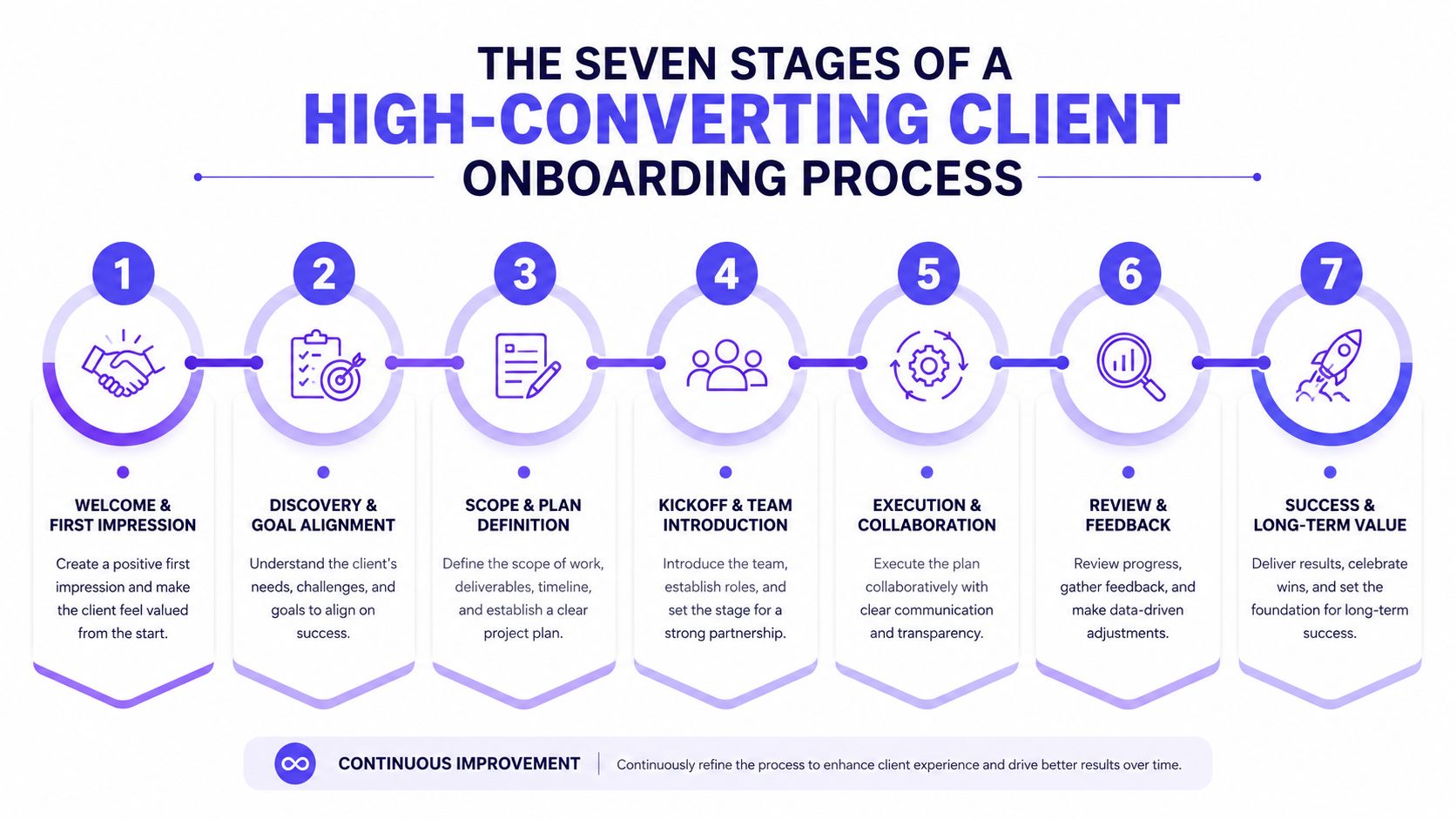
Lead to welcome
The first stage is lead capture. Its job is to stop enquiries disappearing across WhatsApp, email, Instagram DMs, and voice notes. If you don't centralise that input, you'll keep retyping the same details and missing the same details.
The second stage is welcome. That's where you confirm the enquiry, set the response window, and tell the client what happens next. A digital business card or enquiry form should land straight into one contact record, so you're not rebuilding the same profile every time a customer switches channel.
Intake to booking
The third stage is intake. It turns the raw enquiry into usable job information, like site address, preferred dates, decision-maker details, VAT status, and access requirements. In a UK service setting, that's where compliance or safeguarding flags also surface, which matters because regulated and semi-regulated work can't afford sloppy assumptions.
The fourth stage is scheduling. It confirms when the work will happen and what the client needs to have ready. The fifth stage is quoting. The output should be a clean price, a defined scope, and clear terms. The point is not paperwork for its own sake, it's reducing uncertainty before work begins.
A client who knows what happens next is far easier to serve than one who's guessing.
Fulfilment to handoff
The sixth stage is fulfilment. That's when the job gets delivered against the agreed scope, using the same record that captured the original requirements. The seventh stage is invoicing, payment, follow-up, and analytics. At this point, onboarding stops being admin and starts acting like a revenue pipeline, because the process proves whether the client has moved from interest to approved work to money in the bank.
A practical way to think about the whole flow is this. Contacts and enquiries handle capture, digital business cards support intake, scheduling manages the booking, quotes collect approval, invoices take payment, and the analytics dashboard shows where clients stall. That's cleaner than stitching together half a dozen disconnected tools, and it matches the sequence service businesses already use. The strong reason to keep it to seven stages is simple. Shorter flows get finished. Longer ones get ignored.
For a simple comparison framework, see the broader sales flow logic in this AetherCloud cycle of sales guide.
Capturing Leads and Sending a Welcome That Actually Converts
The worst mistake here is treating lead capture as an inbox problem. It isn't. You need one place where every enquiry lands, whether it comes from a scan of your digital business card, a website form, or a direct message someone sent after seeing your van, flyer, or portfolio.
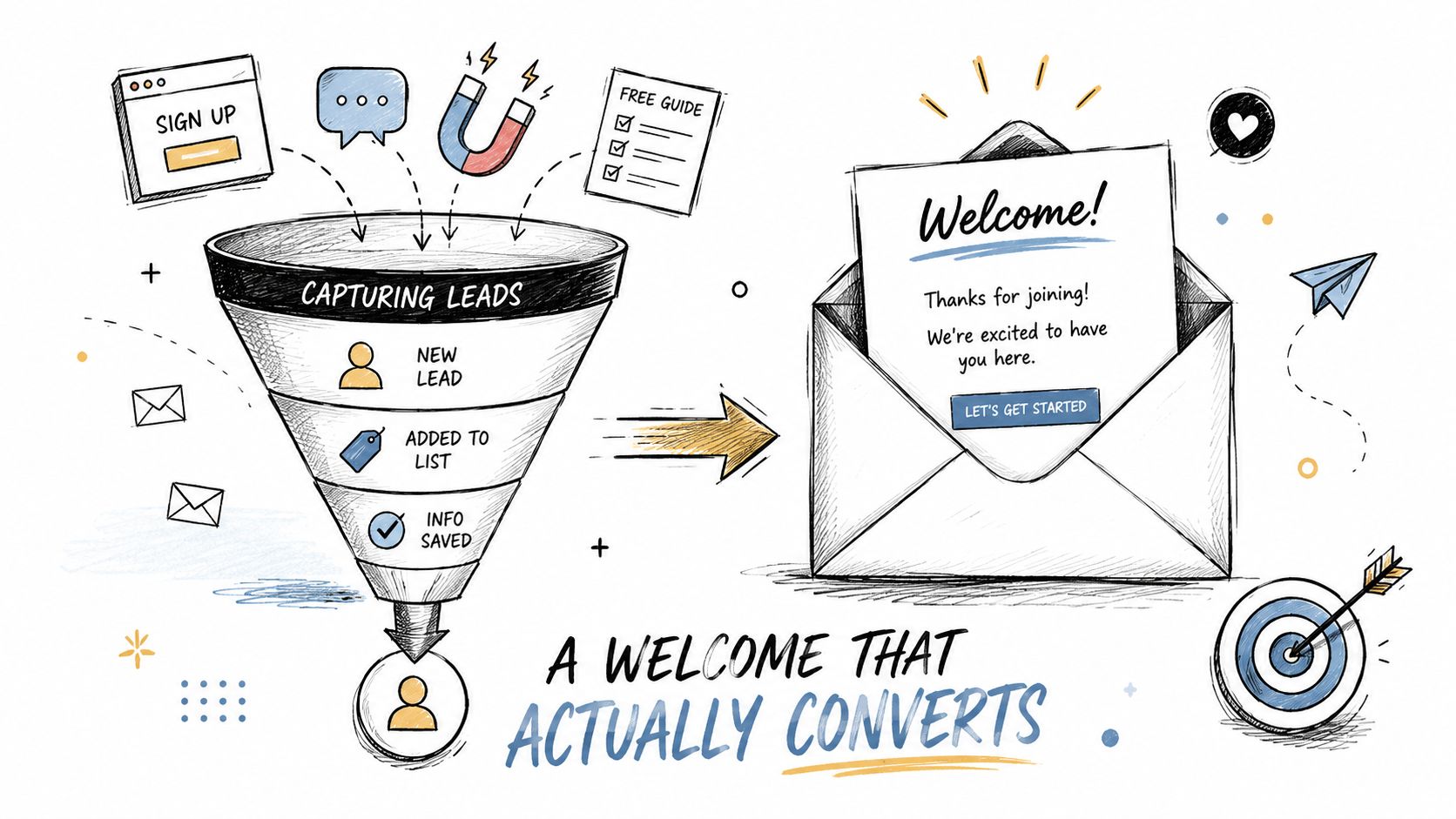
Use a single intake path and make it the default. For a cleaner setup, your welcome message should go out as soon as the enquiry lands, because the top-performing firms in the benchmark respond within 4 hours of signing (SundaySky onboarding statistics). You don't need a novel. You need acknowledgement, expectation-setting, and a next step.
Copy-ready welcome email
Here's a plain British English version you can use:
Hi [Name], thanks for getting in touch.
We've received your enquiry and I'll review the details today.
If everything is clear, I'll come back to you with the next step, usually a call, booking confirmation, or quote, depending on the work.
If you can send any site photos, preferred dates, or access notes now, that'll help me move faster.
Thanks,
[Your name]
That message does three useful things. It confirms receipt, sets a response expectation, and nudges the client into the intake step without sounding clumsy. It also keeps you in control, because the client knows what happens next instead of chasing you for updates.
After that, keep the intake form short and specific. Ask only for what you need to scope the job properly:
- Site address or service location: So you can confirm travel, access, or postcode constraints.
- Preferred dates or windows: So you know whether the client needs speed or flexibility.
- Decision-maker details: So the right person approves the quote or booking.
- VAT status: So pricing and invoicing are correct from the start.
- Access or compliance requirements: So you don't arrive unprepared for DBS checks, safeguarding rules, keys, alarm codes, or site induction.
The point is not to interrogate the client. It's to stop the same information being requested three times in three different channels. A central contacts and enquiries workflow does that far better than scattered inboxes do.
For service businesses, the best pattern is immediate acknowledgement, intake within the same day, and a clear booking or quote pathway straight after. That's the difference between looking busy and looking organised.
The practical habit is this. If the first message comes in before lunch, the welcome should be sent before the day ends. If it lands after hours, the client should still get an acknowledgement straight away, even if the human follow-up happens the next morning.
Scheduling, Quoting and Fulfilment Without the Back-and-Forth
UK service firms waste too much time at this stage of client onboarding. A booking request comes in, the team sends a few emails to agree the slot, the quote gets rebuilt from scratch, the client asks for a tweak, another version goes out, and the work only starts once the thread has dragged on long enough to kill momentum. That is not a sales process. It is admin with a calendar attached.
Start with confirmed availability, then move the client straight to a booking page. Let them choose a slot or approve a proposed one without another exchange of messages. Keep the confirmation short, specific, and operational. Skip the warm wording that does nothing for delivery.
Booking confirmation script
Send something like this:
Hi [Name], your booking is confirmed for [date] at [time].
Please make sure [access note, parking note, photos, or site contact] is ready before then.
If anything changes, reply here and I'll update it.
That message gives the client certainty and gives your team one source of truth. It also stops people on your side working from an old email thread or a note scribbled on paper and then forgotten. Use a customer-facing booking page in AetherCloud so the appointment, notes, and status sit in the same place instead of being split across inboxes.
Once the booking is fixed, turn the captured requirements into a quote that a real customer can read quickly. A trades quote usually needs labour, materials, call-out, and VAT. A consultant quote usually needs discovery, delivery, revisions, and VAT. An agency quote usually needs strategy, design, implementation, and ongoing support. Keep the headline price visible and the structure clean, because clients approve faster when the document reads like a business document rather than a puzzle.
Useful rule: if a client needs a call to understand your quote, the quote is not finished.
A public quote response page removes email ping-pong. The client approves, requests changes, or declines in one place. That keeps the decision visible, shortens the gap before work starts, and stops approvals drifting into “I thought I replied to that” territory. AetherCloud can carry the quote status, the client response, and the next action together, which is the point. One platform keeps the workflow moving. Three tools usually slow it down.
For fulfilment, keep the same contact record live from the booking right through to delivery. The agreed scope, booking details, notes, and price should move with the job, so the team is not rereading old messages on day one. If you are still creating jobs from scratch after a quote is approved, you are wasting the strongest part of the onboarding process.
For a cleaner structure behind the workflow, the logic in this spreadsheet-to-process article is useful background. The main lesson is simple. One record should drive booking, quote, and fulfilment, not three separate places that drift apart.
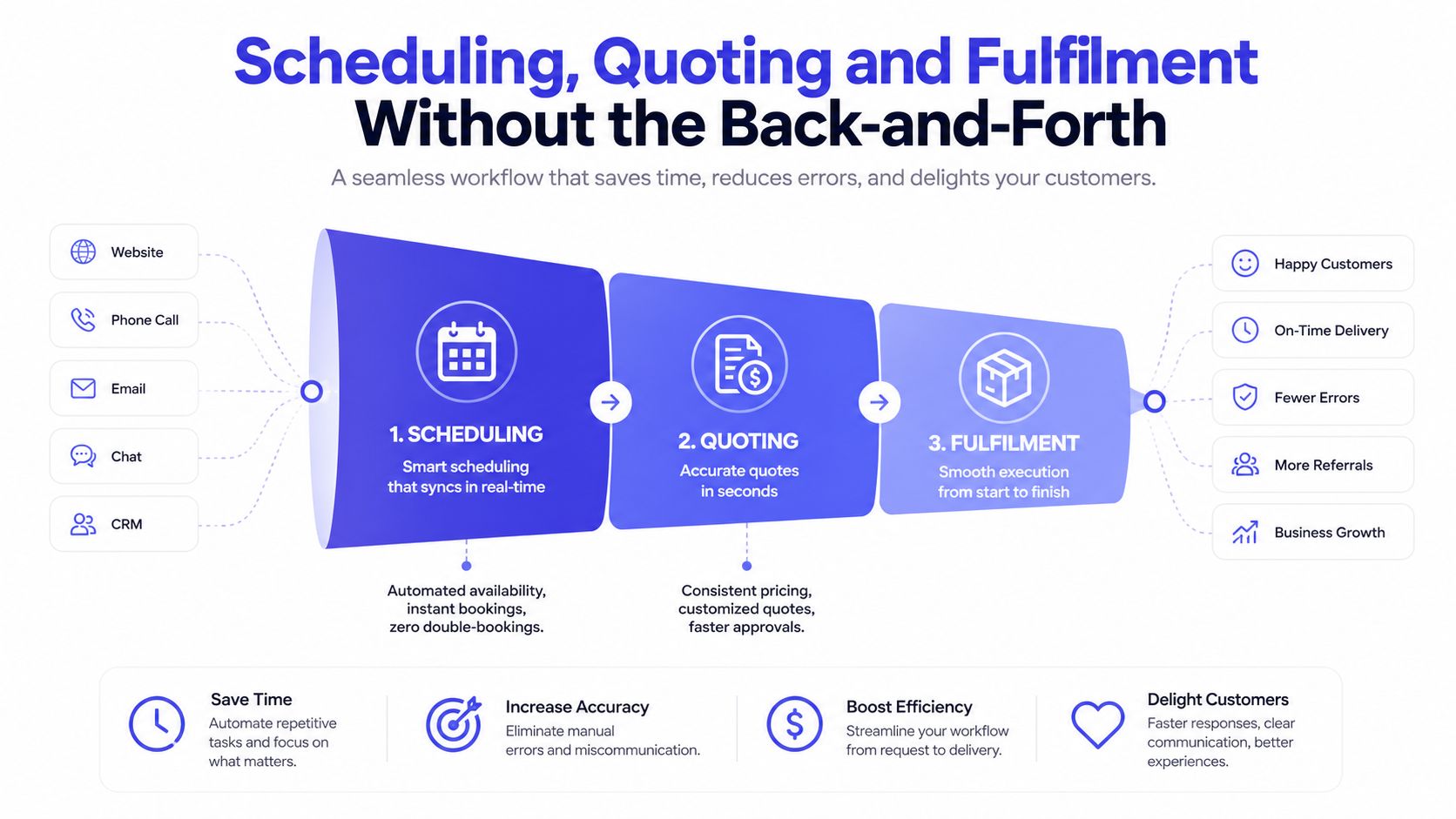
The handover note should include the job location, the approved scope, any special access steps, and the exact price that was agreed. If those details live in one place, delivery starts smoothly. If they do not, the first job of the day becomes detective work.
Turning Approved Quotes into Paid Invoices Faster
Cash flow pressure hits UK small firms hard, which is why the invoicing stage should never be treated as an afterthought. The onboarding journey isn't complete when the quote is accepted. It's complete when the first invoice is paid and the money has landed.
An approved quote should convert into a VAT-ready invoice with one action, preserving the line items, totals, and any agreed deposit. That matters because rekeying invoice data creates errors, and errors delay payment. If you already captured the service scope correctly at quote stage, there's no reason to rebuild it.
What the client should see
The invoice payment page should be simple. The client sees the amount due, the payment method, the reference, and any due date or deposit term. They click, pay securely, and the status updates without your team having to chase bank transfer screenshots or manual confirmations.
That single flow is important because the British Business Bank and the Federation of Small Businesses continue to highlight cash-flow timing and late payment pressure on SMEs, according to the brief's verified data. In practical terms, that means your onboarding process should be designed to move from approved work to paid invoice as quickly as possible, not as an admin task left for later.
A simple worked example
A consultancy sends a quote on Monday, the client approves it the same day, the work is delivered on Wednesday, the invoice goes out on Thursday, and payment arrives before the weekend. That's what good onboarding looks like in practice. The business has compressed the time between approval and cash collection without adding more manual effort.
For deposits, be clear before the job begins. If you take one, state it in the quote and carry it into the invoice without changing the wording later. If you invoice on completion, say so up front. Mixed signals here cause friction, and friction slows payment.
Use one dashboard to reconcile what's been sent, what's due, and what's paid. That's the part many businesses overlook. They collect payments online, but still reconcile them manually across two or three systems, which defeats the point.
For the payment workflow piece, this guide to accepting online payments is the relevant companion reading. The operational lesson is straightforward. The faster the approved quote becomes a payable invoice, the less time your money spends waiting.
Measuring Onboarding Success in the First 30 Days
The first month should prove three things. The client has a booking, the quote has been approved, and the invoice has been paid. Those are the key onboarding milestones for UK service businesses, because they show work has moved from interest to cash. Email opens, polite replies, and “sounds good” messages do not pay bills.
Track those milestones inside one system, not across a spreadsheet and two inboxes. AetherCloud's business analytics guide explains how to set up reporting that shows what is moving and what is stalling, so you can spot weak points before they slow the sale. Use that view to check whether enquiries are turning into booked jobs, quotes are turning into approvals, and completed work is turning into paid invoices.
A simple example makes the point. A trades business can see whether the client confirmed the visit, approved the quote, received the job, and paid the invoice without chasing for updates in half a dozen places. A consultancy can do the same with intake, scheduling, proposal approval, delivery, and payment. If one of those steps is missing, the onboarding flow has a leak.
Use the first 30 days to measure speed, not effort. If the team is sending welcome messages but the quote sits untouched, the process is weak. If the job starts but the invoice is delayed, the process is weak again. Good onboarding is the chain that gets the client from first contact to first invoice paid, and AetherCloud should hold that chain together in one place, from contacts and scheduling to quotes, invoices, and payment status.
External benchmarks from SundaySky have pointed to the importance of the early client window, but the practical lesson is simpler for UK firms. Keep the workflow tight, remove manual retyping, and make every stage visible to the people who need to act on it. That is how you turn onboarding into a measurable revenue pipeline instead of a polite welcome exercise.
Onboarding Milestones and Success Signals
| Onboarding stage | Primary success metric | Failure signal | AetherCloud view |
|---|---|---|---|
| Lead capture | Enquiry lands in one place | Message scattered across channels | Contacts and enquiries record |
| Welcome and intake | Client replies with useful details | Missing scope or contact data | Intake notes and contact profile |
| Booking | Appointment confirmed | Slot still unresolved | Scheduling view |
| Quote | Quote approved or edited once | Long approval delay | Quote status page |
| Delivery | Work starts with agreed scope | Team rereads old messages | Job details on the same record |
| Invoice | Invoice sent promptly after delivery | Manual retyping or delay | VAT-ready invoice view |
| Payment | Invoice marked paid | Chasing by email or bank transfer | Payment status dashboard |
That table matters because it keeps the process tied to business outcomes, not activity for its own sake. If a stage doesn't move the client closer to a paid invoice, it's probably just adding noise. The onboarding work should make the next step easier to complete, not more complicated.
A simple follow-up cadence works best. Check in after first delivery, send a satisfaction message after payment, then run a 30-day review that opens the door to repeat work or a referral. That pattern is grounded in the broader onboarding guidance that treats the first 90 days as the highest-risk relationship window, as noted in the verified brief and the SundaySky source above (SundaySky onboarding statistics).
Don't assume more personalisation is always better. UK small-business digital transformation evidence in the brief suggests owners often prefer immediate operational simplicity over heavy customisation, and the wider adoption picture shows many firms still use only a limited set of digital tools rather than fully integrated workflows (Celent small-business digital transformation evidence). That points to a clear rule. Standardise the minimum viable setup first, then add optional touches later.
Keep the first 30 days boring in the right way. Clear, predictable, and easy to follow beats clever and messy.
If you want the analytics side to be useful, focus on bottlenecks. Quotes stuck waiting for approval, invoices unpaid past terms, and clients who never reached first value are the signals that matter. The dashboard should help you spot those patterns without a spreadsheet hunt. For a broader view of how to read those signals, this business analytics guide covers the basics well.
Your One-Page Onboarding Checklist and Next Steps
Print this. Pin it above the desk. Keep it short enough that the team uses it.
- Capture the lead. Put every enquiry into one system the moment it arrives.
- Send the welcome. Confirm receipt and tell the client what happens next.
- Run intake. Gather address, timing, decision-maker, VAT status, and access notes.
- Confirm the booking. Lock the slot and restate any pre-visit requirements.
- Send the quote. Keep the scope and price clear, with VAT handled properly.
- Get approval. Let the client approve or request changes without email ping-pong.
- Deliver the work. Hand over the job with the same agreed scope the quote carried.
- Issue the invoice. Convert the approved quote into a payable invoice immediately.
- Take payment. Make online payment the default, not the backup plan.
- Follow up. Check in after delivery and again at 30 days.
- Review metrics. Track booking, approval, payment, and the points where clients stall.
The three common UK problems are easy to name and hard to ignore. Slow quote turnaround comes from rebuilding every quote manually, lost messages come from using too many channels, and late payment comes from making invoicing separate from delivery. One fix for each is enough to start with. Standardise the quote template, centralise enquiries, and connect invoicing directly to approval.
If you're already juggling scheduling, CRM, quoting, invoicing, and payment collection in separate tools, that's a drag on the process. AetherCloud brings those steps into one place for UK service businesses, which means your onboarding flow can move from first enquiry to paid invoice without the usual tool-stitching and rekeying. Try AetherCloud if you want to run the whole sequence in one system and stop losing time to disconnected admin.