
Struggling to see where you stand against local rivals? Most competitor analysis examples stop at price lists, review counts, or generic SWOT boxes. That misses the operational details that often decide who wins the job, who gets approved faster, and who gets paid without delays.
For UK trades, cleaners, consultants, and agencies, the sharper question isn't just “What do competitors charge?” It's “How easy are they to buy from?” Speed of response, booking convenience, quote approval, invoice delivery, and payment friction all shape customer decisions. Those are precisely the areas where disconnected tools tend to slow a business down.
The seven templates below treat competitor analysis as an operational exercise, not just a marketing one. Each example gives you a practical way to map local rivals, reproduce the assessment yourself, and turn findings into process improvements. Used well, they help you spot where competitors look strong on the surface but lose ground in the actual customer journey.
That's where a unified system matters. AetherCloud brings scheduling, CRM, quoting, invoicing, online payments, digital business cards, and analytics together for UK service businesses, so you can act on competitor insights without stitching together multiple apps.
Table of Contents
- 1. The Service Business Competitive Positioning Matrix
- 2. The Quote-to-Invoice Speed Benchmark Analysis
- 3. The Local Service Market Positioning Case Study
- 4. The Customer Friction Point Comparison Framework
- 5. The Tool Stack Efficiency Comparison Audit
- 6. The Customer Lifetime Value Competitive Analysis
- 7. The Payment and Cash Flow Competitor Benchmark Study
- 7-Example Competitor Analysis Comparison
- Putting Competitor Insights into Action
1. The Service Business Competitive Positioning Matrix
A useful competitor analysis example for service firms starts with two axes that reflect how customers choose providers. Use service quality and expertise on one axis, then operational efficiency and customer convenience on the other. That gives you a more honest picture than a simple price-versus-quality map.
A plumber can rank local rivals by workmanship reputation on one side and by quote speed, booking ease, and payment convenience on the other. A cleaner can compare reliability and scope of service against appointment flexibility. An independent consultant can compare specialist knowledge against proposal turnaround and payment simplicity.
Choose axes that reflect how service firms really compete
A UK digital marketing case study on service business competitor analysis found that a client's top three competitors captured 68% of local search traffic while the client held 12% in the same SERPs, before an SEO strategy rebuild lifted organic traffic by 214% and cut quote-to-appointment conversion time from 4.2 days to 1.3 days within six months. The obvious lesson is search visibility. The less obvious one is operational follow-through. Better positioning only matters if your process converts demand quickly.
That's why your matrix should include signals such as response time, approval flow, booking clarity, and payment ease. A rival might look premium because of branding, yet still sit low on operational efficiency if customers have to chase quotes or pay manually.
Practical rule: If two competitors look similar on expertise, customers usually choose the one that feels easier to deal with.
How to reproduce it
Start with five local competitors. Score each one using visible evidence from reviews, website journeys, enquiry replies, and your own customer interviews. Then place your business on the same matrix and ask where the open space is.
- Score service credibility: Use review themes, accreditation mentions, case examples, and clarity of service descriptions.
- Score operational maturity: Test enquiry response, booking flow, quote clarity, follow-up, and payment options.
- Spot your message gap: If rivals are trusted but slow, lead with speed and professionalism instead of discounting.
- Turn insight into execution: Use a go-to-market approach that reflects your strongest operational edge.
AetherCloud fits naturally into this matrix because it lets a small service business compete on convenience as well as expertise. See how AetherCloud simplifies this process by replacing disconnected admin with one customer-facing workflow.
2. The Quote-to-Invoice Speed Benchmark Analysis
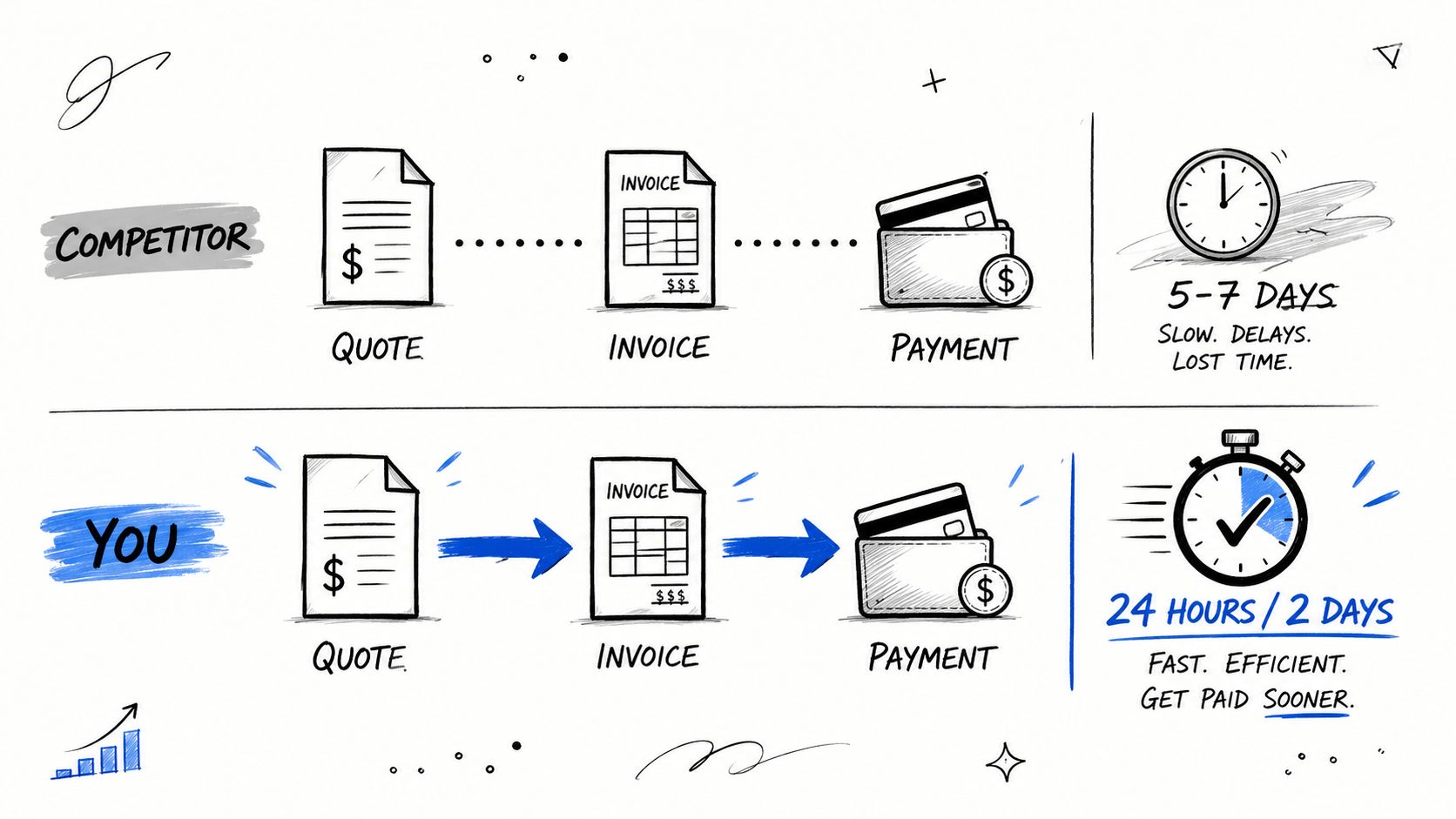
A slow admin path often hides behind a polished website. This competitor analysis example measures how long rivals take to move from first enquiry to quote, approval, invoice, and payment prompt. In local services, that timeline often matters more than a small pricing difference.
A good benchmark starts with mystery shopping. Ask for a quote from relevant competitors, record how long they take to respond, note whether approval is digital or manual, and track how clearly they explain next steps. Then compare that with your own path.
Here's the workflow contrast to study:
A real benchmark from UK service operations
A UK-based consultancy reviewing eight direct service business platforms found that using fragmented tools across four or more systems created an average of 3.7 hours of weekly rework and a 19% drop in quote approval rates, while consolidation to a single-platform model produced a 34% increase in quote-to-invoice conversion, reduced payment reconciliation delays by 62%, improved cash flow velocity by 11 days, and led 87% of providers to report higher customer trust. The direct insight isn't just that software matters. It's that speed and trust are linked.
If you run an electrical firm, a customer doesn't experience your internal systems as “software architecture”. They experience them as waiting, uncertainty, and extra emails. Faster quote approval and cleaner invoicing become visible service quality.
How to reproduce it
Document each stage in a simple timeline. Include who sends what, how approval happens, where payment options appear, and how many channels the customer has to use.
- Measure the hand-offs: Count every switch between phone, email, PDF, portal, and payment page.
- Track visible delays: Record whether the pause comes before the quote, after approval, or at invoicing.
- Compare your own bottlenecks: If your team retypes details from notes into invoices, that delay is part of your competitive position.
- Map the commercial impact: Review your sales cycle stages and shorten the slowest points.
Fast quoting only helps if invoicing and payment collection keep pace.
Manage this in one place with AetherCloud, where quotes, approvals, invoices, and payments sit in one connected workflow.
3. The Local Service Market Positioning Case Study
Most businesses don't lose work to a national giant. They lose it to a handful of nearby operators who appear in the same search results, the same Facebook groups, and the same local recommendations. A stronger competitor analysis example focuses on those actual alternatives.
A local case study should examine how competitors present themselves, how quickly they respond, what customers praise, and where people encounter friction. For a cleaner, that might mean checking whether booking is clear and whether availability is obvious. For a consultant, it might mean whether the proposal process feels professional and whether payment terms are easy to understand.
Look at the rivals customers actually compare
One gap in mainstream guidance is that it rarely shows sole traders and micro-businesses how to analyse operational weaknesses ethically. Generic guides often stop at pricing spreadsheets and service lists, while UK-focused commentary has noted the need to visit competitor websites as if you were a customer and identify task friction, especially where quote lag and manual reconciliation affect conversion in service sectors as discussed in this UK business planning article.
That matters because local customers often compare “who feels easiest to hire” rather than “who has the best strategic messaging”. A Manchester plumber who promises online booking and clear follow-up may beat a larger rival that still makes customers call, wait, and chase.
How to reproduce it
Build a local file on each competitor with four evidence sources. Use public reviews, website checks, social activity, and direct response testing. Keep the review window recent enough to reflect current operations.
- Review customer language: Note complaints about missed calls, slow replies, booking confusion, or payment hassle.
- Test discoverability: Check how easy it is to find services, contact details, service area, and next steps.
- Assess professionalism signals: Look for branded quote pages, business email domains, and coherent customer journeys.
- Use your own data better: Business analytics can turn scattered observations into clearer decisions.
AetherCloud helps here because its digital business cards, public customer pages, and analytics make your local presentation easier to benchmark and easier to improve. Try AetherCloud to streamline your workflow once you've identified the weakest point in your local journey.
4. The Customer Friction Point Comparison Framework
Some competitors don't lose because of quality. They lose because customers get tired before the job is even booked. This framework compares the amount of effort a customer must spend to move from interest to payment.
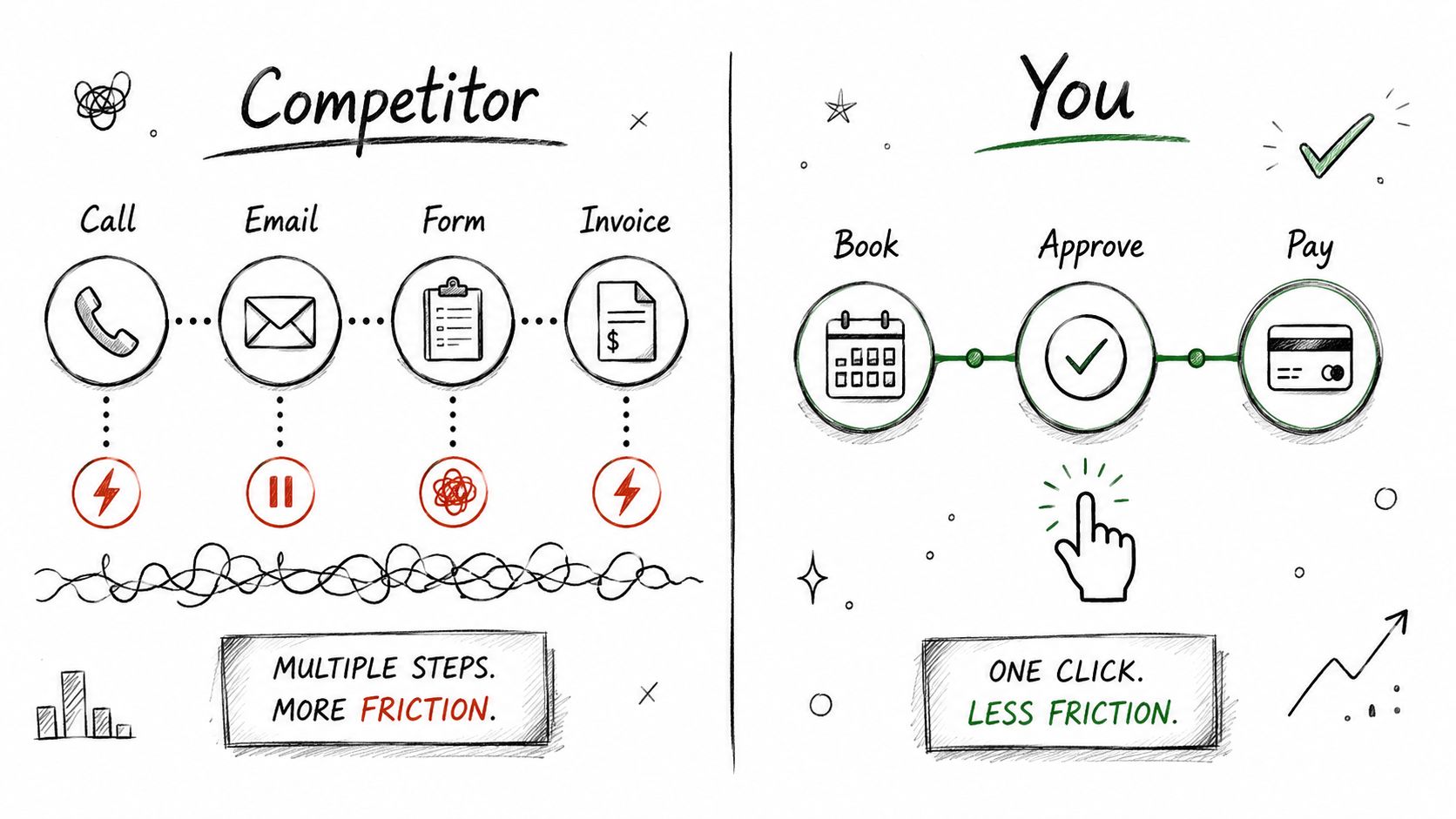
A contractor might require a phone call for the first enquiry, an email exchange for the quote, another email to confirm changes, then a bank transfer after receiving a PDF invoice. A rival with online request forms, public quote approval, and online payment doesn't just look modern. They remove steps, which makes buying easier.
Map the customer effort, not just the offer
Recent UK-focused commentary has pointed to an overlooked issue in competitor analysis: public microsite friction. Guides often discuss social tone and keyword rankings, but they rarely benchmark whether quotes, appointments, and payments happen on dedicated public pages or stay buried inside generic portals. That gap matters because service customers increasingly abandon awkward booking and payment paths, particularly where local businesses rely on speed and simple customer actions as outlined in this UK competitor analysis guide.
That idea is especially relevant for cleaners, beauticians, tutors, and tradespeople. If a customer can't quickly approve, book, or pay, they often move to the next provider.
Customers don't describe this as “workflow friction”. They say, “It was too much hassle.”
How to reproduce it
Mystery shop three or four competitors and map each step from the customer's view. Note every delay, repeated question, and channel switch. Then compare that with your own journey.
- Count customer actions: Measure how many clicks, calls, forms, and emails it takes to get the job moving.
- Find avoidable waiting: Delays between quote, approval, and invoice often reveal internal hand-offs.
- Compare page architecture: Public appointment, quote, and invoice pages usually reduce confusion versus mixed channels.
- Improve messaging after the fix: Customer engagement works better when the underlying journey is smooth.
AetherCloud is useful here because its public microsites for appointments, quotes, invoices, and payments reduce customer effort without requiring a patchwork of tools.
Here's the kind of contrast worth mapping:
5. The Tool Stack Efficiency Comparison Audit
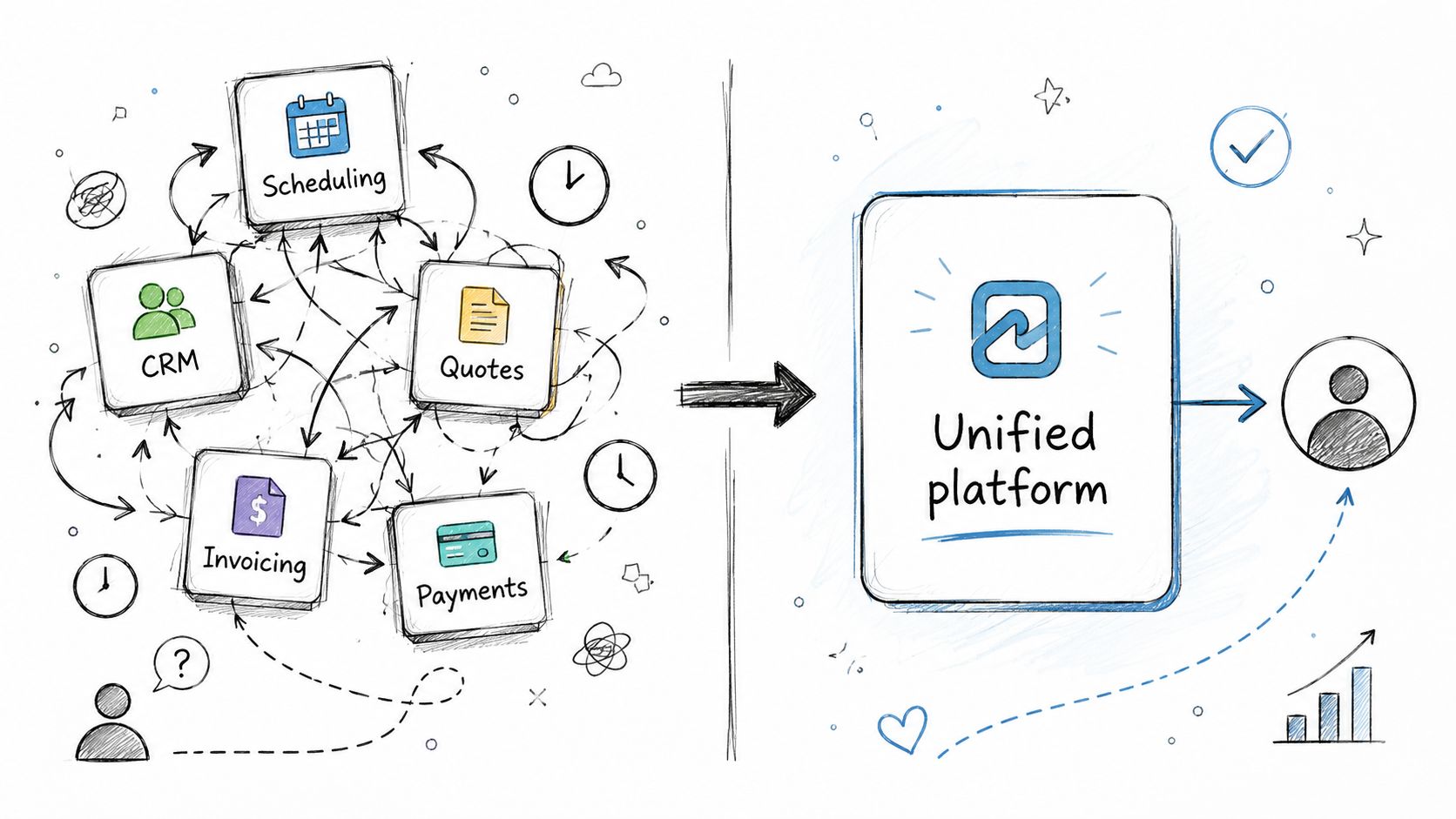
When a competitor looks disorganised, the cause is often hidden in their software stack. This audit uses visible clues to infer whether a business is running one joined-up system or juggling multiple disconnected tools.
Start by looking at what customers can see. Different branding styles across quotes and invoices, separate booking widgets, generic payment instructions, or a mismatch between contact records and appointment confirmations can all suggest fragmentation.
A visual way to frame the audit helps:
What visible software clues tell you
Operational chaos caused by fragmented tools and inconsistent processes has been described as a serious UK business problem, with firms reporting that multiple deviations from standard processes create inefficiencies and bottlenecks that hurt performance in this Business Reporter coverage of operational chaos in UK business. For service firms, that usually shows up as re-entry, missed updates, delayed follow-ups, and reconciliation headaches.
An agency that books in one app, tracks contacts in spreadsheets, writes quotes in Word, invoices elsewhere, and asks for manual bank transfer will usually struggle to appear consistent. Customers notice that even if the business never names the tools.
How to reproduce it
Create an audit sheet with visible categories: scheduling, CRM, quoting, invoicing, payments, and customer-facing pages. Then infer likely tools or at least likely hand-offs from what you can observe.
- Check brand consistency: If booking, quote, invoice, and payment pages all look different, the stack may be stitched together.
- Look for data repetition: Repeated requests for the same customer details often signal poor system integration.
- Watch for manual payment cues: Payment instructions in emails often indicate extra admin later.
- Benchmark your own stack objectively: Compare planner and scheduling approaches before adding another disconnected app.
This short demo shows why consolidation changes the customer experience as well as the admin burden:
AetherCloud's advantage is straightforward. It replaces multiple tools with one UK-focused platform for scheduling, contacts, quotes, invoices, online payments, digital business cards, and analytics.
6. The Customer Lifetime Value Competitive Analysis
A short-term competitor analysis example can miss the real commercial difference between service firms. The stronger business isn't always the one that wins the first job. It's often the one that makes repeat work easiest.
For a cleaning company, retention depends on how simple it is to rebook. For a consultant, it depends on how easy it is for past clients to restart work, approve a new quote, and settle invoices. For a trades business, reminders and follow-up often matter as much as technical skill.
Retention signals are competitive signals
Look for evidence that competitors are built for repeat relationships. Are they posting only to attract new leads, or do they also make existing customer contact easy? Do reviews suggest repeat use? Do they have a professional digital business card or a clean re-engagement path, or does every repeat customer start from scratch?
A unified system changes the economics of a small service firm. If the same platform stores contact history, appointment details, quotes, invoices, and payment status, re-engagement becomes simpler. The customer experiences continuity. The business avoids rework.
Field note: If returning customers have to resend their details every time, the business is leaking future revenue.
How to reproduce it
Review competitors through a retention lens instead of a lead-generation lens. Look for signs of easy repeat booking, clear follow-up, and orderly customer records.
- Read reviews for repeat behaviour: Phrases such as “used again” or “booked them back” indicate retention strength.
- Check re-engagement paths: See whether a returning customer can restart quickly or has to call and explain everything again.
- Assess relationship signals: Seasonal reminders, follow-up messages, and easy contact routes usually support repeat work.
- Fix your own continuity gaps: AetherCloud keeps contacts, appointments, quotes, invoices, and payments connected, which makes repeat business easier to manage.
For UK consultants and local service firms, this isn't just a CRM issue. It's a competitive one. Businesses that feel easier to return to often earn more over time, even without being the cheapest.
7. The Payment and Cash Flow Competitor Benchmark Study
Many competitor reviews ignore the final stage where margin and cash flow are won or lost. This framework compares how rivals invoice, collect payment, handle approval, and remove or create friction after the work is done.
A tradesperson might deliver excellent work, then undermine the experience with a plain document and manual bank details. An agency might send polished proposals but rely on awkward invoice chases later. A cleaner might confirm appointments well but still collect payment in a way that slows everything down.
Cash flow is part of positioning
The strongest insight here is that payment experience isn't just a finance issue. It affects trust, professionalism, and speed. Customers notice whether paying is immediate and clear or whether they need to read instructions, switch apps, and send proof.
There's also a policy layer to remember. In the UK, the Competition and Markets Authority regulates competition and consumer law, including market conditions relevant to business management software. Small service firms should benchmark competitors ethically and compete on service quality, convenience, and process clarity, not on questionable tactics.
How to reproduce it
Request quotes where practical, or inspect publicly visible invoice and payment flows where available. Then record payment methods, clarity of terms, and how much action the customer must take.
- Track payment options: Card links, public payment pages, and clear invoice status usually reduce delay.
- Record payment friction: Manual transfers, unclear references, and separate confirmation emails slow collection.
- Compare your follow-up load: If your team has to reconcile payments manually, that admin cost is part of your competitive position.
- Position around professionalism: AetherCloud links invoices directly to secure online payment pages, reducing friction for both sides.
The clearest commercial advantage often appears after the operational audit is complete. Businesses that quote clearly, invoice promptly, and let customers pay online usually look more organised and protect cash flow better.
7-Example Competitor Analysis Comparison
| Analysis / Template | Implementation Complexity 🔄 | Resource Requirements ⚡ | Expected Outcomes ⭐📊 | Ideal Use Cases 💡 | Key Advantages ⭐ |
|---|---|---|---|---|---|
| The Service Business Competitive Positioning Matrix | 🔄 Medium, two‑axis mapping and qualitative scoring | ⚡ Moderate time for competitor research and interviews | ⭐⭐, clearer market position; identifies gaps (convenience, response time) | 💡 Trades, consultants, agencies wanting local differentiation | ⭐ Reveals operational efficiency as a competitive lever vs price |
| The Quote-to-Invoice Speed Benchmark Analysis | 🔄 Medium–High, timed benchmarking and workflow tracing | ⚡ Moderate effort: request quotes, track approvals/payments | ⭐⭐⭐📊, quantifies speed advantages; measurable cash‑flow gains | 💡 Businesses prioritising conversion speed and payment collection | ⭐ Provides concrete ROI case for integrated quoting/payment systems |
| The Local Service Market Positioning Case Study | 🔄 Low–Medium, focused audit of 3–8 local competitors | ⚡ Low, web audits, review reading, short mystery shops | ⭐⭐📊, actionable local messaging; discoverability improvements | 💡 Small local businesses seeking immediate local wins | ⭐ Highly relevant local insights to guide operations & marketing |
| The Customer Friction Point Comparison Framework | 🔄 Medium, journey mapping and mystery shopping | ⚡ Moderate, process mapping, customer interviews | ⭐⭐⭐📊, exposes friction to remove; boosts satisfaction & retention | 💡 Businesses focused on customer experience and repeat bookings | ⭐ Eliminates multi‑channel friction; wins on convenience not price |
| The Tool Stack Efficiency Comparison Audit | 🔄 Medium–High, technical audit of visible integrations | ⚡ Moderate–High, tool detection, time‑cost estimation, analysis | ⭐⭐⭐📊, reveals hidden time/costs; projects efficiency gains from consolidation | 💡 Firms with fragmented software or manual processes | ⭐ Shows measurable ROI for consolidating to a unified platform |
| The Customer Lifetime Value Competitive Analysis | 🔄 High, requires retention estimation and long‑term metrics | ⚡ High, data analysis, surveys, CRM review | ⭐⭐⭐📊, increases profitability via retention, upsell and referrals | 💡 Businesses aiming for sustainable growth and repeat revenue | ⭐ Shifts focus from one‑off sales to lifetime profitability |
| The Payment and Cash Flow Competitor Benchmark Study | 🔄 Medium, payment method and collection benchmarking | ⚡ Moderate, test invoices/payments, cash‑flow modelling | ⭐⭐⭐📊, faster collections, improved cash flow, lower working capital | 💡 Cash‑sensitive trades and small agencies | ⭐ Direct financial impact; justifies online payments and deposits |
Putting Competitor Insights into Action
These seven frameworks work best when you treat competitor analysis as a repeatable operating discipline. A one-off spreadsheet won't do much. A working benchmark, updated regularly and tied to actual process changes, can reshape how your business competes locally.
The pattern across all seven examples is consistent. Customers rarely see your internal admin setup, but they feel its effects immediately. They feel it when a quote arrives late, when an appointment takes too long to confirm, when a payment page is missing, or when they have to repeat information across multiple channels. That's why a strong competitor analysis example for UK service businesses has to go beyond pricing and promotion.
The practical move is to choose one template first, not all seven at once. If you lose work before approval, start with the quote-to-invoice benchmark. If customers complain about hassle, run the friction-point comparison. If your admin feels messy internally, begin with the tool stack audit. Each framework gives you a narrower lens, which makes action easier.
From there, turn the findings into operational changes customers can notice. Improve response time. Reduce channel switching. Standardise quote approval. Add online payment. Give staff professional digital business cards. Connect your contacts, appointments, quotes, and invoices so repeat customers don't have to start over every time.
That's where AetherCloud becomes more than software. It becomes the execution layer for your competitor analysis. Instead of spotting weaknesses in rival businesses and then trying to patch your own processes with separate apps, you can manage booking, CRM, quoting, invoicing, payments, digital business cards, and analytics in one place. That simplifies day-to-day work and makes your improvements visible to customers faster.
For UK trades, cleaners, consultants, freelancers, and agencies, that combination matters. Better analysis tells you where the gap is. Better systems let you close it quickly. Use these templates to benchmark local rivals, then act on what you learn with a platform built for service operations in the UK.
If you want to turn competitor insights into faster quoting, smoother booking, cleaner invoicing, and easier online payments, try AetherCloud. It gives UK service businesses one simple system for scheduling, CRM, quotes, invoices, payments, digital business cards, and analytics, so you can compete on professionalism and convenience without juggling multiple tools.