
You finish a job, send the invoice, and get a polite “thanks”. Then you're left guessing. Was the client very pleased, mildly disappointed, or already comparing you with someone else for the next job?
That guesswork is expensive. UK service businesses don't usually lose ground because they lack effort. They lose it because they don't have a simple, repeatable way to hear what customers experienced, at the moment it still matters. That's where customer feedback surveys stop being a “marketing extra” and start becoming part of how a business runs day to day.
Table of Contents
- Why Customer Feedback is a Superpower for UK Service Businesses
- Designing a Survey People Will Actually Complete
- Choosing the Perfect Moment to Ask for Feedback
- Automating Your Surveys with AetherCloud
- Turning Feedback into Actionable Insights
- Closing the Feedback Loop to Build Customer Loyalty
Why Customer Feedback is a Superpower for UK Service Businesses
A plumber, electrician, designer, consultant, or freelance accountant often hears the same thing at the end of a job: “All looks good.” That sounds reassuring, but it doesn't tell you much. Clients often stay polite in the moment and save their honest opinion for a review, a recommendation to a friend, or silence when you quote for the next piece of work.

For small businesses, that gap between what you think happened and what the customer felt is where referrals, repeat work, and reputation are won or lost. This isn't theory. For UK SMEs, collecting customer feedback increased referrals for 60% of businesses, and 32% changed their overall business strategy as a result of feedback, according to the Barclays feedback economy report.
Why smaller service businesses gain more
Those numbers matter because a local service business feels customer opinion more sharply than a large company does. One strong recommendation can bring in a valuable job. One poor experience can erode word of mouth in a local area or niche.
The same Barclays research also found that UK SMEs get more value from feedback than larger businesses in areas like referrals and innovation. That fits what happens in practice. A sole trader or small team can act on feedback quickly. They can tighten communication, adjust quoting, improve punctuality, or tidy up invoicing without waiting for a committee meeting.
Practical rule: If customers keep telling you the same thing, it's not a one-off comment. It's an operating issue.
Feedback also helps you make better commercial decisions. If you want a broader view of how service businesses sharpen their market position, AetherCloud's guide to a go-to-market strategy for small businesses is a useful companion read.
Why guessing creates costly blind spots
Most service owners already care what customers think. The problem isn't intent. The problem is relying on memory, instinct, and the odd casual message.
That approach misses patterns. You might think customers choose you on price, while their comments show they value speed and clarity more. You might assume your quotes are fine, while customers feel they're too vague. You might believe your service is smooth, while people are getting frustrated by the handover between job completion and payment.
Customer feedback surveys turn all of that into something you can see and act on. They give you a way to spot what's working, catch friction before it turns into a public complaint, and improve the parts of the service that directly affect cash flow and referrals.
Designing a Survey People Will Actually Complete
Most customer feedback surveys fail before the first answer arrives. They ask too much, take too long, and read like a form someone built for internal curiosity rather than customer convenience.
The fix is simple. Keep it short. UK guidance recommends 3 to 5 questions total, using one rating question, one or two open-ended questions, and a Customer Effort Score question, with CES often producing more honest answers from British consumers, according to ProfileTree's survey best practice guidance.
Keep it short or lose the response
A short survey respects the customer's time and gives you cleaner data. Long surveys attract two bad outcomes. Either people ignore them, or they rush through and give low-quality answers that don't help you.
A good structure for most UK service businesses looks like this:
- Start with one rating question: Ask for an overall view of the specific interaction, not the entire relationship.
- Add one open question: Give customers room to explain the score in their own words.
- Use a CES question: Ask how easy the process felt, especially after a booking, job, or payment.
- Finish with one targeted follow-up: Use this only if you need to improve a specific step such as quoting or communication.
Short surveys don't feel like admin. They feel like a quick chance to be heard.
The key is specificity. Don't ask “How do you feel about our business?” Ask about the job, the quote, the visit, or the invoice. Customers answer better when they know exactly what they're judging.
What to ask at each stage
Different touchpoints need different questions. A survey after a lost quote should not look the same as one after a paid invoice.
| Touchpoint | Recommended Question |
|---|---|
| Post-quote | How clear and helpful was the quote you received? |
| Post-quote | If you didn't go ahead, what was the main reason? |
| Post-appointment | How satisfied were you with the service delivered today? |
| Post-appointment | What could we have done better during the visit? |
| Post-appointment | How easy was it to book and complete this service with us? |
| Post-invoice | How easy was it to understand and pay your invoice? |
| Post-invoice | Did any part of the process feel unclear or frustrating? |
| Ongoing clients | What's one thing we should keep doing, and one thing we should improve? |
That mix gives you both signal and detail. The rating tells you where to look. The open response tells you why. The effort question shows whether your process feels smooth or clunky from the customer's side.
Avoid two common mistakes:
- Don't stack multiple ideas into one question. “Was the job quick, professional, and good value?” creates messy answers because the customer may agree with one part and disagree with another.
- Don't ask questions you won't act on. If you're not prepared to change something based on the answer, leave it out.
The best customer feedback surveys feel almost modest. They ask a few sharp questions, at the right moment, about something the customer can clearly remember.
Choosing the Perfect Moment to Ask for Feedback
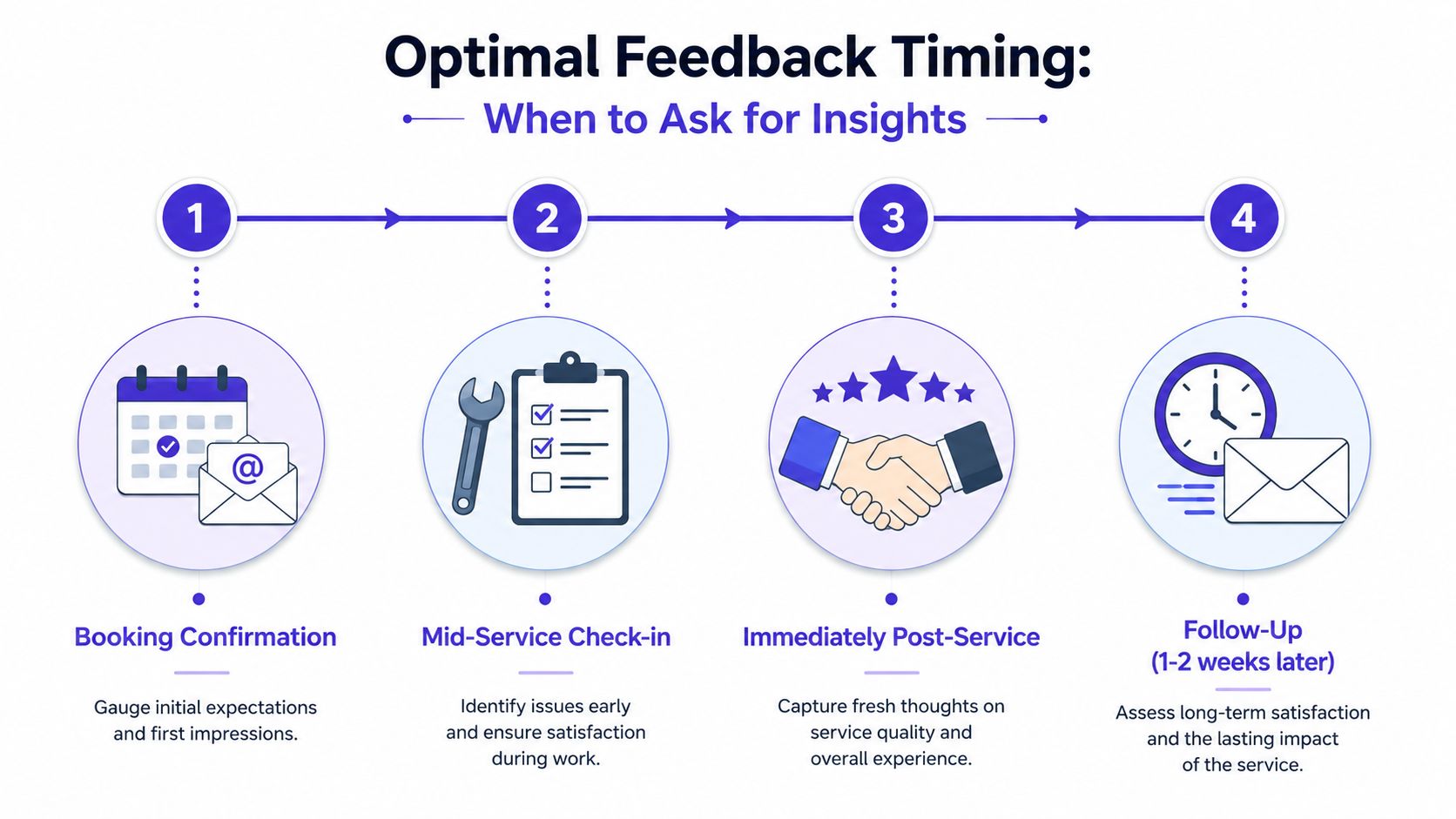
Timing matters as much as wording. Send a survey too late and the details are fuzzy. Send it at the wrong stage and you collect answers about the wrong issue. Send something too long and customers put it off or bin it.
For UK businesses, survey completion rates drop sharply when surveys take longer than 1 to 2 minutes, and the most effective methods are short post-interaction surveys sent by email, SMS, or inside mobile apps, according to HGS guidance on customer satisfaction survey best practice.
Match the survey to the touchpoint
A service business usually has several natural feedback moments, and each one tells you something different.
- After sending a quote: Here, you learn why jobs are won or lost. If the quote was clear but too slow, that's different from being too expensive or too vague.
- Immediately after the job or appointment: This moment is ideal for assessing service quality. The customer still remembers punctuality, tidiness, communication, and whether the work matched expectations.
- After payment: This stage provides insight into the full end-to-end experience. A job can be excellent and still leave a poor final impression if the invoice is confusing or awkward to pay.
That sequence mirrors the way a service business operates. It also lines up neatly with the broader cycle of sales in a service business, where quoting, delivery, invoicing, and payment all shape the customer experience.
Use the channels customers already respond to
The best survey channel is usually the one attached to an action the customer is already taking. That's why feedback links inside routine messages work better than separate, forgettable requests.
Use these placements:
- Email confirmations: Good for quotes, completed work, and invoice receipts.
- SMS follow-ups: Useful when the interaction happened on-site and you want a quick response while the visit is fresh.
- QR codes: Handy for physical premises, printed paperwork, or handover packs.
- Customer-facing pages: If the customer is already viewing a quote or paying an invoice online, that's an ideal point to ask one simple question.
A tradesperson visiting homes has an extra timing challenge. The customer may be happiest when the problem is solved, but less enthusiastic when the invoice arrives later. A consultant may get positive feedback after a meeting, then lose goodwill if follow-up is slow. That's why a single “post-transaction” survey isn't enough. You need feedback at meaningful service touchpoints, not just after the fact.
Ask when the experience is still fresh, not when you finally remember to send the form.
The strongest survey habit is operational, not promotional. It sits inside the normal flow of your business, exactly where the customer already expects to hear from you.
Automating Your Surveys with AetherCloud
Most small businesses don't ignore feedback because they don't care. They ignore it because manual follow-ups are easy to forget. You finish the job, jump to the next booking, chase a payment, and by the time you remember to ask, the window has passed.
That's why automation matters. If your survey process depends on memory, it won't last.
Build feedback into the workflow you already use
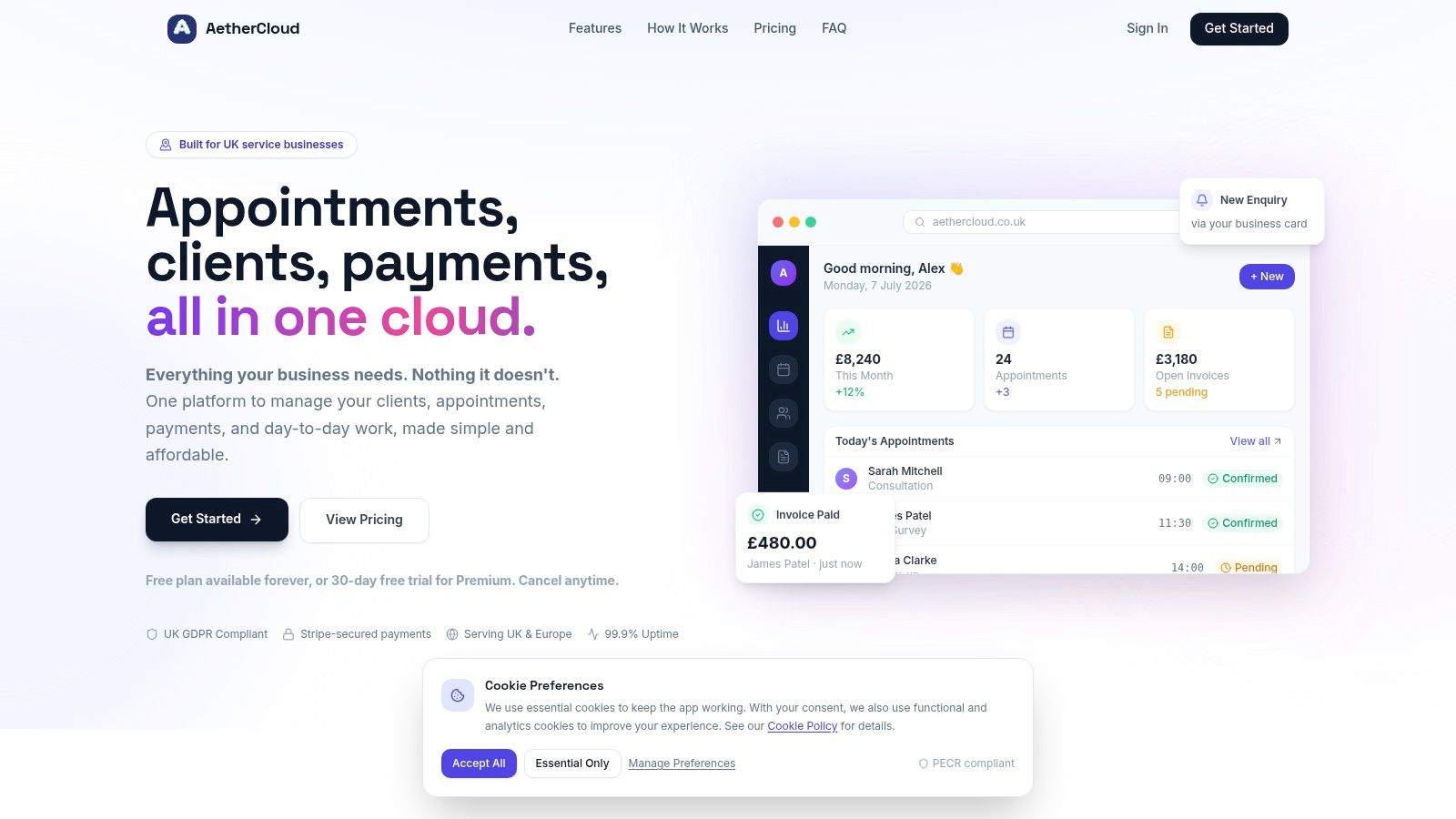
AetherCloud is built for UK service businesses that already need to manage appointments, contacts, quotes, invoices, payments, and basic reporting in one place. That makes it a practical home for feedback triggers because the customer interactions are already happening there.
A simple approach is to add a standing feedback link to the messages you send most often. For example:
- Quote emails: Add a short “Was this quote clear?” link for customers who don't proceed.
- Invoice emails: Include a quick feedback option after payment confirmation.
- Appointment follow-ups: Send a one-minute survey after the visit while the service is still fresh.
You can also use AetherCloud's public customer pages as natural trigger points. When a customer approves a quote or pays an invoice online, you already have their attention. That's often a better moment than sending a separate request days later.
A simple setup that doesn't rely on memory
The practical version doesn't need to be complicated. Use a short form built in a survey tool you already trust, then place that link consistently inside your AetherCloud workflow.
A straightforward setup looks like this:
- Create one short survey for each key event: one for quotes, one for completed work, one for invoices.
- Use plain labels: “Rate your quote”, “Tell us about today's visit”, or “How easy was payment?”
- Place links in templates: build them into the email and customer touchpoints you send every week.
- Review answers on a regular schedule: not constantly, but often enough to spot problems early.
If you're trying to remove more admin from the business, AetherCloud's article on time and motion templates for small teams is useful because the same principle applies here. Repeated tasks should live in a system, not in your head.
Customer feedback surveys become sustainable when you stop creating them as separate projects. You're attaching a small listening habit to the documents and actions that already run the business.
Turning Feedback into Actionable Insights
Collecting answers is the easy part. The value comes from interpreting them without overcomplicating the process.
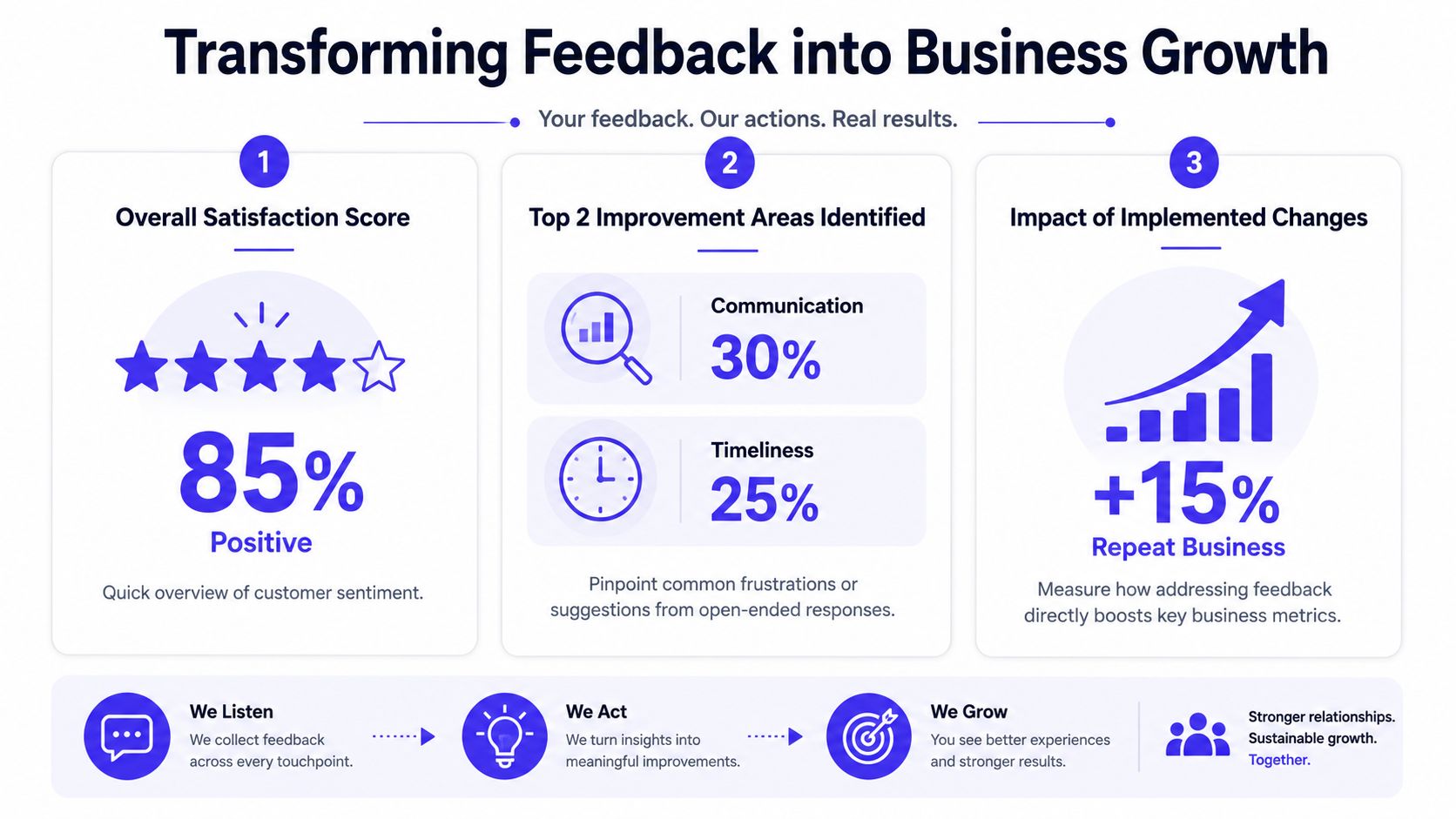
Start with one simple score, then read the comments for patterns. That combination gives most service businesses enough insight to improve without drowning in dashboards.
Start with a simple score
A useful place to begin is CSAT, or Customer Satisfaction Score. The calculation is straightforward. Divide the number of satisfied responses, usually ratings of 4 or 5, by the total number of responses and multiply by 100. For example, 80 satisfied responses out of 100 gives a CSAT score of 80%, as explained in Xero's guide to client satisfaction metrics.
That score helps you track direction over time. If it slips after you changed your booking process, your comments will usually tell you why. If it improves after making invoice wording clearer, you know the change worked.
But don't stop at the number. A score tells you there's smoke. Comments tell you where the fire is.
Turn comments into decisions
The best way to use open text is to sort it into a few plain-English categories. Don't make this academic. A notebook, spreadsheet, or simple tagging system is enough.
Try categories like these:
- Communication: Did customers understand what was happening and when?
- Punctuality: Were you on time, or did expectations get managed well if plans changed?
- Clarity of quote: Did people understand what was included?
- Ease of payment: Was the invoice straightforward and simple to settle?
- Quality of work: Did the end result meet expectations?
After that, look for repetition. If several customers praise how clearly you explain work, that's a strength worth using in your sales copy. If several mention delays, unclear arrival windows, or messy follow-up, that's an operational problem, not a branding problem.
A useful comment category is one that leads to a decision. If it doesn't change what you do, it's too vague.
There's also a risk in relying only on private survey data. Public reviews can tell a different story from direct survey responses. That gap is worth watching because private feedback often comes from your most engaged customers, while unhappy customers may head straight to a public platform. For a broader view of business reporting and trend spotting, AetherCloud's piece on business analytics for small service companies is worth reading alongside your survey work.
A practical review routine looks like this:
| What to review | What to look for |
|---|---|
| Ratings | Any drop or rise that coincides with a process change |
| Open comments | Repeated words, complaints, or praise |
| Touchpoint | Whether problems happen at quote, delivery, or payment stage |
| Urgency | Issues that need a direct follow-up with a customer |
| Opportunity | Positive remarks that could become testimonials or sales messaging |
Good analysis doesn't mean more complexity. It means taking a pile of customer comments and turning it into one or two clear changes the business can make this month.
Closing the Feedback Loop to Build Customer Loyalty
A survey on its own doesn't build trust. The response to the survey does.
For UK service businesses, expert methodology recommends closed-loop feedback systems where alerts fire immediately after key touchpoints such as invoice payment, and failing to act on feedback is a primary reason feedback programmes fail, according to Qualtrics guidance on B2B customer feedback.
Respond quickly when something went wrong
Negative feedback is often more valuable than praise because it gives you a chance to recover the relationship before the customer writes you off.
A good response is simple:
- Acknowledge the issue clearly: Don't argue with the customer's account in your first reply.
- Own the next step: Tell them what you'll check, fix, refund, clarify, or redo.
- Move quickly: The longer you leave it, the more likely the frustration spreads into a public complaint or quiet churn.
For example, if a client says the invoice was confusing, don't send a defensive paragraph explaining your billing logic. Reply with something practical: thank them, apologise for the confusion, explain the charge clearly, and confirm what you'll change going forward.
If the complaint is about service delivery, call when appropriate. Some issues are resolved faster in a calm two-minute conversation than in a long email thread.
Customers don't expect perfection. They do expect evidence that someone listened.
Use positive feedback properly
Positive responses deserve more than a thumbs-up reply. They create an opening.
When someone sends strong praise, you can:
- Thank them properly: make the reply personal and specific.
- Ask for a public review: if they're pleased, this is the easiest moment to request one.
- Save strong wording: keep a record of phrases customers use naturally. That language is often better than whatever marketing copy you would have written yourself.
There's also a loyalty effect here. A customer who sees you respond thoughtfully to feedback is more likely to trust you with future work. They can see your standards in action, not just in your brochure or website.
For more ideas on maintaining that dialogue after the work is done, AetherCloud's guide to customer engagement strategies for service businesses complements a closed-loop approach well.
The important point is simple. Customer feedback surveys start the conversation. The follow-up proves whether you meant it.
If you want to stop chasing feedback across separate tools, AetherCloud makes it easier to run your service business in one place, from scheduling and CRM to quotes, invoices, payments, and analytics. That means you can build feedback into the daily workflow instead of treating it as an extra admin job. See how AetherCloud simplifies this process and try it to streamline your workflow.