
You've probably had one of those weeks where a customer has approved a quote, the job's done, and the money still isn't in the bank. The invoice lives in one tool, the diary lives in another, the payment link was sent from somewhere else, and you're left checking the bank app, the spreadsheet, and the inbox to work out what's been paid. For a lot of UK service businesses, that admin pile-up is the cost of getting paid.
The fix isn't just a faster card checkout. It's a way to connect the whole quote-to-cash process so the customer journey, the invoice, the payment, and the records all stay in step. That's what an integrated payment system does, and for trades, agencies, consultants, and freelancers, it can mean far less chasing, cleaner records, and a more professional experience from first quote to final receipt. If you want a useful primer on the scheduling side of that workflow, AetherCloud's guide to time in motion templates is worth a look.
Table of Contents
- The Real Problem with How UK Service Businesses Get Paid
- What an Integrated Payment System Is
- How Payments Connect to Scheduling, Quoting and Invoicing
- UK Security and Compliance Considerations That Actually Matter
- From Fragmented Tools to One Unified Workflow
- Pricing, UX and Selection Criteria for the Right Platform
- Implementation Checklist and Next Steps
The Real Problem with How UK Service Businesses Get Paid
A plumber finishes a boiler repair on a Thursday afternoon, takes a note of the job in one app, sends a quote from another, then types the invoice into a third system later that evening. A small design agency has the same issue in a different outfit, the project is booked in the diary, the proposal is approved by email, and the payment reminder comes from a separate invoicing tool. By Friday, both businesses have done the work, but neither feels fully on top of the money.
The pain is rarely dramatic. It's the repeated little things, retyping invoice numbers, copying client details, checking whether a quote was approved, and matching bank transfers to invoices by hand. Each step feels manageable on its own, but by the end of the week the admin has spread across too many places to trust at a glance.
What the owner actually sees
A sole trader usually notices the problem when a customer says, “I've already paid,” and there's no easy way to confirm it. A small agency sees it when a colleague updates the project board, but the invoice status still says unpaid. The business is busy, but the records lag behind the work.
That's why the move to a connected sales workflow matters. When scheduling, quoting, invoicing, and payment live in separate tools, every handoff creates a chance for delay or mistake. When they're stitched together, the job, the customer record, and the money all point to the same place.
Practical rule: if you need to open three tabs to answer one payment question, your process is already costing you time.
The wider shift behind this is bigger than any one business. Cashless payments are growing quickly, and payment infrastructure is being treated more like a core utility than a side feature. PwC's global payments research projects cashless transaction volumes to rise by more than 80% from 2020 to 2025, from about 1 trillion to almost 1.9 trillion transactions, which shows why businesses are being pushed towards tighter payment workflows. For UK service firms, the answer isn't just “take cards”, it's “make the whole process fit together”.
By the end of this article, you'll know what an integrated payment system is, why it matters for UK service businesses, and what to look for before you change tools.
What an Integrated Payment System Is
A workshop counter with a till, a chip-and-pin terminal, and a job sheet all feeding one record is easier to run than three separate bits of kit. If the sale goes through, the receipt matches the job, the customer record updates, and accounts can see the transaction without someone retyping it later. An integrated payment system does that same job in software.
In plain English, payment collection is built into the business system you already use, rather than sitting off to the side as a separate tool. The payment page, invoice, customer record, and reporting all connect, so when a customer pays, the rest of the record updates around it. That is different from a standalone card reader or a loose payment gateway, where you still have to stitch the payment back to the job by hand.
The parts that usually sit together
For a UK service business, the useful building blocks are pretty familiar.
- Scheduling keeps the appointment or job booking attached to the customer record.
- CRM or contact management stores the client details you keep using.
- Quoting lets you send a price for approval before the work starts.
- Invoicing turns the approved work into a proper bill, ready for VAT-ready invoicing where needed.
- Online payment pages let the customer pay without extra back-and-forth.
- Analytics show what has been billed, paid, and is still open.
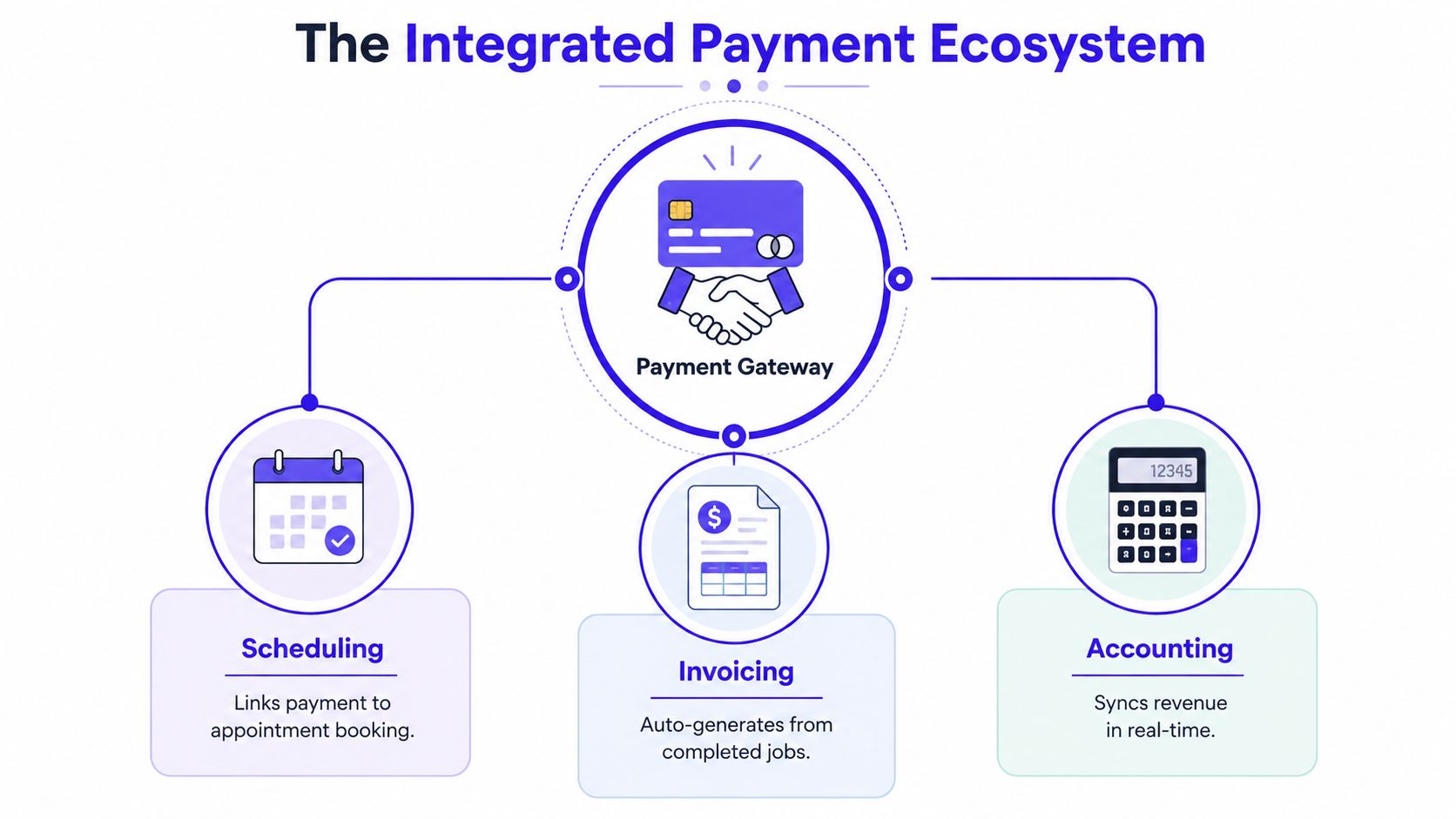
The shared data layer is the part that stops the same details being entered again and again. Nobody should need to type the customer name, address, job note, and invoice total into three different places. That matters as much as the payment method itself. A modular setup also fits the way modern payment systems are designed, with a quick payment action up front and slower reconciliation happening in the background through webhooks or settlement files, so the customer gets a prompt confirmation while the records stay aligned.
For UK businesses, the system has to work in GBP, support VAT-ready invoicing, and keep customer data aligned with UK GDPR and the Data Protection Act 2018. If a colleague can explain the system in one sentence, they have probably understood it properly. For a practical overview of how the payment side fits together, see AetherCloud's own overview. A cleaning firm comparing software may also find Estimatty's recommendations for cleaners useful when weighing up how quoting, invoicing, and payments sit together.
How Payments Connect to Scheduling, Quoting and Invoicing
A proper integrated workflow starts before the invoice ever exists. A customer enquiry comes in, the job gets booked, the quote is sent, and once that quote is accepted, the rest of the chain should already be waiting. That is the difference between a payment tool and an operating process.
Take a plumber. A homeowner books a boiler repair for Tuesday morning, the job is added to the schedule, and the approved quote turns into an invoice without retyping the same details. Once the work is done, the invoice carries a secure payment link, and when the customer pays, the job and the account record update together. The office does not need to chase the bank statement to work out what happened.
A design agency follows the same logic, even if the work looks different. A brand project is scoped, the quote is approved online, the deposit or final invoice is issued from the same customer record, and the payment status updates as soon as the money lands. The workflow is the same, only the service changes.
Payments are fastest when they are the last step in a clean workflow, not a separate task bolted on afterwards.
The reason this saves time is simple. The payment does not have to be matched by hand. The invoice, customer, and transaction are already linked, so reconciliation becomes a background task rather than a Friday afternoon headache. That is the practical benefit of integration, less copying, fewer errors, and a clearer picture of what has been paid.
For readers who want to compare how service software handles that job-to-payment flow in another niche, Estimatty's recommendations for cleaners shows how this logic applies beyond trades and agencies. The underlying idea is the same, quote, approve, invoice, pay, then record.
The same connected flow also fits the wider quote-to-cash journey, where approval, invoicing, and payment need to move together instead of sitting in separate systems.
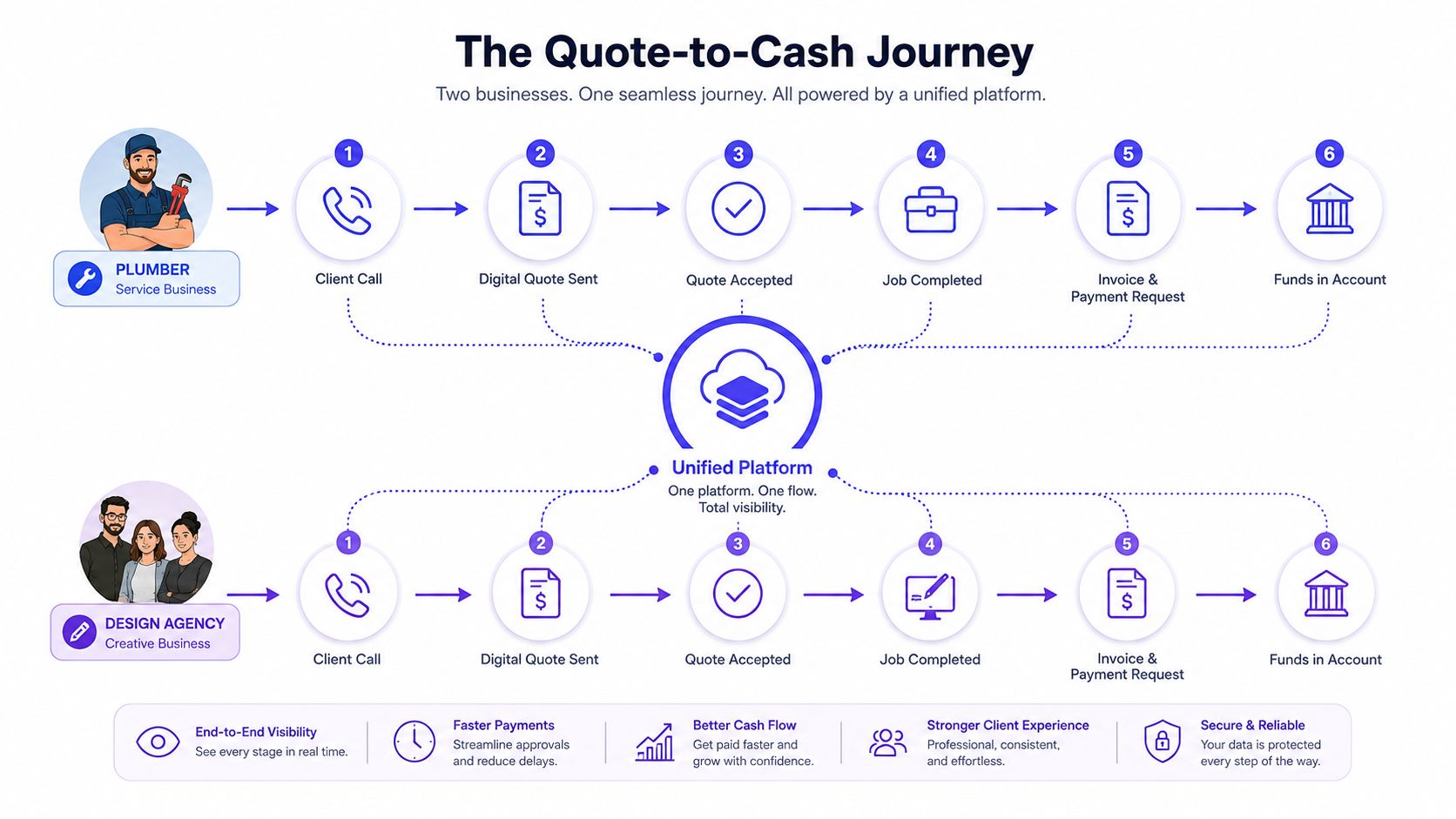
When a service business gets this right, the handoff from quote to invoice feels straightforward. The job is booked, the price is agreed, the invoice is ready, and payment follows without a pile of manual checks. This alignment between approval and payment is what turns a quote into cash without manual follow-up.
UK Security and Compliance Considerations That Actually Matter
A lot of owners hear PCI DSS, PSD2, SCA, and GDPR and assume compliance is only for big firms with legal teams. It isn't. If you take card payments or issue invoices in the UK, the way your system handles data and authentication matters every time money changes hands.
What to care about in practice
PCI DSS is mainly about making sure card data is handled by the payment provider, not stored loosely on your own systems. That's why an integrated setup is safer when it keeps the sensitive payment step inside the provider's environment instead of asking you to manage card details yourself. In other words, you want the platform to reduce what your team ever touches.
Strong Customer Authentication under PSD2 and Open Banking affects everyday card payments too. In practical terms, some customer payments will need a step-up challenge, often through 3-D Secure 2, and your payment flow needs to cope with that without duplicating charges or losing the session. If a customer has to verify a payment, the system should come back cleanly and update the invoice only after the confirmation is real.
UK GDPR and the Data Protection Act 2018 matter because invoices, names, addresses, and payment records are customer data, not just admin clutter. That data should sit in a system that understands UK business rules and keeps the records in one place rather than scattering them across exports and screenshots.
For card acceptance choices, a useful contextual roundup is Baslon Digital's guide to top payment gateways for UK shops. Even though it's written for retail, it helps show how payment providers differ in practice.
HMRC also makes clear that a VAT invoice isn't casual paperwork. It must include a unique sequential number, the time of supply, the invoice date, supplier and customer names and addresses, a description of the goods or services, the quantity or extent of the services, and the net value, VAT, and gross value of the supply. HMRC says a VAT-registered business must issue a VAT invoice to customers and keep a copy in its records, and its guidance on VAT invoicing says the invoice is normally due within 30 days of the supply date when one is required. See the official guidance on VAT invoice records and what invoices must include.
Practical rule: if the platform can't produce a compliant invoice and keep the payment trail tied to it, it's not just inconvenient, it's risky.
The right setup doesn't turn a small business into a compliance specialist. It just stops the payment process from creating avoidable problems in the first place.
From Fragmented Tools to One Unified Workflow
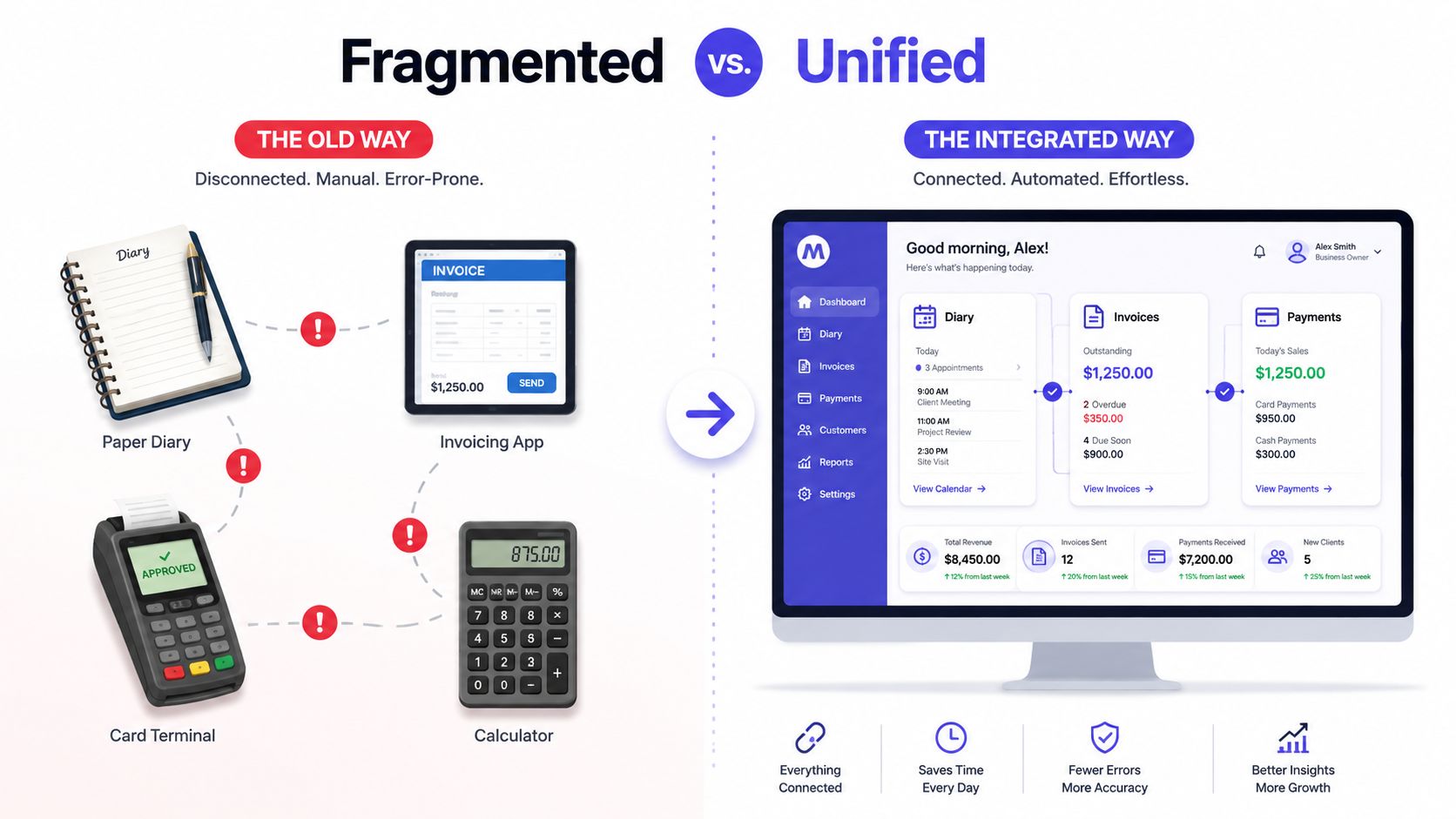
A job can start with a quote, move through approval, then end with payment and VAT records. If those steps sit in different tools, the handover points become weak spots. One app holds the diary, another sends invoices, a card reader takes the payment, and a spreadsheet tries to keep pace. A spreadsheet template for tracking customer records and payment status can help for a while, but it still depends on someone remembering to update it.
That is why fragmented systems feel cheap at the start and expensive later. A missed cell, a duplicate customer record, or the wrong payment link can throw off the whole week. For a UK tradesperson or agency owner, that means more time checking whether a quote was approved, whether the invoice went out, and whether the money has landed in the right place.
A unified setup cuts down that back-and-forth. One customer record sits behind the whole job, so the quote, invoice, payment, and follow-up all point to the same details. The owner does not need to cross-check the bank feed against a spreadsheet, because there is only one live record to follow.
A day in the old way and the new way
In the old way, a consultant finishes a call, updates the diary, exports a quote PDF, sends a payment request from another tool, and later opens accounting software to match the payment manually. In the new way, the same consultant books the meeting, sends the quote, turns approval into an invoice, and sees the payment status change in one place.
That difference affects the full quote-to-cash journey. It changes how quickly the business can see what is overdue, what has been approved, and what still needs chasing. It also helps the business look more organised to customers, because every message, invoice, and payment page comes from the same place, instead of from separate systems stitched together at the last minute.
For a closer look at how system connections help accounting side by side with operations, integrating accounting software in the UK is a useful read from Action Accountants Limited. It shows why reconciliation is easier when the records are aligned from the start.
AetherCloud sits in this camp as an all-in-one system for UK service businesses. It brings together scheduling, CRM, quoting, invoicing, online payments, digital business cards, and analytics, so the business owner is not piecing together a stack of separate tools. That matters because fewer handoffs usually means fewer mistakes, and fewer mistakes means less time spent fixing payment trails after a busy week.
The same logic shows up in the wider payments market too. Analysts at McKinsey report that the global payments industry generated $2.4 trillion in revenue in 2023, handled 3.4 trillion transactions, and processed $1.8 quadrillion in value, with revenue growing 7% annually from 2018 to 2023 and projected to reach $3.1 trillion by 2028. That scale explains why payments keep moving closer to the core business system instead of sitting off to one side as an add-on.
Pricing, UX and Selection Criteria for the Right Platform
A platform choice shows up in the working week, not just on a demo screen. If your team still has to jump between quoting, invoicing, payment links, and spreadsheet notes, the system is making payment work harder than it should. A better fit keeps the full quote-to-cash path in one place, so the business can see what was agreed, what was billed, and what has been paid.
What to compare before you choose
Start with the full cost, not just the card fee. One monthly bill for invoicing, another for scheduling, a separate payment page, and then a processor on top can look manageable until you add the admin time needed to keep them aligned. GBP billing matters too, because it keeps invoices, quotes, and payment records matched to the way UK service firms trade every day.
UX matters just as much. A non-technical owner should be able to send a quote, turn it into an invoice, and take payment without needing a developer or waiting on support. That matters on a busy Monday morning, or when an engineer is sending paperwork from a van between jobs. Mobile-friendly pages help because the job does not always start at a desk.
A practical shortlist usually comes down to this:
- Public quote approval: customers should be able to approve work without long email threads.
- VAT-ready invoicing: the invoice needs the right fields built in, so there is less manual fixing before it goes out.
- Automatic reconciliation: payments should match the correct invoice and customer record.
- Clear dashboards: revenue, paid work, and overdue items should be visible quickly.
- Digital business cards: your team should share one current company profile, not a trail of old contact details.
The late-payment reforms being discussed in the UK make this more important, not less. Government guidance and related enforcement powers are pushing businesses towards clearer invoice records, tighter payment terms, and stronger evidence of who approved what and when. If a customer can only question an invoice inside a fixed window, your system needs to show the quote, the approval, the invoice issue date, and the payment status without guesswork.
For a broader view of how businesses read performance data after the money lands, what business analytics means in practice is a helpful companion piece. Payments become useful operationally only when the numbers sit in context, alongside jobs, customers, and overdue work.
AetherCloud fits these criteria by keeping the payment, quote, invoice, and customer record in one place, with GBP billing and UK-facing workflows built in. That gives a service business one record to work from, which makes day-to-day admin easier without having to stitch together a separate stack just to get paid.
Implementation Checklist and Next Steps
The cleanest switch starts with the boring bits. Audit the tools you use now, list every place you store client details, and note where quotes, invoices, and payment links are being created. If a process depends on someone remembering to copy data across, it's a candidate for consolidation.
A practical first move
- Audit current tools. Write down your diary, invoicing, payment, and spreadsheet steps.
- Import contacts. Bring your client records into one place so the same details are used everywhere.
- Set up VAT-ready invoice templates. Make sure the right fields are built in from the start.
- Enable online payment pages. Let customers pay from the invoice instead of chasing a transfer.
- Test reconciliation. Run one real job end to end and check the payment lands against the right record.
- Brief the team. Make sure everyone knows where quotes, invoices, and payment status now live.
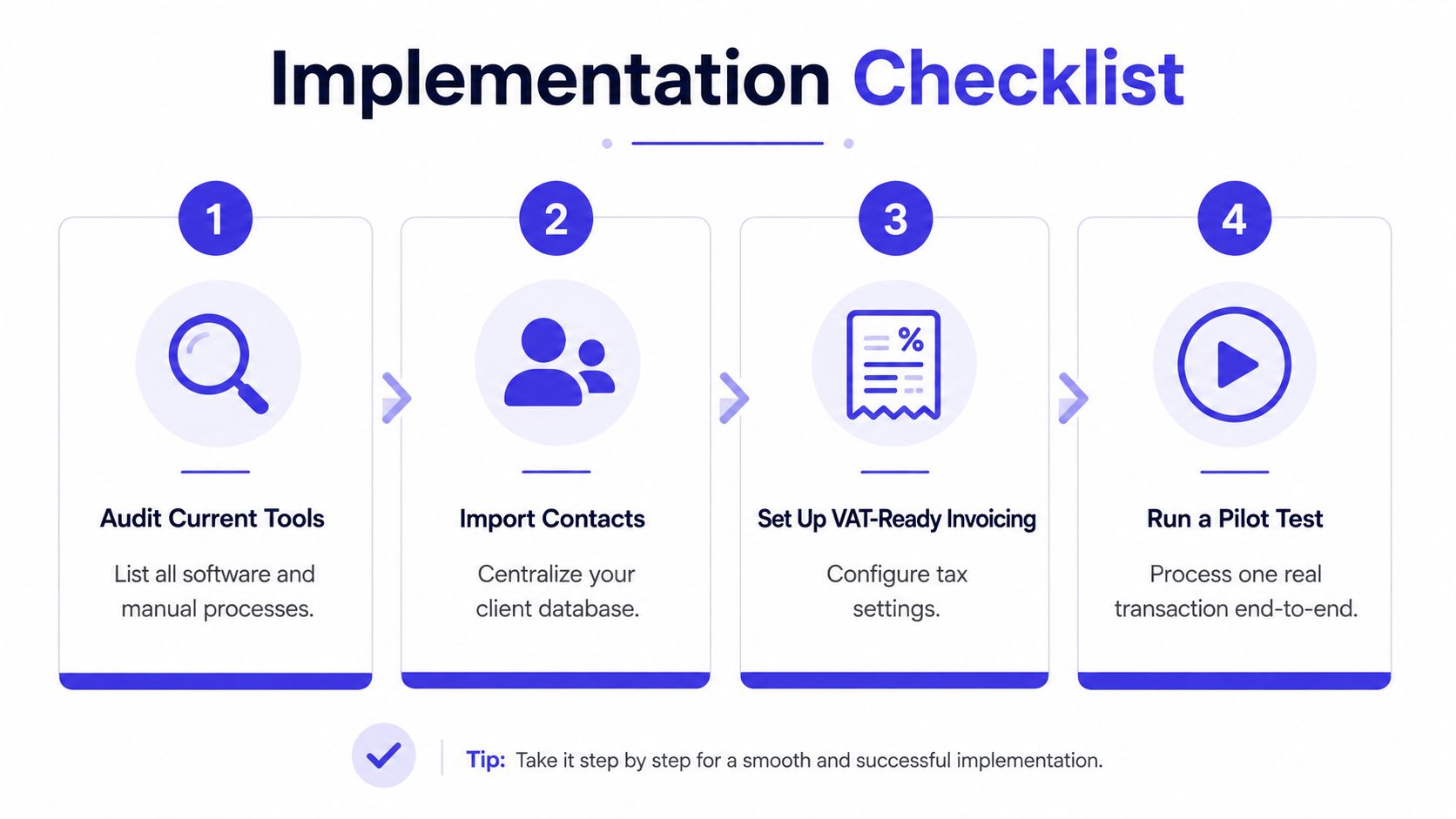
The first 30 days don't need to be fancy. Get one live workflow working from quote to invoice to payment, then tighten the rest around it. Once that's stable, the time saved on chasing, matching, and resending usually becomes obvious very quickly.
If you want to bring quoting, invoicing, scheduling, payments, and customer records into one place, AetherCloud gives UK service businesses a single system to do it. It's built to help you get paid faster, look more professional, and cut down the admin that slows the week down. Visit AetherCloud and see how one platform can simplify the whole quote-to-cash workflow.