
You can finish a job, send the invoice, and still feel the pressure in your chest while you wait for the money to arrive. A customer says they'll pay “later today”, then the reminder turns into a chase, and the chase turns into another week of awkward messages. For many UK tradespeople, consultants, freelancers, and small agencies, the problem isn't just late payment. It's that the payment method makes the whole process harder than it needs to be.
A good online payment method changes that. It shortens the path from completed work to collected cash, reduces back-and-forth, and gives customers a way to pay that feels straightforward and trustworthy. The right setup also helps you look more organised, especially when you're quoting, invoicing, or taking bookings remotely. That matters because online payment is not one channel, it's a family of digital mechanisms that move value without cash handling, including cards, wallets, bank-based methods, and recurring payment tools, as set out in a recent review of digital payments and electronic payment systems digital payment methods review, electronic payment chapter.
Table of Contents
- Why Your Payment Method Choice Matters More Than You Think
- Understanding the Main Online Payment Methods Available in the UK
- Comparing Fees Settlement Times and Risk Across Payment Methods
- UK Regulatory Requirements and Security Considerations
- Integrating Payment Methods into Your Service Business Workflows
- How Unified Platforms Streamline Payment Collection and Reconciliation
- Making Your Decision and Getting Started
Why Your Payment Method Choice Matters More Than You Think
A plumber finishes a boiler repair on Friday afternoon, sends the invoice from the van, and then spends Monday morning checking whether the customer has paid. A designer does the same after a website update, except the invoice sits in a crowded inbox beside half a dozen other requests. The work is done, but the money still feels distant. That gap is where the wrong online payment method costs time, cash flow, and customer goodwill.
The hidden cost is rarely just the fee
Many business owners fixate on the headline cost per transaction and ignore what happens after the invoice lands. If payment needs manual chasing, bank matching, or back-and-forth emails, the cost is the admin sitting on your desk at the end of every day. For service businesses, that delay also affects how soon you can pay suppliers, book materials, or move on to the next job.
Practical rule: the cheapest payment method on paper is not always the cheapest method in practice, especially when it creates more chasing and reconciliation work.
Customer behaviour matters just as much. Some people want to pay by card because it feels familiar. Others prefer a wallet because it's faster on a phone, while some will only complete a booking if the payment step feels simple and secure. UK checkout data shows debit cards account for 48% of online transactions, with credit cards at 26% and PayPal at 20%, while Buy Now Pay Later is 2% in the same dataset, so card-led checkout still anchors many purchases UK online payment statistics. That mix tells you something important, which is that customers don't want more choice for its own sake, they want the method that fits the moment.
If your payment flow creates friction, people delay. Some never finish. Others pay, but only after a reminder or two. That's why the method choice is a business decision, not a technical one.
If the customer has to think too hard at payment time, you've probably asked them to do one step too many.
A better setup reduces the follow-up work after every completed job. It also makes your business feel more dependable, because the payment experience matches the professionalism of the work itself. That's the prize, not just accepting money online, but making collection feel natural from the start how the sales cycle connects to payment collection.
Understanding the Main Online Payment Methods Available in the UK
A UK service business doesn't need every payment rail under the sun. It needs the few that fit how customers buy, book, and settle invoices. The best approach is to match the method to the job type, the value of the work, and how much friction your customer can tolerate.
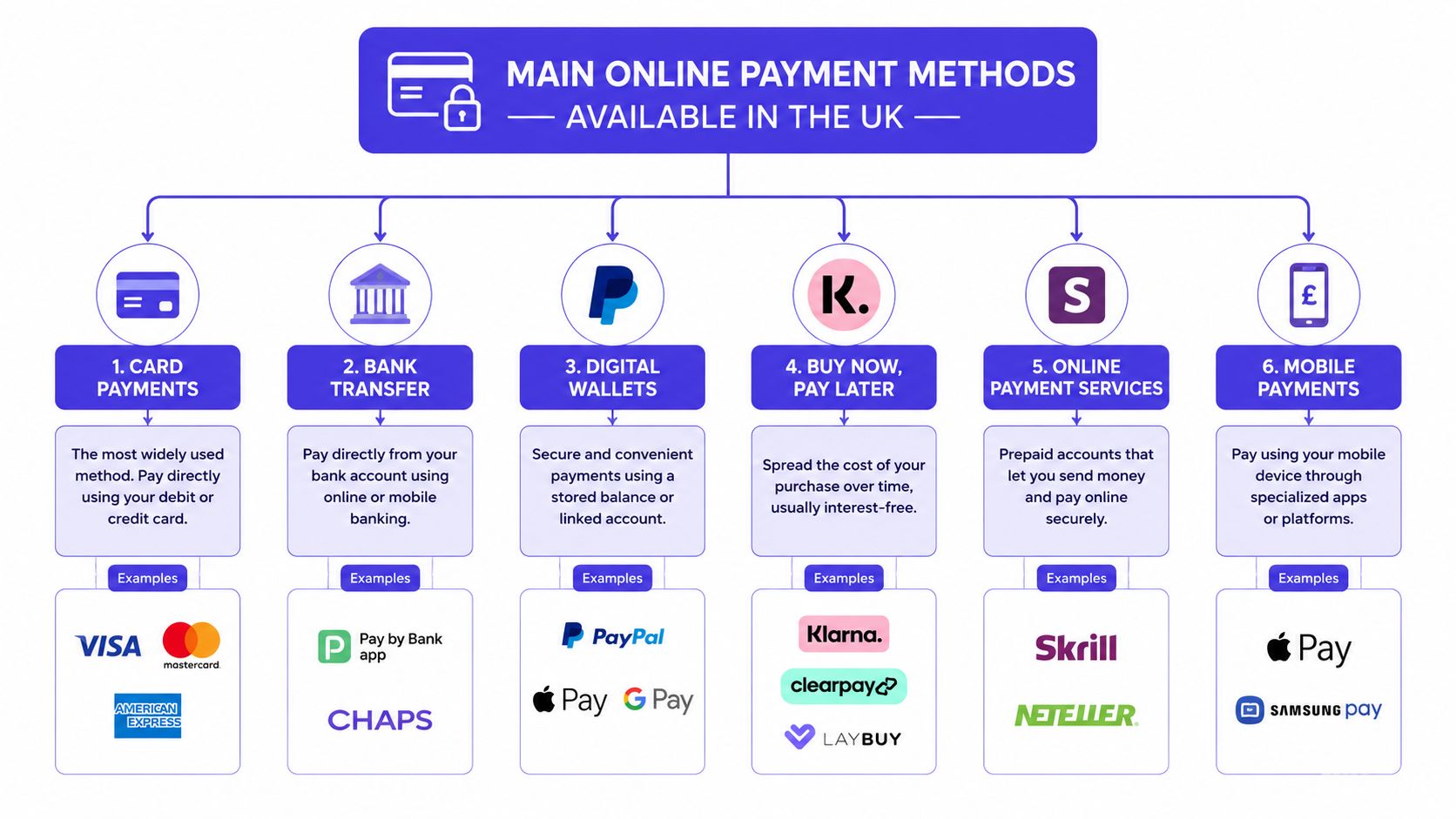
Card payments and digital wallets
For most service businesses, debit and credit cards are the starting point. They're familiar, quick, and widely accepted, which is why they remain central in UK online purchasing patterns UK online payment statistics. Cards work well for one-off invoices, deposits, and ad hoc bookings. They're especially useful where the customer expects a fast checkout experience, such as paying after an emergency callout or confirming a consultation.
PayPal is a common wallet choice because many customers already trust it and know how to use it. Wallets are useful on mobile, where customers don't want to enter full card details again. Apple Pay and similar wallet-style methods are particularly helpful when you want the customer to complete payment in a few taps. The practical value here is speed, not novelty.
Bank transfer, direct debit, and payment links
Bank transfer still has a place, especially for higher-value service work and invoice settlement. In UK operations, the important point is that settlement speed varies by rail, and businesses shouldn't assume all bank-based payments behave the same way. For recurring retainers, direct debit can reduce monthly chasing because the collection is scheduled rather than manually requested each time.
Practical rule: use direct debit when the relationship is ongoing and the payment pattern is predictable, not when every invoice is a one-off negotiation.
Payment links work well when you want a simple, shareable route from quote or invoice to payment. A plumber can send one after an emergency visit. A consultant can add one to a quote approval email. A cleaner or trainer can use one to collect a deposit before the first appointment. These links matter because they reduce the distance between agreement and payment.
Invoice payment pages and instalment options
A dedicated invoice payment page is useful when you want the customer to open a branded page, review the invoice, and pay without hunting through attachments. That feels more professional than asking them to transfer money to an account number from a plain text email. It also makes the payment action clearer for the customer.
Buy Now Pay Later can help in some consumer-facing scenarios, but it's still a small part of the UK online mix in the available data UK online payment statistics. For service businesses, it usually makes sense only where the purchase is large enough to justify the extra complexity and where your customers actively expect instalment flexibility.
If you're setting up any of these methods, the practical walkthrough matters more than the terminology. A clear guide to accepting online payments helps avoid the common mistakes that slow teams down how to accept online payments.
Comparing Fees Settlement Times and Risk Across Payment Methods
Choosing a payment method is a trade-off exercise. Faster access to money often comes with more provider involvement, card payments can bring chargeback exposure, and bank transfers can feel simple until you have to chase references and match them by hand. For service businesses, the right comparison is less about theory and more about what creates the cleanest cash flow with the least admin.
The table below gives a practical view of the main options.
| UK Online Payment Methods Comparison | Typical Fees | Settlement Time | Chargeback Risk | Reconciliation Effort |
|---|---|---|---|---|
| Debit and credit cards | Variable by provider | Commonly takes two to three business days in the payment lifecycle, though some providers offer faster funding Checkout payment lifecycle | Present, because card payments can be disputed | Moderate, because card settlements often need matching across batches |
| PayPal and other wallets | Variable by provider | Usually not immediate into your bank, depends on provider flow | Present | Moderate |
| Bank transfer | Often lower on the surface, but provider and banking costs still matter | Depends on the rail used | Low | Higher if references are inconsistent |
| Direct debit | Often suited to recurring collection | Scheduled, not instant | Lower than card in many recurring setups, but cancellations still need handling | Lower once mandates are set up |
| Payment links | Usually tied to the underlying payment method | Depends on the method behind the link | Depends on the method behind the link | Lower if linked to invoice records |
| Invoice payment page | Usually tied to the underlying payment method | Depends on the provider and method used | Depends on the method behind the link | Lower when payment status updates automatically |
What the trade-offs mean in real work
A sole trader who needs money quickly after each job may value card payment links more than a slightly cheaper alternative, because collection speed matters more than fine-grained fee differences. An agency running staged project billing may care more about clean records, invoice matching, and a method that supports partial payments without confusion.
Bank-based methods often look tidy at first glance, but they can become messy when multiple clients pay similar amounts. Card payments are easier for customers, yet they may create more reconciliation work if you're not tracking them in one place. Direct debit can be excellent for retainers, but it's only a good fit when you've got a recurring relationship and a stable scope of work.
Practical rule: if your team spends more time identifying payments than completing the job, the “cheap” method is costing you money elsewhere.
The other misconception is that every digital payment settles straight away. It doesn't. The payment path runs through the customer, gateway, acquirer, card network, issuing bank, authorisation, clearing, and settlement, and the funding timeline is often measured in business days, not seconds online payment system flow. If your cash flow depends on same-day availability, build that assumption into your provider choice and your working capital planning.
For businesses still building out their processes, a simple spreadsheet can help compare real-world collection behaviour before you switch providers or add another method spreadsheet setup for payment tracking.
UK Regulatory Requirements and Security Considerations
Payment convenience doesn't remove legal and security duties. If anything, online collection raises the stakes, because customers are trusting you to handle personal and financial data safely. The best payment setup is one that feels easy for the customer and controlled for the business.
What security should actually be in place
For online payment flows in the UK, the technical stack should include encryption, 3D Secure, fraud detection, and AVS/CVV-style verification Checkout payment system features. Those controls help protect the transaction as it moves from the customer through the payment chain. You don't need to build those mechanisms yourself if your provider handles them, but you do need to know they're there.
PSD2 and Strong Customer Authentication matter because they change how payment authentication works in practice. For day-to-day operations, that usually means customers may need to verify the payment with an extra step, such as a code or banking app approval. That's not a bug, it's part of making card payments safer in a regulated environment.
What you remain responsible for
Your payment provider can handle much of the technical compliance, but you still need to choose a provider that operates securely and that fits UK data obligations. If you store customer details, payment references, or billing data, you also need to think about UK GDPR and the Data Protection Act 2018. The practical question is simple, which is whether you really need to hold sensitive data yourself, or whether your provider can reduce that burden.
Secure checkout isn't just about stopping fraud. It also tells the customer that your business takes their information seriously.
The payment flow matters too. A secure process usually includes clear identity steps, payment detail capture, schedule confirmation where relevant, and a receipt or reference number at the end. That kind of flow is visible in real-world payment-plan systems, where the customer signs in, validates their email, enters details, chooses a plan, confirms payment information, and receives a reference for the agreement FACTS tuition payment instructions. For a service business, the same principle applies, even if the customer journey is shorter.
If you're choosing a processor, ask whether it supports secure authorisation flows, what data it stores, and how it handles disputes or failed authentication. A smooth payment page should still look serious under the bonnet. That's the balance that protects both your customers and your cash flow.
Integrating Payment Methods into Your Service Business Workflows
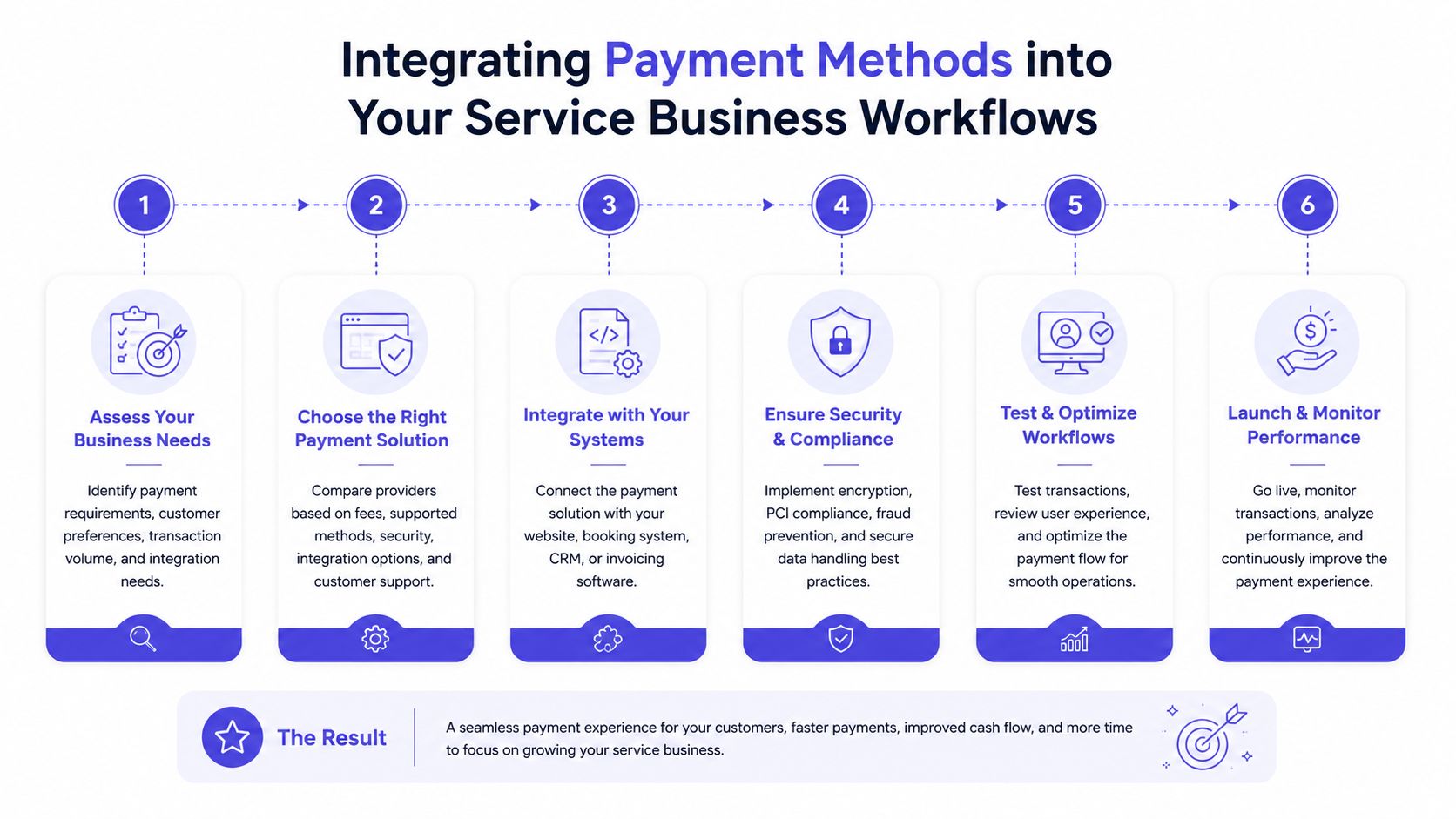
Payment methods work best when they sit inside the jobs you already run. If they live in a separate tab, a separate app, or a separate spreadsheet, they create more work every time a quote is approved, an appointment is booked, or an invoice is sent. The cleaner approach is to build payment into the workflow itself.
Booking deposits and upfront payments
For appointment-led work, deposits can reduce no-shows and stop diary slots being wasted. A beauty therapist, electrician, or tutor can collect a deposit at booking, then apply the rest later if needed. The key is to tell the customer when payment happens and what it covers, before they click confirm.
The payment step should be short and obvious. If a customer has to leave your booking flow to find a separate payment request, conversion drops because the momentum is gone. The same principle applies to quotes. The faster the customer can approve and pay, the less chance there is for the job to stall.
Quote approval and invoice settlement
Approved quotes should move straight into invoices, with a payment link or payment page attached. That removes one of the biggest sources of friction, which is the gap between saying yes and paying. A consultant might send a quote for a half-day project, then convert it to an invoice the moment the client accepts.
Keep the payment action attached to the commercial decision. If the client has already agreed to the work, don't make them search for a second route to pay.
Invoice pages are especially useful when you want the customer to see the amount due, the due date, and the payment method in one place. They also help with partial payments and staged billing, because the reference point stays tied to the invoice rather than a loose email thread. A simple workflow guide can help teams standardise this without turning every job into a manual exercise workflow timing templates.
Confirmation and failure handling
Every payment should end with a clear confirmation and a receipt or reference. If the payment fails, don't leave the customer guessing. Show what happened, give them another route to pay, and keep the tone calm. People abandon failed payments when the recovery path is clumsy.
That's where a good workflow beats a patched-together one. The booking, quote, invoice, and payment stages should all point to the same customer record, so no one has to retype names, amounts, or addresses. Once that's in place, the payment method stops being a bolt-on and starts behaving like part of the service itself.
How Unified Platforms Streamline Payment Collection and Reconciliation
Fragmented tools create hidden friction. One app holds bookings, another stores contacts, a third produces invoices, and a fourth collects payments. The result is duplication, mismatched records, and too much time spent checking whether a payment has been matched to the right job.
Why the joined-up model matters
A unified system connects the whole chain. When a customer books, their details can flow into your CRM. When a quote is approved, it can become an invoice. When the invoice is paid, the status updates in the same place. That means fewer copy-and-paste errors and less chance of sending the wrong follow-up message.
The gain shows up in reconciliation. If the payment record, customer record, and invoice record all live together, you're not hunting across separate dashboards to understand what's paid, what's pending, and what still needs attention. That's especially important for service businesses that rely on fast turnover and accurate cash tracking.
Public payment pages reduce customer friction
Public-facing quote and invoice pages also help on the customer side. They make the action clear, which means less confusion and fewer dropped payments. A customer can review, approve, and pay without swapping between documents or asking for a bank detail check.
That simplicity matters because operational visibility feeds better decisions. If you can see which jobs are paid, which invoices are overdue, and which clients book most often, you can manage your pipeline with more confidence business analytics overview. The payment method then becomes part of a broader operating system rather than an isolated function.
When scheduling, CRM, quoting, invoicing, and payment collection all point to the same record, the business stops losing time to admin that nobody wants to own.
For UK service teams, the point isn't to chase software for its own sake. It's to cut the number of places where information can drift out of sync. A unified platform does that better than a patchwork of tools because it removes the handoffs that create reconciliation headaches in the first place.
Making Your Decision and Getting Started
The right payment mix depends on how your customers buy and how your business runs. A solo electrician won't need the same setup as a creative agency on retainer work, and a tutor taking weekly bookings won't need the same process as a contractor billing in stages. Start with the reality of your jobs, not the feature list on a provider's website.
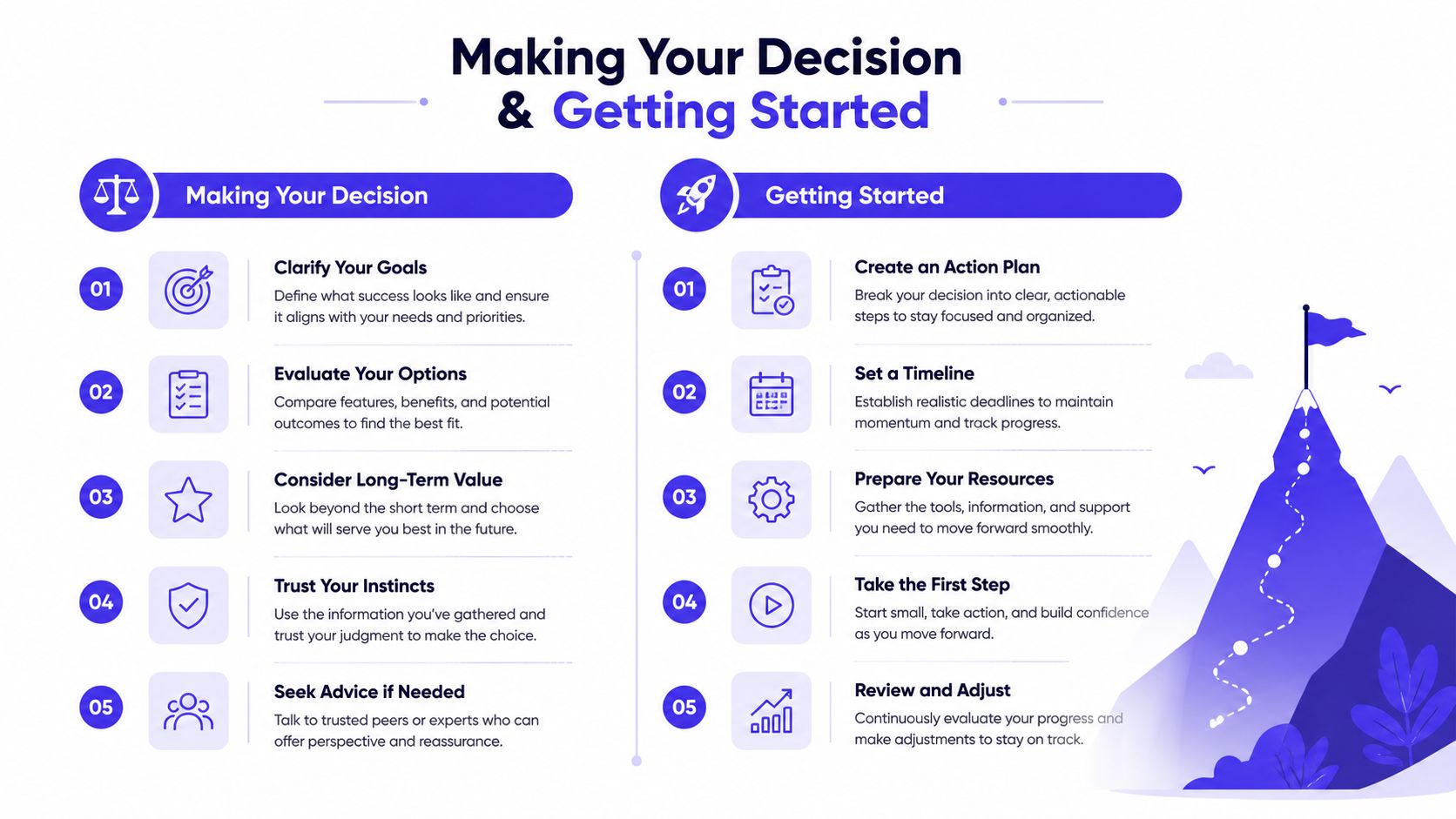
A simple decision checklist
Use these questions before you choose a provider or add another method.
- Customer preference: Do your clients expect cards, wallets, bank transfer, or recurring payment?
- Job type: Are you collecting deposits, one-off invoices, or ongoing retainers?
- Cash flow need: Do you need faster settlement, or is simple reconciliation more important?
- Admin capacity: Can you handle manual matching, or do you need automation?
- Integration fit: Will the method work cleanly with your booking, quoting, and invoicing process?
What to ask a provider
Ask how settlement works, what security features are included, and how payment statuses are updated after the customer pays. Check whether the flow supports invoices, payment links, and recurring charges without forcing you into separate tools. If the answers are vague, expect more admin later.
A good rollout starts small. Test the payment journey yourself on mobile and desktop, send it to a colleague, then check whether the receipt, reference, and status update all make sense. If customers need help completing payment, the issue is usually the flow, not the customer.
Start with the method your customers will actually complete, not the one that looks clever in a demo.
After that, review what happens in real use. Are customers paying faster? Are you chasing fewer invoices? Is reconciliation easier at the end of the week? Those answers matter more than a glossy feature list.
If you want to reduce tool sprawl and keep booking, quoting, invoicing, and payment collection in one place, try AetherCloud to simplify the whole workflow and make getting paid feel much less complicated.