

A scope of work is the formal document that defines exactly what will be delivered, by when, and at what cost. In UK service work, it's often the single most important tool for avoiding scope creep, delayed payment, and invoice disputes.
If you've ever finished a job only to hear, “We thought that was included,” you already know why this matters. A clear scope stops the argument before it starts, especially when you're trying to keep cash flowing and the next job moving.
Table of Contents
- Why UK Service Businesses Lose Money Without a Proper Scope
- What a Scope of Work Is
- Essential Components of an Effective Scope of Work
- Scope of Work Examples for UK Service Businesses
- Common Scope of Work Mistakes and How to Avoid Them
- Legal and Contractual Considerations for UK Businesses
- How AetherCloud Simplifies Scope of Work Creation and Execution
Why UK Service Businesses Lose Money Without a Proper Scope
A plumber in Manchester finishes a bathroom refit, sends the final invoice, then gets told the client expected the towel rail, vanity unit, and disposal of the old suite to be included. A consultant in London delivers a strategy deck, then spends three evenings rewriting slides because the brief never said how many revision rounds were allowed. Those are not edge cases, they're the everyday result of a weak scope of work.
The damage usually starts without notice. The first missed boundary becomes a small extra task, then a rushed favour, then a disputed invoice line that takes longer to chase than the work took to do. In UK delivery settings, a properly written scope is often the difference between a fixed-price engagement and repeated rework, which is why public-sector guidance treats scope as a control document, not a formality. The clearer the scope, the less room there is for misunderstanding, and the less time you lose explaining what was never included in the first place.
For trades, agencies, and consultants, the pressure is practical, not theoretical. If your quote, job sheet, and invoice don't match the same agreed boundaries, you're left negotiating after the work is done, when your position is weakest.
Practical rule: if you can't point to a clause that says a task was included, don't assume the client sees it the same way.
That's why many small firms pair tighter scopes with cleaner payment workflows, such as the one explained in how to accept online payments. If the scope is vague, payment collection becomes harder, not easier.
A useful external reference for builders and contractors is the Growth 4 Trades construction business resource, which reflects how commercial delivery becomes more manageable when expectations are fixed early. The same lesson applies far beyond construction. Clear scope protects time, margin, and client relationships at the same time.
What a Scope of Work Is
A scope of work is the blueprint for service delivery. Like an architect's drawing, it sets out what is included, what is excluded, and how the finished job will be judged. Without that level of detail, every side fills the gaps with its own assumptions, and disputes start there.
In UK procurement and public-sector contracting, scope has moved from an informal request to a control document. UK government guidance on service contracts treats ambiguity in scope as a source of variation orders, delays, and disputes, which is exactly what service businesses see when a client keeps adding “just one more thing” after the quote has been accepted. A well-written scope often keeps a job fixed-price instead of letting it drift into repeated rework and unpaid extras. If you have seen a profitable project turn messy halfway through, the issue was usually definition, not effort.
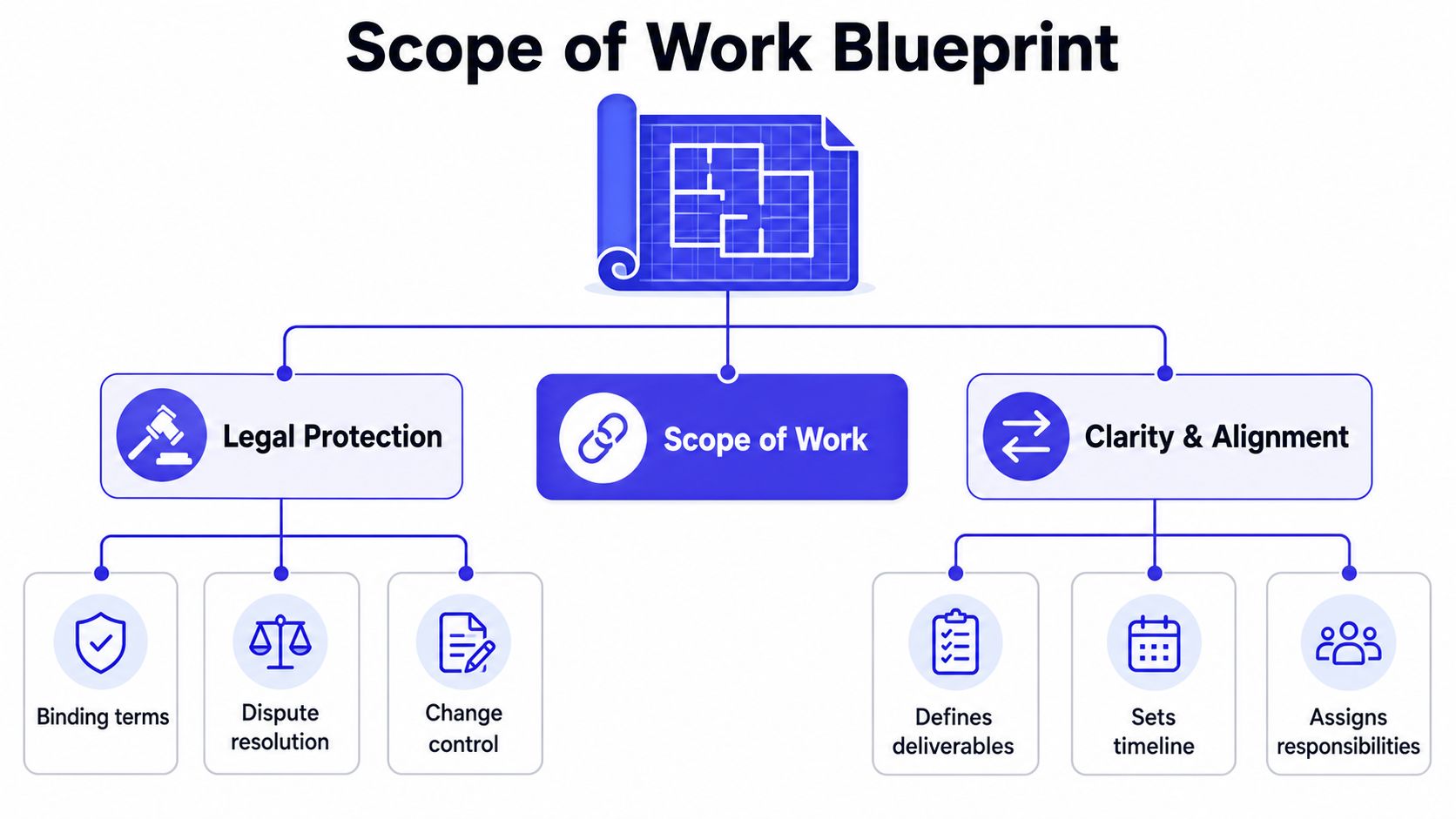
A practical way to read it is this, a scope of work serves both operations and protection. It helps the contractor price the work accurately, helps the client understand what they are buying, and gives both sides a shared reference when someone later asks for a change. If a request is not visible in the scope, it should be treated as a new request, with a separate decision on price, timing, and responsibility.
For a plain-language comparison of the broader contract format, what is a statement of work gives useful context. The aim is not to make the document longer. It is to make the boundaries visible enough that everyone works from the same expectation.
UK teams often manage that clarity alongside quoting and sales workflows, which is why it helps to keep the scope connected to the wider cycle of sales. When the handoff from enquiry to quote to delivery is structured, fewer promises get lost.
Essential Components of an Effective Scope of Work
A strong scope of work is not a paragraph of vague intent. It's a working document with clear sections that let the client, contractor, and anyone stepping in later understand exactly what's happening. The standard format usually includes the project title, objectives, deliverables, acceptance criteria, timeline, responsibilities, scope boundaries, assumptions, and change-control process. That structure matters because every one of those items closes off a common source of friction.
Start with outcomes, not instructions
The most effective scopes are result-oriented. They define what will be delivered, not how the contractor must do the work, and they separate responsibilities, deliverables, schedule, acceptance criteria, and payment terms. That distinction matters because clients often want to control process, while contractors need room to price and execute against measurable outputs. If you specify the result clearly, you avoid turning the scope into a micromanagement script.
Use acceptance criteria as a boundary
Acceptance criteria aren't admin filler. They're the line between “job done” and “please revise this again.” The New York State Office of General Services recommends sections covering project overview, requirements, deliverables, schedule, terms and conditions, and acceptance and signoff, while NYU's guidance adds milestones, reports, deliverables, end products, and a timeline. In practice, those elements give both sides a test for completion, which is exactly what most disputed jobs are missing.
Make the scope measurable
The work should be detailed enough that someone unfamiliar with the job can see what is included or excluded. Avoid soft phrases like “to our satisfaction” or “in a timely manner,” because those words sound professional but behave badly when payment is due. The Utah Purchasing guide also stresses accurate technical requirements and a breakdown of costs, often by billable task or unit. That's the level of clarity service businesses need when they want fewer arguments and faster approval.
A simple way to check your draft is to ask whether a stranger could price it, schedule it, and sign it off without having to call you first. If the answer is no, the scope still has gaps.
For teams that want a more structured way to map this into their admin, a practical reference is how to create spreadsheet, especially if the business is still managing quotes and delivery through manual files.
Scope of Work Examples for UK Service Businesses
The same framework looks different depending on the job. A plumber, a digital marketing agency, and an independent consultant all need a scope of work, but each one will define deliverables, exclusions, and sign-off in a different way. That's why generic templates often fail, they ignore the actual shape of the business.
| Business Type | Key Scope Elements | Typical Deliverables |
|---|---|---|
| Plumbing company | Fixtures included, installation standards, testing, completion date, exclusions for decorative extras | Installed bath, tested pipework, sealed fittings, completion sign-off |
| Digital marketing agency | Campaign phases, content approvals, revision limits, reporting cadence, excluded ad spend | Landing page copy, ad creatives, launch schedule, monthly report |
| Independent consultant | Objectives, workshop dates, report format, review rounds, sign-off criteria | Strategy report, advisory sessions, final recommendations |
A trades scope should read like a job card with boundaries. A marketing scope needs campaign milestones, content outputs, and any performance reporting the client can reasonably expect. A consultant's scope usually benefits from clarity around meetings, written outputs, and the point at which advice becomes complete. The common thread is that each scope tells the client what is in, what is out, and what counts as finished.
The best scope is the one that answers the follow-up questions before the client asks them.
That's also why vague wording causes problems. A document that says work will be completed “to our satisfaction” gives the provider no practical end point, and “in a timely manner” says nothing useful about dates, sequencing, or delay risk. The California Department of Transportation warns against undefined responsibilities, and that warning translates directly to UK service work, especially where a job has several handoffs.
If you're building scopes from scratch, it helps to tie them to your scheduling and job flow, not just the quote. A reference like time in motion templates can help when you need to translate work into realistic time blocks rather than guesswork.
Common Scope of Work Mistakes and How to Avoid Them
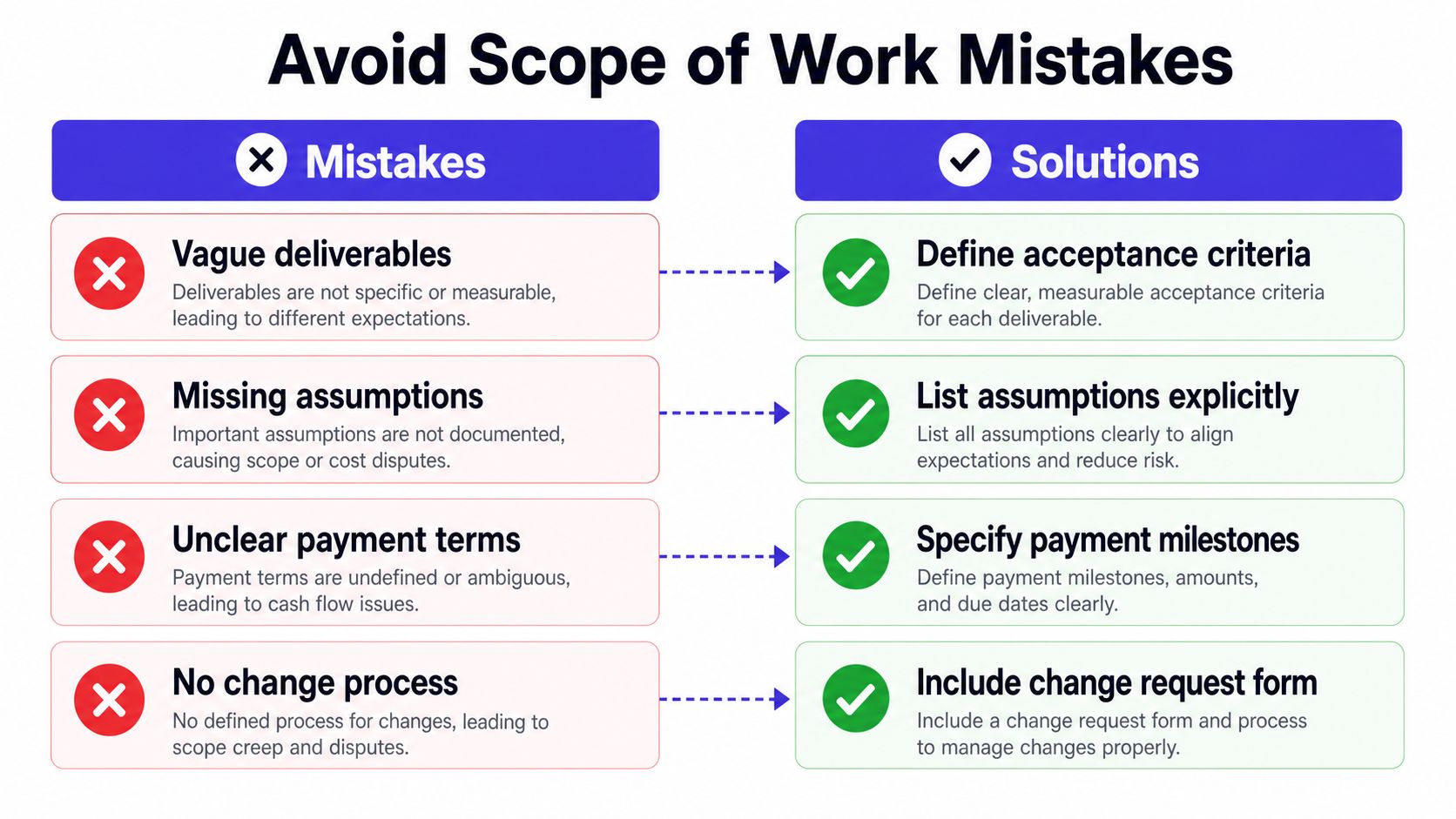
A longer scope isn't automatically a better one. The biggest mistakes usually come from the gaps that create disputes, especially around exclusions, change orders, and payment triggers. Generic guides love to list tasks and deliverables, but that doesn't stop a client from asking for extra work once the job is underway.
The most common failure is leaving the boundary line fuzzy. If you don't say what's excluded, the client assumes it's included. If you don't define how changes are approved, the job expands by conversation. If you don't state when payment is triggered, you end up delivering first and arguing later, which is a poor position when cash is already under pressure.
That pressure matters in the UK. UK Finance reported that in 2024, 63% of small businesses were in an overdraft at some point, and late payment remains a recurring cash-flow issue for SMEs. In that environment, unclear scope changes are not just frustrating, they're expensive. A weak scope can delay payment, drag out admin, and create work you never priced for.
Build a change process that people can actually use
If the client wants extra work, the request should be written, reviewed, and approved before anyone starts. Keep the process simple enough that a busy customer will follow it. The goal is not bureaucracy, it's avoiding the “I thought it was included” conversation after the invoice lands.
The strongest scopes also define performance boundaries, responsibilities, and supporting documents, because those elements directly reduce variation orders and mismatched expectations. In plain English, that means the scope should say who does what, what documents sit behind the work, and what happens when the client changes the brief. A change request form, a revised quote, or an approved variation is far easier to enforce than a verbal agreement.
Protect payment without sounding hostile
Payment triggers should be tied to visible events, such as approval of a quote, completion of a milestone, or delivery of a defined output. That way, the client knows what sets off the next step, and you know when money should move. The wording can stay polite, but the logic needs to be firm.
For service businesses that also manage enquiries, estimates, and billing, it helps to connect the scope to what is business analytics so you can see where jobs stall and which stages cause payment friction. If the same pattern keeps showing up, the scope usually needs tighter boundaries, not longer explanations.
Legal and Contractual Considerations for UK Businesses
A scope of work is not just an admin file, it's a contractual anchor. When it's written properly, it protects both sides by making the terms of delivery easier to prove, easier to approve, and easier to enforce if something goes wrong. That's especially important in UK service businesses where work often happens through quotes, email threads, rescheduling messages, and digital approvals rather than one heavyweight contract.
Hybrid, customer-facing workflows make this more important still. A modern scope may need to cover response windows, booking rescheduling, quote acceptance, invoice disputes, and online approval flows, because those are the moments where misunderstanding turns into delay. Many smaller firms still rely on basic online tools rather than integrated process systems, so scope documentation often ends up carrying more weight than it should.
Data handling matters too. If you're quoting, scheduling, or invoicing with client details, UK GDPR and the Data Protection Act 2018 sit in the background whether you mention them or not. The scope should be written in a way that supports the operational handling of client data, especially where approvals, billing contacts, or rescheduled appointments pass through your workflow. That doesn't mean the scope needs legal jargon, it means the process around it should be clean, traceable, and consistent.
A practical external reference for contractor-facing commercial risk is the 2026 IR35 rules guide. While IR35 is its own topic, the wider lesson is the same, sloppy documentation creates avoidable exposure.
The key contractual point is simple. If the scope clearly defines what's being delivered, how changes are approved, and when payment is due, it reduces the chance of disputed completion and payment friction. That's not theoretical compliance language, it's operational protection for businesses that need to get paid on time and keep work moving.
How AetherCloud Simplifies Scope of Work Creation and Execution
A scope of work only works if it lives inside the same system as the quote, approval, schedule, and invoice. AetherCloud lets UK service businesses build that flow in one place, with quoting, public quote response pages, scheduling, invoicing, and GBP billing working together. That means the agreed scope can move from initial quote to approval to payment without being scattered across separate tools.
When a client can approve or request adjustments online, the scope stops being a static PDF and becomes a live agreement. Once approved, the quote can convert into a VAT-ready invoice immediately, which helps keep payment triggers aligned with the work that was signed off. The same system also keeps appointments, digital business cards, and client details organised, so the handoff between sales and delivery stays professional.
AetherCloud is built for UK service businesses, with UK GDPR and the Data Protection Act 2018 compliance in mind, which matters when you're handling client contacts, quotes, and invoices in the same workflow. If you want fewer admin gaps, fewer missed approvals, and less scope confusion, it's easier to manage everything in one place than to stitch together separate apps.

If you're tired of chasing approvals across email, spreadsheets, and invoices, AetherCloud brings quoting, scheduling, payments, and client management into one system built for UK service businesses. Visit AetherCloud to see how it can simplify your scope of work workflow and help you protect your time, margins, and cash flow.