

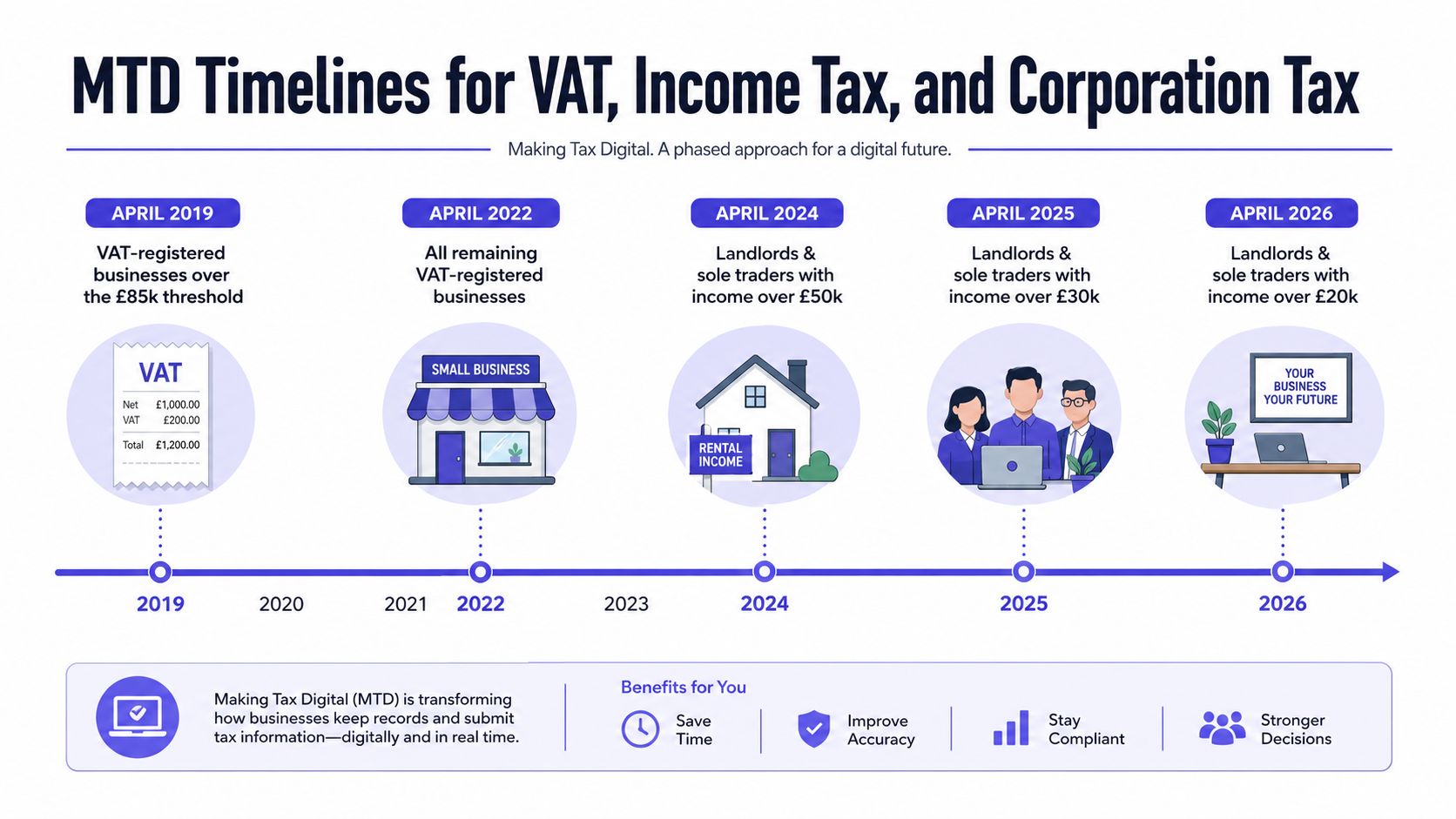
Making Tax Digital is HMRC's move to digital records and quarterly updates, and the first big VAT phase started in April 2019 for businesses at or above £85,000, with the wider VAT rollout completed by April 2022. For many UK service businesses, that means the old habit of leaving everything until year-end isn't enough any more.
If you're a plumber, designer, consultant, or landlord, the change usually shows up in ordinary admin first. A quote becomes an invoice, an invoice becomes a payment, and those records now need to stay clean enough to be reported through compatible software instead of patched together later from paper or spreadsheets.
Table of Contents
- What Making Tax Digital Actually Means for UK Businesses
- The Core Requirements of Making Tax Digital Explained
- MTD Timelines for VAT, Income Tax, and Corporation Tax
- How Digital Record-Keeping Works in a Service Business
- Quarterly Updates and the New Five-Submission Pattern
- Exemptions, Penalties, and Common Compliance Mistakes
- A Practical MTD Readiness Checklist for Service Businesses
- Why a Single Platform Makes MTD Simpler
What Making Tax Digital Actually Means for UK Businesses
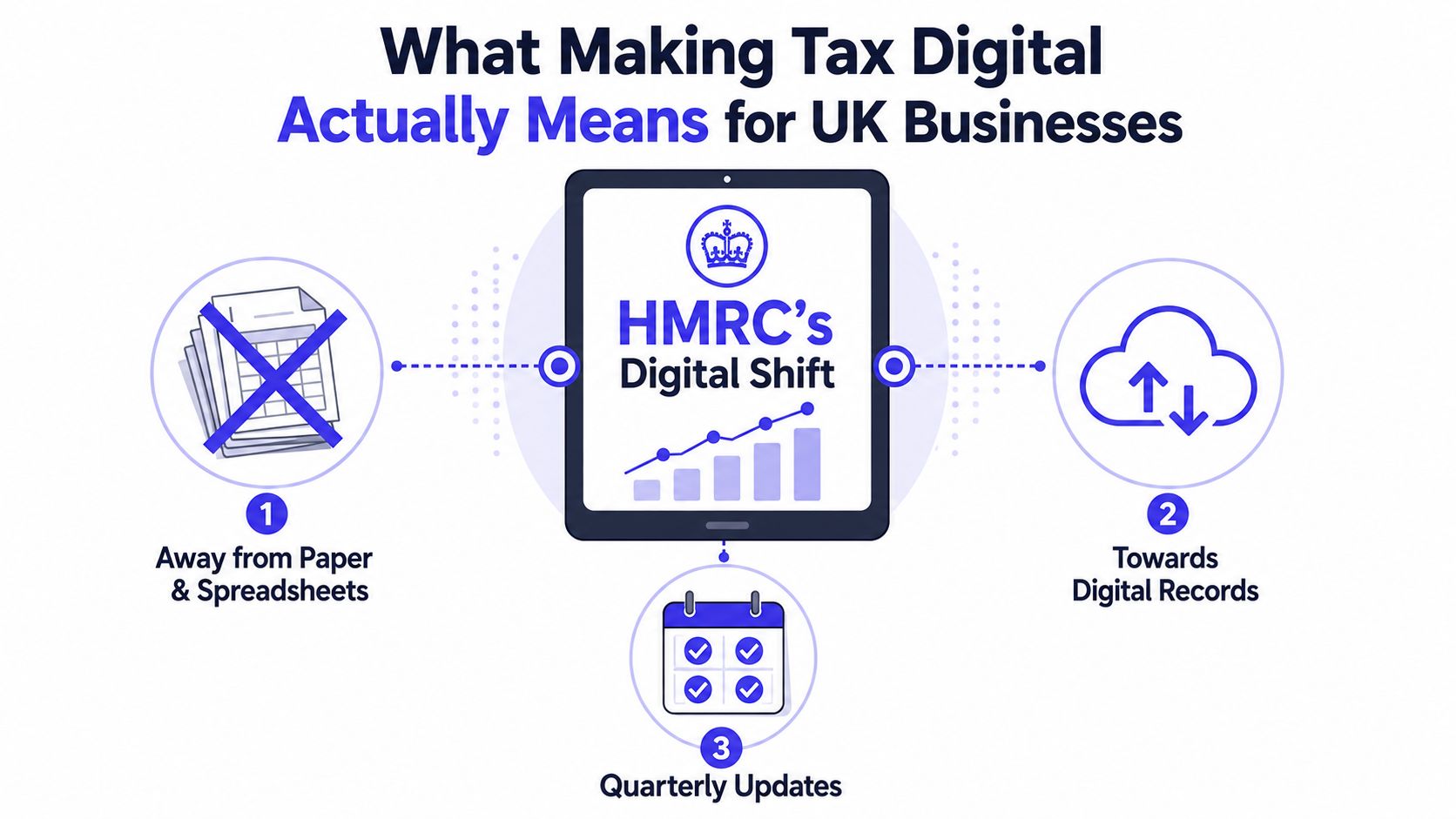
Making Tax Digital is HMRC's requirement to keep business tax records digitally and send updates through compatible software, instead of relying on paper files or a spreadsheet that gets rebuilt at the end of the quarter or the year. For a small UK service business, that's not just a filing change. It changes how you capture jobs, invoices, deposits, and expenses while the work is still fresh.
A sole trader electrician, for example, might finish a call-out, send a quote, take a deposit, and collect the balance later. Under MTD, those transactions need to live in a digital system in a way that can be reused for tax reporting, not retyped from memory months later. That's why MTD is better understood as an operations change than as a simple form-filling exercise.
E-filing is not the same as digital record-keeping
A lot of confusion comes from treating MTD like an online portal. It isn't. A typed-up spreadsheet emailed to an accountant may still be digital in the broad sense, but HMRC's model expects structured records that can flow through software and reconcile properly with the tax submission process. The government's technical note on MTD describes a move toward structured data capture, API-based submission, and reliable reconciliation between the business ledger and HMRC's systems, which is a very different model from entering totals once a year (HMRC technical note).
Practical rule: if your records only become “tax-ready” when someone has to rebuild them at the end of the quarter, the workflow still has a weak point.
For a freelance designer or a small consultancy, the best way to think about MTD is simple. Every quote, invoice, payment, and expense should be captured once, at the source, in a way that can be checked later. That's what makes the records usable for HMRC and useful for the business at the same time.
The Core Requirements of Making Tax Digital Explained
A small service business can feel MTD pressure in ordinary day-to-day work, not just at tax return time. An invoice is sent, a payment arrives late, an expense gets photographed on a phone, and then someone has to rebuild the same story at quarter end. MTD is designed to stop that rework by making the business keep one connected digital trail from the source record to the submission.
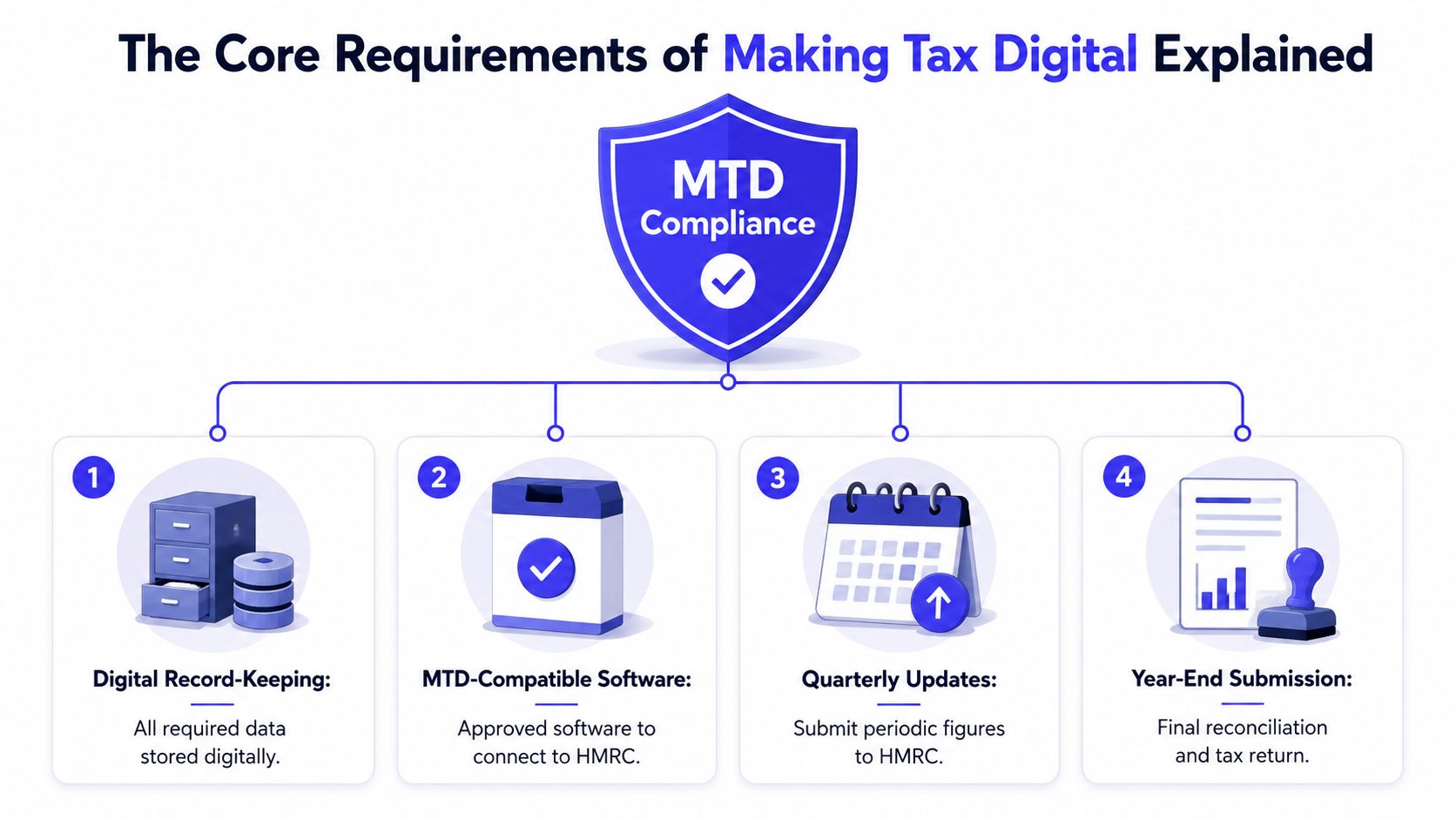
MTD compliance rests on four connected parts. First, you keep digital records. Second, you use MTD-compatible software. Third, you send quarterly updates. Fourth, you complete a year-end submission that reconciles the year.
That structure matters because HMRC is not asking for the same numbers in a prettier format. It wants a workflow that starts with the transaction and ends with a submission. The OECD's tax-modernisation guidance is clear that data standards, legacy data cleanup, process mapping, and interoperability are prerequisites for successful digital tax delivery, because poor source data leads to incorrect reporting and extra rework (OECD guidance).
What the software has to do
“Compatible software” sounds vague until you break it down. It needs to store records, create reports from those records, and send the right information to HMRC in the right format. For a small service business, that usually means one system should handle invoicing, expense capture, and reconciliation rather than leaving those jobs split across disconnected apps.
The more often you rekey data, the more chances you give errors to creep in.
That is why invoicing, payments, and bookkeeping need to be linked. If your invoice totals, bank receipts, and expense records live in separate places, you spend time matching them later. If they are connected from the start, the tax workflow becomes part of normal admin instead of a scramble before the deadline.
The practical check for most owners is straightforward. Can the software create the records, keep them digitally, and support the submission process without manual patching? If the answer is no, it may look digital but still leave you doing spreadsheet clean-up by hand. For a plain-English guide to making that financial structure tidier, see how to format financial statements.
For a plumber, a marketing consultant, or a cleaner with a few regular clients, this usually means the same daily habits matter more than a once-a-quarter tidy-up. Enter the job, capture the cost, match the bank line, and keep the records in the same place. A unified platform helps because it reduces the number of times the same information has to be checked, copied, or corrected.
MTD Timelines for VAT, Income Tax, and Corporation Tax
The timeline is the part many owners need first, because MTD is not just a tax deadline problem. It changes how the business runs week to week, since records, invoices, and bank entries have to stay organised in a digital flow rather than being sorted out once a year.
VAT is already live, and HMRC's final evaluation says the programme generated an estimated £185 million to £195 million in additional tax revenue in 2019–2020, with central estimates of about £57 per quarter per business for businesses above the VAT threshold and £19 per quarter per business for those below it. HMRC also reported that more than 1.4 million businesses had signed up to MTD for VAT by 9 March 2020 (HMRC final evaluation).
For a service business, that means VAT compliance is no longer a once-a-year tidy-up. The records have to be kept in a way that supports regular updates, so the practical job is to build a routine that captures sales, expenses, and payments as part of normal admin.
When Income Tax enters the picture
The next big change is Income Tax Self Assessment. HMRC's revised estimates say 2,916,000 taxpayers will need to comply, out of 7,020,000 taxpayers with self-employment or property income within ITSA for 2023/24, which is about 42% of that group. HMRC plans to begin the phased start from 6 April 2026, with 864,000 taxpayers in scope above £50,000, then 1,077,000 planned from April 2027 above £30,000, and 975,000 planned from April 2028 above £20,000 (ICAEW summary).
For a sole trader or landlord, the key point is not just the start date. It is whether your qualifying income places you in the first, second, or third wave. A small decorator with a busy mix of jobs and rent income needs to check gross income carefully, because the phase-in is based on that scope, not on how profitable the year felt.
What about Corporation Tax
Corporation Tax is still being discussed within the wider MTD programme, but it is not the live obligation for most small companies yet. That means the immediate planning focus for many service firms is still VAT, then Income Tax if they are sole traders or landlords. If you run a company, keep an eye on the direction of travel, but do not treat a planned future phase as a filing duty that already applies.
For a practical way to plan the week and see where admin really sits, time-in-motion templates can help you map the jobs, payments, and bookkeeping tasks instead of assuming they can all be squeezed in later.
How Digital Record-Keeping Works in a Service Business
A digital record only helps if it is created while the job is still fresh. Take a self-employed plumber who quotes for a boiler repair on Monday, takes a deposit on Tuesday, buys parts on Wednesday, and receives the final payment on Friday. If each step is entered once, in the same system, the record stays consistent. If the details are split across text messages, a notebook, a bank feed, and a spreadsheet, quarter-end tidy-up quickly turns into the biggest job of the quarter.
That is the practical side of MTD for a service business. It is not just about filing at the end. It is about keeping everyday work, quotes, invoices, payments, and expenses in one place so the tax record grows naturally from the business record.
Where mistakes usually begin
The biggest risk is retyping. A quote gets approved, then the invoice is entered again separately. A payment arrives, then someone matches it later. A receipt is photographed, then typed in by hand. Each extra step creates another chance to misclassify a cost or miss a transaction altogether.
That is why HMRC and wider tax-modernisation guidance put so much weight on data quality and interoperability. If your chart of accounts, invoice data, and bank transactions do not line up, the mistake does not stay in one place. It spreads through the whole tax record. A connected system keeps the source record and the tax record aligned from the start.
Good practice: capture the transaction once, as close to the job as possible, then let the system carry it forward.
A spreadsheet can still help at the beginning, especially if you are learning the structure. A clear setup matters as much as the figures, and how to create a spreadsheet is a useful reminder that columns, labels, and formulas need to be consistent if you want the records to stay reliable.
Why service businesses feel the pain faster
Service firms rarely move in neat straight lines. There are deposits, part payments, revised quotes, and mixed-use costs such as fuel or materials. A cleaner workflow handles those realities without making you rebuild the same job three times. That matters because MTD does not reward heroic end-of-quarter tidying. It rewards records that were sensible all along.
A small business owner can feel this most clearly on a busy week. A gardener might quote for a hedge cut, take a partial payment, buy extra supplies, then finish the work after a client changes the scope. If those steps sit in different places, the quarter-end job becomes a memory test. If they sit in one system, the business can see the income, the cost, and the job history without having to stitch everything together later.
The same pattern is why a unified service-business platform matters. It reduces the need to chase down paperwork, copy figures between tools, and check whether the bank feed matches the invoice trail. That saves time in the ordinary run of the week, not just at filing time.
Quarterly Updates and the New Five-Submission Pattern
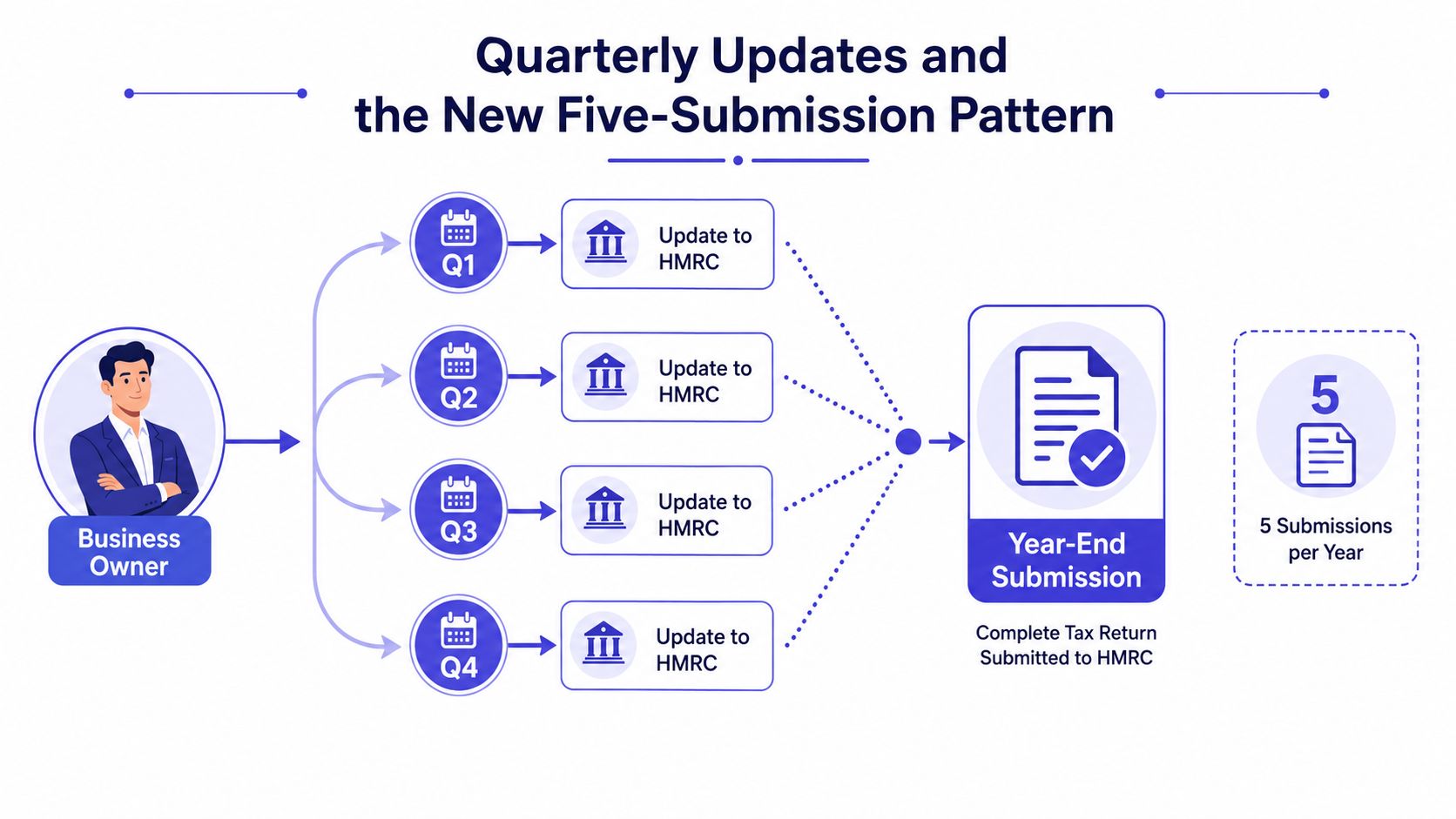
MTD for Income Tax changes the old once-a-year routine into five submissions a year for eligible sole traders and landlords, four quarterly updates and one year-end tax return (Making Tax Digital campaign). That does not mean five separate tax bills. HMRC receives regular summaries during the year, and the final tax position is still settled through the year-end process.
A self-employed cleaner can see the change in day-to-day terms. Income and expense records need to be captured as the work happens, then the quarterly update is sent from the digital records already in the system. The year-end return then pulls the quarters together, applies any adjustments, and finalises the position. The rhythm changes, but the bookkeeping logic stays familiar.
What goes into a quarterly update
A quarterly update is a summary of what the business has recorded so far. It is not a fresh hunt for receipts, and it is not meant to become a separate bookkeeping project. If the records are good, the update should come straight from them, not require a rebuild.
That is why software support matters. If the platform cannot compile the quarter from what has already been logged, you end up doing manual reconciliation every three months. For many service businesses, that means the compliance task sits inside the weekly workload rather than appearing as a one-off filing job.
A cleaner example makes the point clearly. If a client pays by card at the invoice stage, the money, the invoice, and the bank record all need to line up in the same place. A guide on how to accept online payments can help here, because quicker collection makes the quarterly record easier to trust.
What the year-end submission does
The year-end return is where the numbers are brought together and adjusted properly. Quarterly figures are summaries, so they are not the final word. Many owners assume MTD turns tax into a quarterly payment cycle, but the main change is the reporting rhythm, not always the payment timing.
For a service business, that matters because the year-end stage should be a tidy review, not a rescue mission. If the quarterly records already match the invoices, payments, and expenses, the final submission is the point where everything is checked and settled.
Exemptions, Penalties, and Common Compliance Mistakes
A small service business can run into MTD problems long before it reaches a filing deadline. The issue is usually not the return itself, it is the day-to-day record keeping behind it. If your quotes, invoices, bank entries, and expenses live in different places, the quarterly admin starts to behave like a separate job.
Some businesses will also fall into exemption categories. For VAT, there are existing exemption routes. For Income Tax, the guidance allows for exemptions where digital record-keeping would be impractical, including cases linked to age, disability, insolvency, or other accepted reasons. These are handled case by case, so an exemption is not something an owner can assume just because digital reporting feels difficult.
Where small businesses get caught out
The first mistake is mixing personal and business spending. The second is treating a spreadsheet as if it were a complete digital system, when it only holds totals and does not always preserve a usable transaction trail. The third is letting invoices, payments, and bookkeeping drift apart, so the numbers at quarter end no longer agree cleanly.
A service business can see this most clearly in its own cycle of sales. A quote is issued, the invoice follows, payment arrives later, and each step should still point back to the same record. If one part is missing, the whole chain becomes harder to explain.
If your records cannot explain themselves, you will spend quarter end explaining them.
That matters because MTD depends on ongoing record quality. HMRC's later penalty model for Income Tax will use a points-based system, where missed quarterly or annual obligations can lead to penalty points and then a financial penalty once a threshold is reached. Lateness and sloppy records are not just admin issues. They become compliance issues.
What to watch in mixed-use records
Mixed-use purchases are a common trap for service businesses. A van, phone bill, software subscription, or home office cost can look straightforward when you first pay it, but the tax treatment may not be straightforward at all. If the source record is weak, the correction has to happen later, and that is the kind of extra work MTD is meant to reduce.
The answer is to keep the source record clean from day one and make sure the software preserves that trail. For a business owner, the aim is not perfection. It is consistency, because consistent records are much easier to defend, reconcile, and submit.
A Practical MTD Readiness Checklist for Service Businesses
The fastest way to prepare is to look at the workflow you already use and ask where the gaps are. If quotes live in one place, invoices in another, and payments somewhere else, MTD will expose that fragmentation quickly. If the records already sit in one system, the move is much smoother.
| MTD Requirement | What You Need to Do | AetherCloud Capability |
|---|---|---|
| Digital record-keeping | Capture quotes, invoices, payments, and expenses as they happen | Quoting, invoicing, online payments, and client records |
| Compatible software | Use one system that supports digital tax workflows | Unified business management platform |
| Quarterly updates | Pull summaries from live records without manual rebuilds | Analytics and reporting |
| Year-end submission | Reconcile the year from the same source records | Centralised operational data |
| Cleaner audit trail | Keep one version of the truth across the business | Integrated CRM, billing, and payments |
Start with the records you already create every day. Then check whether the system can turn those records into something MTD-ready without duplicate entry. If it can't, the problem isn't your discipline, it's the workflow.
Finally, test the whole path from quote to payment. That shows you whether your business can keep compliant records without adding another layer of admin at quarter end. For many service firms, that one exercise reveals exactly where the bottleneck is.
Why a Single Platform Makes MTD Simpler
MTD rewards businesses that already work from one source of truth. When quoting, invoicing, payments, and records all live together, the quarterly task is mostly a reporting step. When they're split across multiple tools, the quarterly task turns into a reconciliation project.
That's the business case behind simplification. HMRC says MTD for Income Tax applies from 6 April 2026 to sole traders and landlords with income above £50,000 and requires software that can create, store, correct, and submit digital records plus quarterly updates and the year-end return (HMRC Income Tax guidance). A fragmented setup can still be compliant, but it usually costs more time and attention to keep it that way.
For a service business, that extra attention is expensive. It slows quote turnaround, delays payment follow-up, and makes it harder to see what's happening in the business week by week. One connected platform reduces those handoffs, which is why MTD is often easier for owners who have already tidied up their operations.
If you want a simpler way to handle quotes, invoices, payments, and client records in one place, take a look at AetherCloud. It's built for UK service businesses that want cleaner operations and less quarter-end admin, and it can help you get ready for Making Tax Digital without stitching together a stack of disconnected tools.