
You've got three quotes in your inbox, two PDFs in different formats, and one supplier who sent a five-page email thread instead of a proper proposal. If you're trying to compare cost, scope, and timelines without losing half a day to back-and-forth, the problem isn't the suppliers. It's the lack of a clear Request for Proposal template.
A strong template of RFP turns a messy buying process into something you can manage. It gives suppliers the same brief, the same format, and the same deadline, so you can compare responses fairly and keep the project moving. For a growing UK service business, that matters because procurement isn't just admin, it's part of how you protect margin, reduce delay, and choose partners you can trust.
Table of Contents
- Why Your Service Business Needs a Proper RFP
- Anatomy of a Powerful UK RFP Template
- Customising Each Section of Your RFP a Practical Walkthrough
- A Completed RFP Example for a UK Service Business
- Evaluating Responses with a Simple Scoring Matrix
- Managing the RFP Process from Issuing to Invoicing
- From RFP to Invoice Streamline Your Business Growth
Why Your Service Business Needs a Proper RFP
A small agency, trades business, or consultancy usually feels the problem first in the inbox. One supplier sends a neat PDF, another sends a Word document, and a third answers three questions out of ten, then drops a price at the end with no context. At that point, the decision stops being evidence-led and starts turning into guesswork.
A proper RFP fixes that by putting structure in place before the quotes arrive. UK guidance says simple procurement can take about 2 weeks, complex RFPs usually need 3 to 4 weeks, and highly technical projects may need 6 to 8 weeks, so supplier research and holiday periods can be built in from the start. A good template also sets out the background, scope, budget, legal and compliance terms, and the submission timetable, which reduces ambiguity in quote and proposal workflows (UK request for proposal template guide).
Practical rule: if you need to compare suppliers fairly, the brief has to be more disciplined than the responses.
That is why the RFP is more than paperwork. It acts as a project-control instrument, setting expectations for vendors, clarifying evaluation criteria, and cutting the back-and-forth that usually slows decisions. For a service business, that means fewer misunderstandings about deliverables, fewer awkward budget surprises, and a cleaner handover once you have chosen a supplier.
The bigger issue is process. If your team is still writing the brief in one place, collecting responses in another, and chasing payment details somewhere else, the whole procurement flow gets messy fast. A practical sales cycle view shows why keeping each stage ordered matters when different people touch the same customer journey, and the same logic applies when you want quoting, supplier replies, and payment steps to sit in one system.
A proper template of rfp gives small UK service businesses a repeatable way to run sourcing without wasting hours on admin. It helps the team ask for the right information, compare suppliers on the same basis, and keep the job moving from first brief to final invoice.
Anatomy of a Powerful UK RFP Template
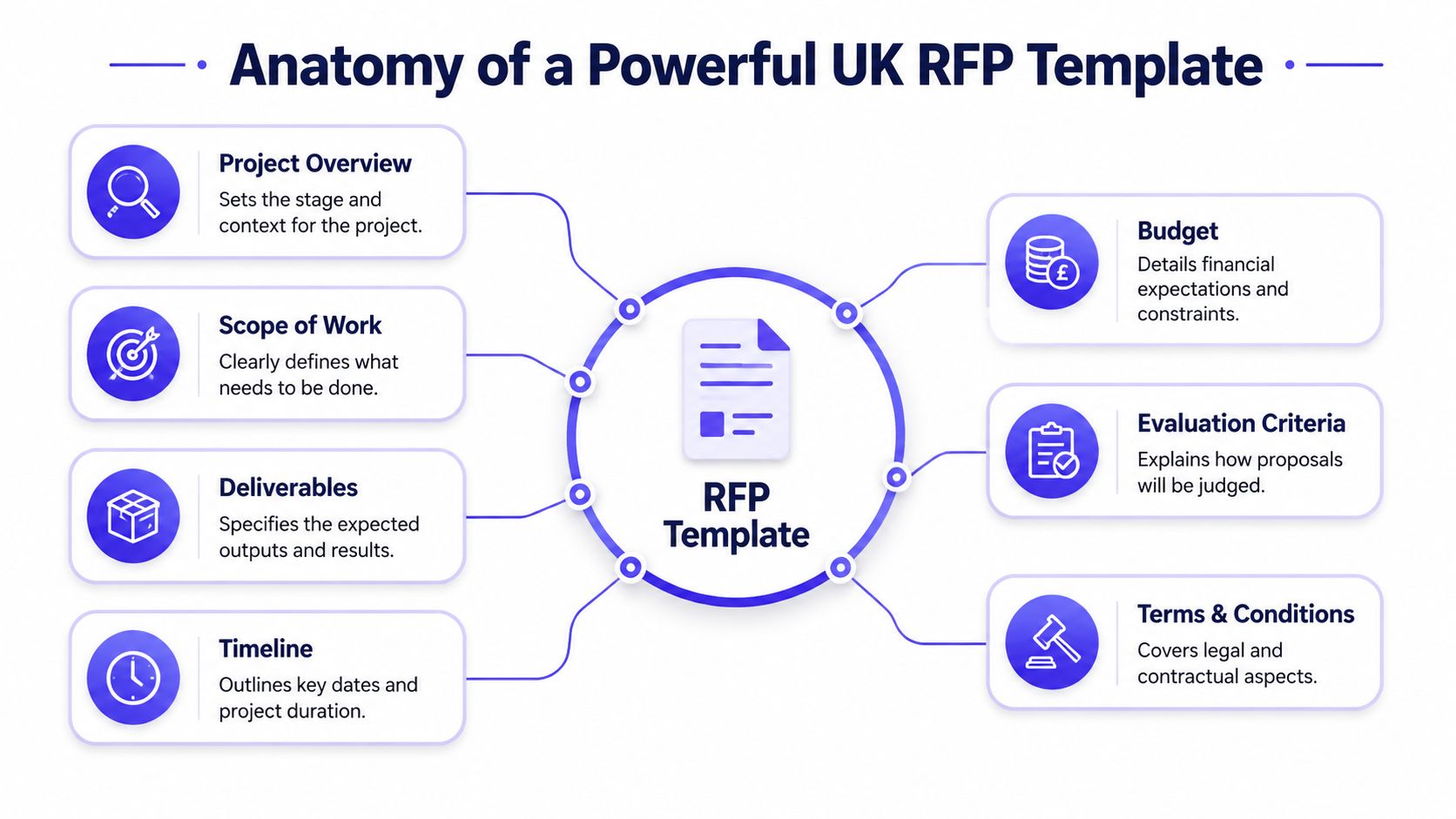
A strong UK RFP should read like a clear buying pack, not a rough notes document. The structure matters because it forces vendor comparability and makes it easier to score bids against the same criteria, rather than relying on who wrote the slickest cover note. how to write a powerful RFP free template
Project Overview and Scope of Work
The project overview tells suppliers what the business does, what problem it wants solved, and why the work matters. Keep it factual. A supplier should understand the context without having to guess whether this is a one-off fix, a longer-term engagement, or part of a bigger change.
The scope of work should be specific enough that a supplier can price it properly. List the tasks, the boundaries, and anything that is definitely out of scope. If the brief is vague here, every response will drift in a different direction, and you'll spend your time normalising answers instead of comparing them.
Submission Guidelines and Evaluation Criteria
The submission guidelines should spell out where proposals go, what format is required, and when they're due. Include contact details for questions, because unanswered queries lead to inconsistent bids and a messy clarification round later.
The evaluation criteria are where you make the scoring process fair. If suppliers know the weight you place on service quality, experience, or price, they can answer in a way that reflects what you care about. This is the point where a good template of RFP becomes a decision tool rather than a document archive.
Budget Timeline and Terms
The budget and timeline section keeps suppliers realistic. You don't need to overexplain your internal finances, but you do need to state the commercial shape of the work so nobody submits a proposal that can't be delivered within your constraints.
The terms and conditions section is where you lock in the legal basics, delivery expectations, confidentiality, and any required compliance language. For a UK service business, this matters when the buyer and supplier will handle client data or sensitive operational detail. A clean structure helps avoid later disputes because expectations were written down before the work started.
If procurement sits inside a wider growth plan, the same discipline helps keep internal stakeholders aligned too. A go-to-market planning view helps here because the brief works better when it is tied to a clear business outcome.
Customising Each Section of Your RFP a Practical Walkthrough
A generic template is only useful until the first real project lands on your desk. After that, the wording has to reflect the job you're buying, the way your team works, and the compliance rules you can't afford to miss. Generic RFP templates often fail to address UK-specific compliance, so businesses should explicitly update legal, security, and data protection requirements, including GDPR, rather than leaving them implicit (how to write a winning request for proposal).
Start with the brief, then add the checks
Begin with the facts the supplier needs to do the work properly. What's the goal, who's involved, what does success look like, and what decisions are fixed versus flexible? Once that's clear, add the practical constraints, such as availability, dependencies, and any client-facing deadlines that can't move.
A good RFP answers the supplier's obvious questions before they have to ask them.
For the scope, write in business language, not internal jargon. A web developer, for example, needs to know what must be built, what systems it has to fit with, and what handover is expected. A consultant needs the problem statement, the desired output, and the decision process. A cleaner, builder, or trainer needs the job boundaries, timing, and site access details.
Make compliance and pricing explicit
UK compliance language belongs in the template itself, not in a side email. Spell out data handling, security expectations, and any contractual requirements that matter to your business. That keeps all bidders on the same footing and reduces the risk of getting proposals that look fine on the surface but fail when you review the legal detail.
The budget section should be firm without boxing yourself into a bad anchor. State the commercial model you're open to, such as fixed price, day rate, or phased delivery, and make it clear whether suppliers should include assumptions. If you need staged pricing, ask for it directly so you can compare like with like.
I'd also keep the timeline honest. If a project has internal approvals, customer dependencies, or holiday risk, say so. A supplier can work with a tight deadline, but they can't work with a fantasy one.
You can even map how long each internal step should take before you issue the brief. That's where time-in-motion template thinking helps, because the better you understand your own workflow, the less likely you are to understate the effort in the RFP.
A Completed RFP Example for a UK Service Business
A small marketing agency in Manchester needs a freelance web developer for a client landing page. The agency wants speed, but it also wants clean handover, mobile performance, and a supplier who can communicate without constant chasing. That's exactly the kind of job where a completed RFP saves time.
Example brief
Project overview: We are a Manchester-based marketing agency looking for a freelance web developer to build a responsive landing page for a client campaign. The page needs to match an approved design, work across mobile and desktop, and support a simple enquiry form.
Scope of work: Build one landing page from supplied designs, connect the form to the nominated inbox, test on current major browsers, and hand over the finished files with basic documentation. Please note any assumptions about content loading, analytics setup, or hosting.
Submission guidelines: Submit your proposal by the stated deadline. Include your approach, relevant project examples, estimated delivery dates, and itemised pricing. Questions should be sent through the named contact only.
Evaluation criteria: We will review fit for the brief, relevant experience, clarity of communication, delivery approach, and price.
Terms and conditions: Proposals should confirm data handling, confidentiality, and acceptance of the stated payment terms before work begins.
That kind of wording gives suppliers enough information to respond properly without forcing them to reverse-engineer the job from fragments. It also stops you from comparing a polished pitch against a vague estimate.
If the brief is short, the answer can still be professional. The point is not to make it long. The point is to make it complete enough that a supplier can say yes, no, or a sensible version of maybe.
Evaluating Responses with a Simple Scoring Matrix
A scoring matrix keeps the decision honest. Without one, the loudest internal opinion or the cheapest quote often wins, and neither is a reliable buying method. With one, every proposal is judged against the same measures, so the process is easier to defend and easier to repeat next time.
Use weights that match the job
If technical ability matters most, do not hide that behind a vague “overall quality” column. Give each criterion a weight that reflects how the work will be delivered. For a service project, that often means giving more weight to delivery capability and less to presentation polish.
| Evaluation Criteria | Weighting | Vendor A Score (1-5) | Vendor A Weighted Score | Vendor B Score (1-5) | Vendor B Weighted Score |
|---|---|---|---|---|---|
| Technical Skill | 40% | 4 | 1.6 | 5 | 2.0 |
| Cost | 30% | 3 | 0.9 | 4 | 1.2 |
| Experience | 20% | 5 | 1.0 | 3 | 0.6 |
| Communication | 10% | 4 | 0.4 | 5 | 0.5 |
| Total | 100% | 3.9 | 4.3 |
Score the proposal, not the personality
Keep the scoring tied to evidence in the response. If a supplier gives a detailed method, recent examples, and clear timings, that should score better than a general promise to “work closely” with your team. The same applies to pricing, where a lower number only helps if the proposal still meets the brief.
A structured scorecard also makes life easier once responses start arriving through one place, which is why many teams use a central RFP workflow rather than chasing attachments through inboxes. A clear response format helps you compare suppliers properly, and it keeps the handoff to selection, contract, and payment in the same system. That matters if you want a process that stays tidy from proposal to invoice, and if you use AetherCloud's guide to accepting online payments as part of that workflow, you can keep the commercial side aligned with the decision itself.
If two bids look close, the scoring notes usually show which one is actually easier to trust.
Use a short comment box beside each score so you remember why you marked a section up or down. That becomes invaluable when stakeholders ask why one supplier won and another did not. A number without a reason is easy to challenge later.
Managing the RFP Process from Issuing to Invoicing
A strong brief still falls apart if the process around it is loose. A growing UK service business needs one place for supplier questions, one closing time for submissions, one method for comparing replies, and one clear route from award to invoice. If those steps sit in different inboxes and spreadsheets, the work slows down and suppliers feel they are dealing with an unsteady buyer.
Keep supplier communication tidy
Set one channel for questions and answers, then keep every update there. If a supplier raises a point by email and the reply appears somewhere else, the details start to split apart. A changed assumption on pricing, scope, or timing can get missed, and that creates avoidable friction on both sides.
Centralising submissions helps as well. A single response page or shared intake route means suppliers send proposals into one place rather than into separate inboxes, so you can compare them without hunting for attachments or checking which version is current. It also makes it easier to see who has responded, who still needs a reminder, and which proposal is ready for review. A practical response template for RFP gives suppliers a clearer way to answer, and it gives you cleaner information to work with.
Move from selection to payment without chaos
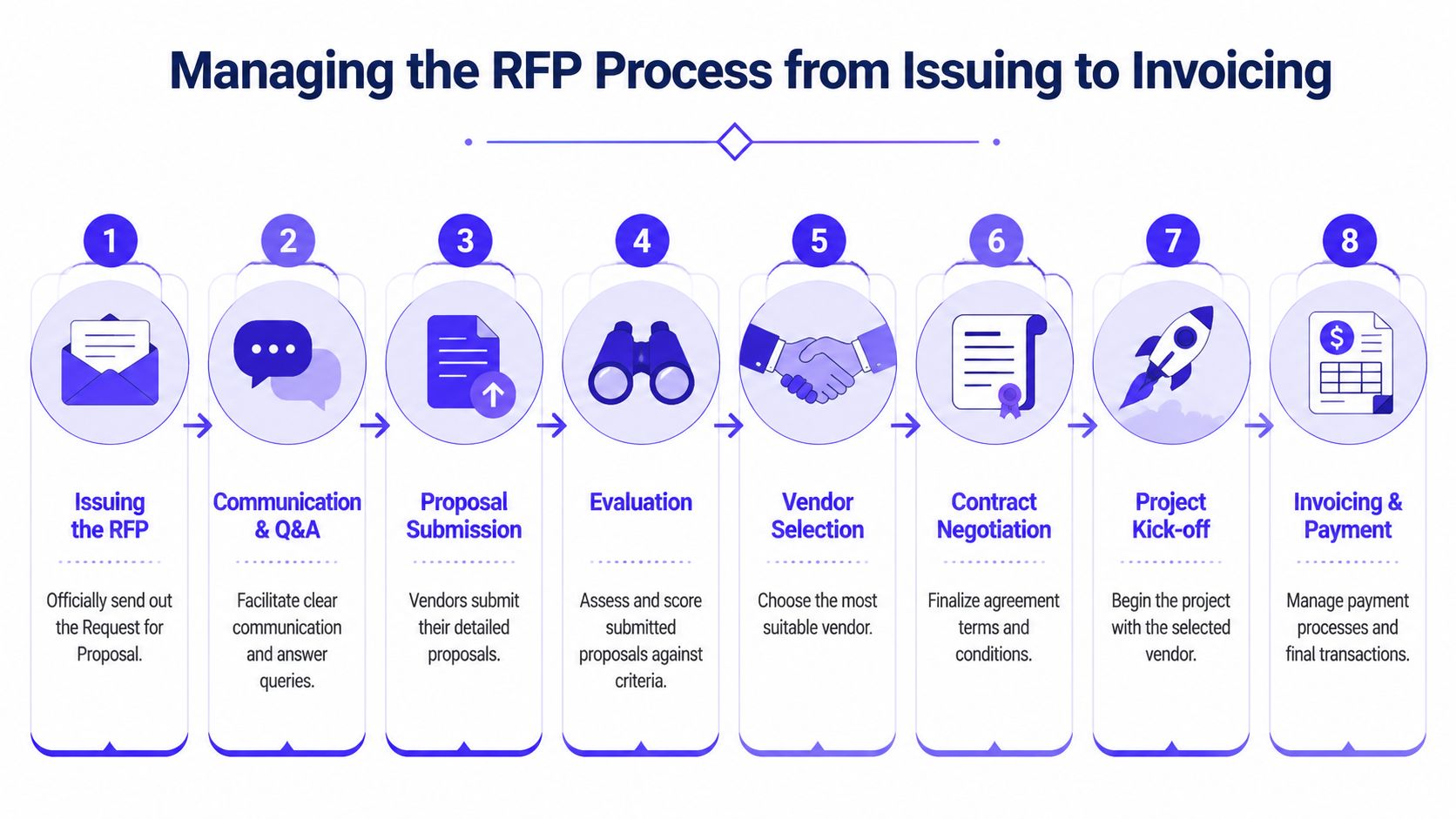
Once the review is done, keep the handover formal. Tell unsuccessful bidders promptly and respectfully, confirm the selected supplier in writing, finish the contract, and line up the kick-off. That keeps the process professional and avoids the awkward pause where everyone assumes someone else is dealing with the next step.
The paperwork should support the commercial decision, not drift away from it. If you keep the accepted proposal, the contract, the invoice, and the payment record in one workflow, the admin stays under control and the project keeps moving. That matters even more when your business wants purchase and payment handling in the same place, because accepting online payments smoothly reduces the chance of delay between approval and cash collection.
Unstructured handovers usually create the same problems. Someone chases an answer that was already given, a supplier waits for sign-off, or finance is left searching for the approved amount before payment can be made. A central system removes most of that back-and-forth and gives you a cleaner route from award to invoicing.
From RFP to Invoice Streamline Your Business Growth
A good RFP process does more than help you pick a supplier. It sets out the work clearly, keeps the decision fair, and cuts down the time spent chasing clarification. It also gives you a repeatable way to buy services without rebuilding the brief each time.
For UK SMEs, the wider point is operational. Businesses need to map core processes such as onboarding and invoicing, then track measures like time to deliver a service and average payment delay, because cleaner workflows support better operational efficiency (operational efficiency explained for UK SMEs). Procurement sits in that same discipline because it affects delivery speed, cash flow, and customer experience.
A simple template of RFP is only the starting point. Significant gain comes when the brief, response collection, supplier selection, invoice, and payment all live in one organised workflow instead of being split across documents and inboxes. That is how a service business stays professional while it grows.
If you are still building the process in spreadsheets, how to create a spreadsheet gives you a practical starting structure. The better option is to keep the same controls inside one system, so your team can issue the RFP, compare responses, approve the supplier, and move straight into invoicing without rekeying the same details.
That is where AetherCloud fits in. It brings the procurement steps together so a small UK service business can handle the full path from request to payment in one place, with less admin and fewer handoffs.
A CTA for AetherCloud.