

You've probably had this happen without calling it commission. A partner sends you a client, the job gets done, the invoice is paid, and then someone asks who's owed a slice of the money. If you've ever stared at that question over a cup of tea and thought, “Right, but how do I handle this?”, you're in the right place.
For UK service businesses, commission payment is less mysterious than it first looks. It's a payment linked to a result, usually a sale, referral, or completed transaction, and it needs to be tracked with the same care as the rest of your invoicing and payment flow. That matters whether you run a decorating business, a small agency, or a consultancy, because commission affects how you quote, how you record income, and when you pay people.
Table of Contents
- The First Time You Pay a Commission and Nothing Makes Sense
- What Commission Payment Actually Means in Simple Terms
- The Three Commission Structures UK Service Businesses Use
- How to Calculate a Commission Payment Step by Step
- UK Tax and Recordkeeping Considerations for Commission Payments
- Tracking and Paying Commissions Through Your Invoicing and Payment Tools
- Simple Commission Rules Worth Remembering
The First Time You Pay a Commission and Nothing Makes Sense
A small plumbing firm wins a bathroom refit because a local designer recommended them. The job is finished, the customer pays the invoice, and the designer sends over a polite message asking for the agreed commission. That's the moment many owners realise they've been treating commission like an afterthought, when it's really part of the commercial deal from the start.
The confusion usually starts because the money has already moved through the business. You've quoted, scheduled, delivered, invoiced, and collected payment, so it feels as if the hard part is done. Then a second payment appears, tied to the same work but owed to someone else.
Practical rule: if you can't explain why the commission is owed, when it becomes payable, and how it's calculated, the process isn't ready yet.
Many small firms get tangled up in commission payments. Commission might be paid to a salesperson, a referrer, a subcontractor, or a project lead, and each arrangement can follow a different trail through your records. The simplest way to think about it is to treat commission as part of the business workflow, not just a payroll item.
That's especially true for service businesses, where the “sale” may be an appointment, a quote approval, a completed project, or a paid invoice rather than a shop-floor transaction. The rest of this guide keeps coming back to that point, because commission makes more sense when you see it as money linked to completed business activity.
By the end, you should be able to answer four basic questions without hesitation. What is commission, what does it look like in practice, how should it be recorded, and how do you pay it cleanly?
For a broader look at how sales activity moves through a business, see AetherCloud's guide to the cycle of sales.
What Commission Payment Actually Means in Simple Terms
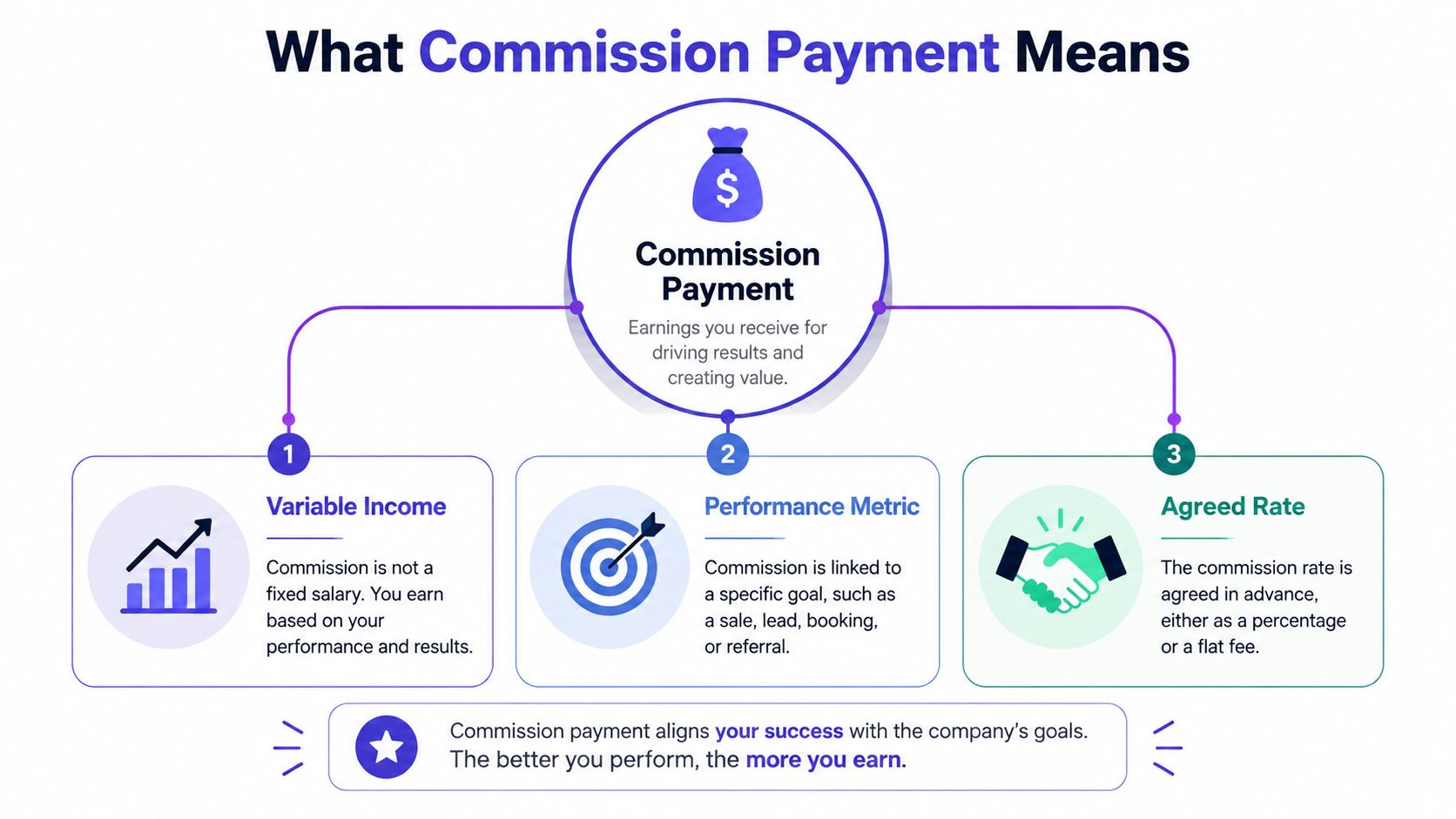
Commission payment means someone gets paid because a defined result happened. In UK business terms, that result is usually a sale, a completed referral, or another measurable outcome that both sides agreed on in advance. The UK government's employment guidance describes commission as a payment often made in addition to basic pay and commonly calculated as a percentage of sales, which is why it's used to reward productivity in commercial roles (US Department of Labor guidance on commissions).
The plain-English version
Commission is a portion of revenue earned from a specific action. A market trader who keeps a share of each sale earns commission rather than a fixed wage. Unlike a salary, which stays the same regardless of business volume, commission is variable pay that rises or falls with results.
That's why commission is different from a one-off fee as well. A fee is usually paid for a service completed, while commission is usually tied to the value of the outcome, such as the sale itself or the money collected from it. In service businesses, that outcome might be a booked appointment, a signed proposal, or an invoice paid in full.
Commission is a payment for performance, not for time on the clock.
Where UK service businesses meet it
You may already be using commission without calling it that. A referral partner who introduces a client and gets paid once the job is complete is in commission territory. A salesperson earning a percentage when a quote turns into a paid invoice is there too.
The key is the agreed trigger. If the trigger is a sale, a closed deal, or an approved invoice, you're dealing with commission, not a flat reward for attendance. That's why the rate, the trigger, and the payment timing all need to be clear before anyone starts the work.
For a small business owner, the practical test is simple. If the amount changes based on business output, not hours worked, it's commission or something very close to it.
The Three Commission Structures UK Service Businesses Use

Commission in service businesses usually appears in three forms. The labels change from business to business, but the logic stays familiar. Someone earns money because they helped create revenue that landed.
Sales commission
This is the version most people recognise first. A salesperson or business development lead earns commission when they close work, convert an enquiry, or bring in revenue. UK HR and sales guidance commonly treats commission as a variable-pay structure, and the rate is agreed before the sale happens (commission payment overview).
Sales commission fits situations where one person has a clear role in winning business. A consultant might close a retainer, a fitter might sell an upgrade after the main job, or an agency account lead might turn an enquiry into a signed project. Some businesses use base salary plus commission, while others use straight commission only. Both are recognised commission structures, and the choice usually depends on how the role is set up and how much certainty the business wants in pay (commission pay structures).
For a sole trader or small team, this often works like a simple incentive on top of ordinary service work. The payment follows the sale, so the person doing the selling has a direct reason to keep enquiries moving.
Referral commission
Referral commission works when someone sends you a lead and gets paid if that lead becomes paying work. This is common with local partnerships, affiliates, and independent introducers who do not carry out the delivery but do help generate the customer. The payment is linked to the referred business, independent of time spent on follow-up.
The rate is usually agreed as part of the referral relationship, then paid once the qualifying event happens. In a service business, that qualifying event is often the customer paying the invoice rather than signing a quote, because that gives you a cleaner point to measure. It also makes the payment easier to track in your invoicing and payment workflow, which is why many owners pair it with a clear written rule in their go-to-market planning.
Contractor or project commission
This model appears when a subcontractor, project lead, or specialist earns a cut based on the work they helped deliver. It can be useful when the person is not a salaried employee but still contributes directly to revenue or margin. Some businesses also use tiered commission, where the rate changes based on the product, service, or deal type (commission pay structures).
The important distinction is that the payment is still tied to a business result. The person might be paid because a project finished, a package sold, or a subscription started, but the trigger needs to be written down. If it is left vague, commission quickly turns into a dispute with invoices.
For go-to-market planning and how this kind of payment fits a wider sales motion, AetherCloud's go-to-market guide is worth a look.
How to Calculate a Commission Payment Step by Step
A commission payment is easiest to calculate when you start with one agreed rule and stick to it. The simple version is commission rate × total sales amount. In a worked sales example, Salesforce shows a rep on a 10% commission rate earning $10,000 from $100,000 in sales (Salesforce commission pay example). For a service business, the same maths still applies, but only to the amount your agreement says counts as qualifying income.
A straightforward service-business example
Say you agree a 10% referral commission on a kitchen installation invoice worth £2,400. If that invoice qualifies for commission, the calculation is simple.
- Commission rate: 10%
- Qualifying amount: £2,400
- Commission payment: £240
That turns the arrangement from a hand-wavy promise into a figure you can write down and pay properly. If your agreement says commission is earned only when the money is collected, then the collected amount is the number you use, not the quote or the invoice total.
The choice that causes most arguments
The main decision is whether commission is based on the quote, the invoice, or the cash received. For a service business, that choice matters because customers do not always pay at once, and refunds or part-payments can change the final amount owed. A clear rule saves you from the usual disagreement where one person says the job is finished and another says the money is still outstanding.
If more than one person helped, you can split the commission or set different percentages for different roles. That works well when a lead generator, a closer, and a delivery partner all touched the same sale. The calculation still needs one agreed trigger, though, otherwise nobody knows when the payment should go out.
Keep the calculation linked to the right record
The cleanest approach is to calculate commission from the same record you trust for revenue tracking. If your system shows an invoice as paid, that is a tidier basis than a rough figure written in a notebook or saved in an email thread. A simple spreadsheet can help you keep the link between the sale, the trigger, and the payout clear, and AetherCloud's spreadsheet guide shows a practical way to set that up.
Practical rule: pay commission from the same confirmed figure you would be comfortable explaining if someone asked you to show the maths.
UK Tax and Recordkeeping Considerations for Commission Payments
Commission isn't just a payment choice, it's a recordkeeping choice. In UK business operations, commission is usually handled as earnings tied to a performance agreement, so the details behind it matter as much as the amount itself. If the calculation basis is unclear, the paperwork becomes messy fast.
What to keep on file
At minimum, keep the agreement, the calculation method, the approved result, and the payment record. That gives you a proper trail from the deal to the payout, which is what you want if anyone later questions why the money was paid. The safer your records, the easier it is to separate a real commission from an informal cash handover.
That distinction matters because the process is different depending on who receives the money. An employee commission sits differently from a payment to an external referrer or subcontractor, and the paperwork should reflect that. If you treat all three the same, you risk making a simple arrangement harder to justify later.
Why approval matters
Commission should be validated before payment. If sales data is late, duplicated, or entered incorrectly, the commission figure can be wrong even when the work itself was genuine. That's why the approval step is not admin fluff, it protects the business from overpaying, underpaying, or paying at the wrong time.
The Bank for International Settlements and the European Central Bank both maintain payment statistics that track transaction-based financial activity across Europe, including the UK context, which underlines how common payment-linked flows are in modern commerce (sales commission benchmarks and payment context). You don't need those statistics to run a small business, but they do show that commission-style payments sit inside a much broader payment environment, not outside it.
For a practical look at formatting financial records so they stay readable later, AetherCloud's guide to financial statements is relevant background.
A tidy commission trail protects both sides. The business can prove why it paid, and the recipient can see how the amount was built.
Tracking and Paying Commissions Through Your Invoicing and Payment Tools
The cleanest commission workflow starts before the sale. Agree the rate in writing, log the qualifying event, calculate the amount from a trusted record, then pay it through the same business system that handles the rest of your money. When that happens, commission becomes a normal part of the workflow rather than a last-minute spreadsheet scramble.

A simple day-to-day process
For most UK service firms, the process looks like this. A quote is approved, the job is delivered, the invoice is paid, and the commission record is created from that confirmed payment. If the system keeps contacts, invoices, and payment status together, you don't need to chase three different places to work out what's owed.
That's where a unified platform helps more than a patchwork of disconnected tools. AetherCloud combines quoting, invoicing, payment collection, contacts, and reporting in one place, so the qualifying event and the money movement sit close together. You still decide the rules, but you're not digging through email threads and spreadsheets to enforce them.
Why this beats manual tracking
Manual tracking tends to fail in the same places every time. Someone forgets to update the sheet, a payment arrives late, or the wrong invoice gets matched to the wrong commission. Once that happens, the fix takes longer than the original calculation.
If you accept online payments inside the same system that issues the invoice, you can tie commission to a real payment event rather than a guess. AetherCloud's guide to accepting online payments connects directly to that workflow, because the cleaner the payment record, the easier it is to handle commission without rework.
Practical rule: if commission depends on the invoice being paid, don't track it in a separate corner of the business that nobody checks.
Simple Commission Rules Worth Remembering
Commission is pay for a result, not for time.
The rate should be agreed before the work starts.
The calculation should be tied to one defined figure, such as sales value or collected revenue.
Every payment should leave a paper trail, even when the relationship is informal.
The cleanest workflow is the one that keeps quoting, invoicing, and payment tracking together.
That's the core lesson for most UK service businesses. Commission isn't only a sales concept, it's a payment process that sits right beside your invoicing and cash collection.
If you want a simpler way to manage quotes, invoices, online payments, and the records that sit behind commission, take a look at AetherCloud. It brings those parts of the job into one place, which makes it easier to see what's been sold, what's been paid, and what's still owed.